
Overview
Ancient Egyptian religion shaped life along the Nile for more than three thousand years, from the first kings around 3100 BCE until Christian emperors closed the last temples. Egyptians honoured hundreds of gods, many shown with animal heads; the greatest were the sun god and Osiris, ruler of the dead. At the centre stood the king, charged with upholding maat, the right order of the world, against chaos, on everyone's behalf. Priests tended the gods' images inside temples, while ordinary people turned to household protectors, festivals and oracles. Egyptians also spent heavily on the next life, preserving bodies and burying the dead with spells to guide them. In its last centuries, Egypt's gods found worshippers across the Roman world.[1–3, 7, 9–16]
History
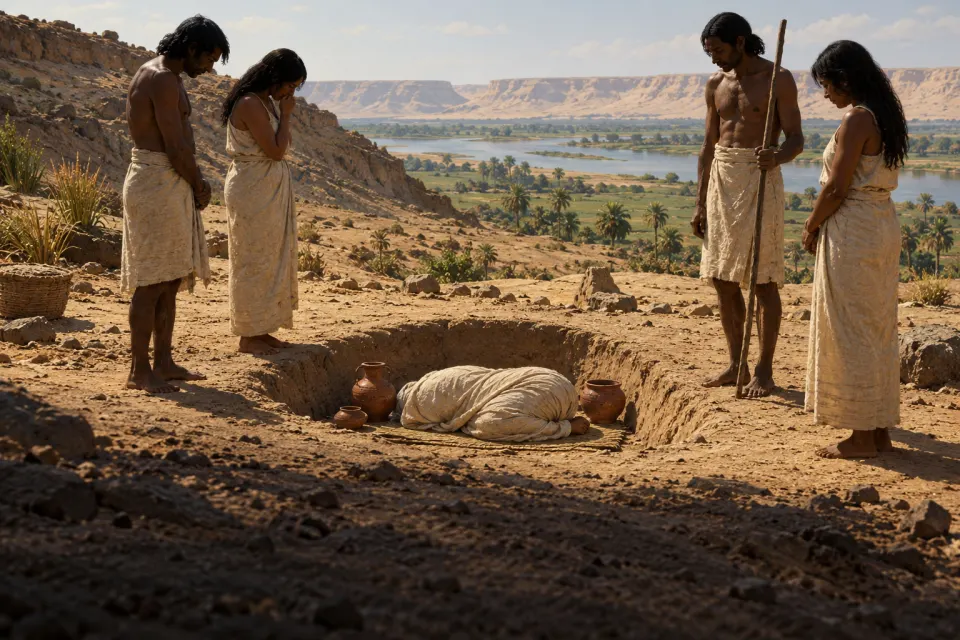
Beginnings and the first kings c. 4000–2686 BCE
Before Egypt was one country, people were buried facing west, the land of the dead, with pots and belongings, a sign of belief in an afterlife; at Hierakonpolis, around 3500 BCE, some bodies were already being wrapped. Around 3100 BCE a single state formed under kings, and religion was bound up with kingship from the start. The king's oldest title, his Horus name, declared him a living form of Horus, the falcon sky god. The earliest kings were buried at Abydos.[17–20]
The pyramid age c. 2686–2160 BCE
In the 4th Dynasty the sun god Ra rose to the head of the gods, and kings took the title "Son of Ra". The same dynasty raised the Giza pyramids for Khufu, Khafre and Menkaure, the largest built for Khufu. Around 2350 BCE King Unas had spells carved in his burial chambers at Saqqara. These Pyramid Texts, meant to protect the dead king and secure his life beyond death, are the oldest surviving body of Egyptian religious writing.[21–23]
Osiris for everyone c. 2160–1550 BCE
From about 2000 BCE, every dead person, not only the king, was believed to be joined with Osiris at death. Officials and others who could pay had spells painted inside their coffins, the Coffin Texts. Abydos became Osiris's holy city, and pilgrims set up memorial stones to be near his tomb. At Thebes the god Amun rose to prominence; merged with the sun god as Amun-Ra, he was hailed as king of the gods for over a thousand years.[24–27]
Empire and the Aten c. 1550–1070 BCE
In the New Kingdom, the wealth of empire flowed to Amun's temple at Karnak, which grew into a vast temple complex, and Book of the Dead papyri went into many burials. Then Akhenaten (reigned c. 1353–1336 BCE) raised the sun disc, the Aten, above all other gods, built a new capital at Amarna, and had Amun's name hacked from monuments. After his death the old gods were restored, Amarna was abandoned, and Tutankhaten, probably his son, became Tutankhamun, honouring Amun.[28–31]
Late Egypt and the wider world c. 1070 BCE–300 CE
In the Late Period, animal cults grew enormously: ibises sacred to Thoth were buried by the million. After Alexander took Egypt in 332 BCE, the Greek Ptolemies ruled from Alexandria and promoted Serapis, a god combining Osiris and the Apis bull in Greek form. Isis became the Egyptian deity best known abroad. Her cult reached Delos, Rome and Pompeii, whose temple of Isis dates to the late 2nd century BCE, and she was worshipped from Britain to Afghanistan.[16, 32–33]
The end of the temples 391–c. 537 CE
As the Roman empire turned Christian, Theodosius I suppressed the old cults, banning them in 391, the year the Serapeum of Alexandria was destroyed. Philae, an island at Egypt's southern frontier, held out longest; the last known hieroglyphic inscription was carved there in 394. The historian Procopius says Justinian had its temple of Isis closed and the priests arrested, an event dated c. 535–537. Many scholars now treat this as imperial propaganda, since the last evidence for active priests there dates to 456/457.[10, 34–35]
Key moments
- c. 2550 BCEThe pyramids of Giza · Giza, Egypt
- c. 2350 BCEThe Pyramid Texts · Pyramid of Unas, Saqqara
- c. 1550 BCEThe Book of the Dead · Egypt
- c. 1353 BCEAkhenaten and the Aten · Amarna, Egypt
- c. 1300 BCEThe tomb-builders of Deir el-Medina · Deir el-Medina, western Thebes, Egypt
- c. 1259 BCEPuduhepa seals the peace with Egypt · Hattusa (Boğazköy), Anatolia, and Karnak, Egypt
- c. 537 CEThe temple of Isis at Philae is closed · Philae, near Aswan, Egypt
Beliefs
Maat
truth, justice, cosmic order
Maat was the order set in place at creation, and also justice, truth and right conduct; she was personified as a goddess, daughter of the sun god. The king's task was to put maat in place of isfet, disorder. In temple scenes he offers a small figure of Maat to the gods, returning the order that came from them.[11, 36]
The gods
netjer, "god"
The word netjer covered a wide range of divine beings, powerful but neither all-knowing nor all-powerful. Most gods had a chief cult centre and favoured animals: the falcon for Horus, the ibis for Thoth, the cow for Hathor. Gods were often fused, as in Amun-Ra, yet each also lived on separately. Heka, magic, was a divine force from creation, used in temple ritual, healing and protection.[37–39]
Creation
Several creation accounts stood side by side. At Heliopolis the creator Atum produced Shu (air) and Tefnut (moisture), from whom came earth, sky and Osiris's family: nine gods in all. A text from Memphis has Ptah create through his heart and tongue, by thought and speech. At Hermopolis, four pairs of gods embodied the dark, watery chaos before creation.[40–42]
Ka, ba and akh
A person had several aspects. The ka was the life force; it survived death and could dwell in a statue. The ba, often drawn as a human-headed bird, let the dead move about and change form. The akh was the transfigured spirit of the blessed dead.[43]
Judgement of the dead
The dead faced judgement before Osiris. The heart was weighed against the feather of Maat; a heart heavy with wrongdoing was eaten by Ammut, part crocodile, lion and hippopotamus. Those who passed farmed for ever in the Field of Rushes, or Reeds; those who failed died a second death outside the ordered world.[44–45]
Practice

Temple ritual and priests
At dawn, priests opened the shrine of a god's image, purified it, praised it, clothed it and offered food, then closed it for the night. This state duty, done in the king's name and largely out of public sight, kept the gods content. Early priests often served one month in four in rotating groups, keeping rules of purity; many women served as temple singers.[12, 46]
Festivals and oracles
At festivals priests carried the god's image out of the temple in a portable boat-shrine, the main chance for most people to come near it. People put questions to the god, who answered by moving the shrine forward or back. Oracles settled local disputes and, late in the New Kingdom, steered affairs of state at Thebes.[14, 47]
Mummification and burial
Egyptians preserved the body so the dead could live on. In the most elaborate method, embalmers removed most organs, dried the body with natron salt and wrapped it in linen, over about seventy days. At the tomb the Opening of the Mouth rite restored the dead person's senses. Full embalming was always too costly for most people.[15, 48–49]
Animal cults
Some animals, such as the Apis bull of Memphis, were held to be living forms of a god, chosen by their markings and buried with ceremony. From the Late Period pilgrims also offered mummified animals, and cats, ibises, falcons and crocodiles filled vast cemeteries.[50]
Religion at home
At home people made offerings and rites of protection and healing, calling on Bes, a dwarf god who guarded childbirth, and Taweret, part hippopotamus. They honoured dead relatives, and the literate sometimes left letters at tombs asking the dead for help.[13, 51]
Holy days
Opet Festival
2nd month of Akhet, the flood season; 11 days, later 24
Thebes' great festival from the 18th Dynasty. Amun's boat-shrine, later joined by Mut's, Khonsu's and the king's, travelled from Karnak to Luxor Temple, renewing the king's power through the god. It ran 11 days under Thutmose III and 24 under Ramesses III.[52]
Beautiful Feast of the Valley
Once a year, at Thebes
Amun's image crossed the Nile from Karnak to the temples of western Thebes, among them Hatshepsut's at Deir el-Bahri. Families gathered at their ancestors' tombs for banquets.[53]
Opening of the Year
New Year's Day, signalled by the dawn rising of Sirius in midsummer
In the lunar calendar the new year began when Sirius reappeared before dawn. In late temples such as Dendera and Edfu, priests carried the gods' statues to a rooftop shrine so the sunlight would renew them.[54]
Mysteries of Osiris
Month of Khoiak
At Abydos, Osiris's image was carried from his temple to his tomb in the desert, re-enacting his death and triumph. Other towns held similar rites, and Middle Kingdom pilgrims set up stelae along the route.[55]
People
Ra (Re)
deity
Sun god and creator, worshipped above all at Heliopolis. By day he crossed the sky in a boat; by night he sailed through the underworld, defeating the serpent Apophis to be reborn each dawn.[56]
Amun (Amun-Ra)
deity
"The Hidden One", god of Thebes, worshipped with Mut and their son Khonsu. Fused with the sun god as Amun-Ra, he became patron of the kings, and his Karnak temple was among the richest in Egypt.[57]
Osiris
deity
King and judge of the dead, and a power of fertility. In the myth his jealous brother Seth killed him; his wife Isis restored him, and their son Horus avenged him. Abydos was his holy city.[58]
Isis
deity
Wife of Osiris and mother of Horus: mourner, healer and great magician. Her name meant "throne". Little known at first, she became one of Egypt's chief deities and was later worshipped across the Roman Empire.[59]
Horus
deity
Falcon sky god, son of Osiris and Isis. He defeated Seth to take his father's throne, and each living king was his earthly form. His healed eye, the wedjat, became a protective amulet.[60]
Hathor
deity
Goddess of the sky, women, love and motherhood, often shown as a cow or with cow's horns. Called the eye or daughter of the sun god, she was worshipped with Horus at Dendera and in many other places.[61]
Thoth
deity
God of the moon, writing and learning, shown as an ibis-headed man or as a baboon, with his cult centre at Hermopolis. At the judgement he recorded the weighing of the heart. Greeks equated him with Hermes.[62]
Akhenaten
ruler · reigned c. 1353–1336 BCE
An 18th-Dynasty king, born Amenhotep IV, who devoted his reign to the Aten, the sun disc, worshipped in open-air temples. He moved the court to Akhetaten (Amarna). His successors restored the old gods and struck his name from the king lists.[63–64]
Scripture
Pyramid Texts
c. 2350–2100 BCE
Prayers, hymns and spells carved in the burial chambers of 5th- and 6th-Dynasty pyramids at Saqqara, starting with Unas's. They aimed to protect the dead king or queen and help them rise to new life in the sky.[23, 65]
Coffin Texts
c. 2130–1630 BCE
Spells painted mostly on wooden coffins of the First Intermediate Period and Middle Kingdom. Derived largely from the Pyramid Texts and used by officials and other wealthy people, they became a main source of the Book of the Dead.[66]
Book of the Dead · Spells for Going Forth by Day
from c. 1550 BCE
The modern name for some two hundred illustrated spells copied on papyrus rolls for burial. Spell 125 describes the judgement of the dead, with the dead person's declaration of innocence before the gods.[67]
Amduat · "What is in the underworld"
New Kingdom
An illustrated underworld book painted in the Valley of the Kings, in the tombs of New Kingdom pharaohs. It follows the sun god through the twelve hours of the night to his rebirth at dawn, naming the many beings he meets.[68]
Great Hymn to the Aten
c. 1340s BCE
A hymn from tombs at Amarna praising the sun disc as creator and sustainer of people, animals and plants in Egypt and foreign lands alike. Scholars have long compared it with the biblical Psalms, especially Psalm 104.[69]
Places

Karnak and Luxor, Thebes
EGY · UNESCO World Heritage, 1979
Karnak, the temple precinct of Amun-Ra and Egypt's largest, was enlarged over many centuries; Luxor Temple, to the south, was the goal of the Opet procession. Both lie in the World Heritage property of Ancient Thebes.[70]
Giza
EGY · UNESCO World Heritage, 1979
Plateau of the three 4th-Dynasty royal pyramids and the Great Sphinx, within the World Heritage property of Memphis and its necropolis.[71]
Saqqara
EGY · UNESCO World Heritage, 1979
Cemetery of Memphis, Ptah's city: here are Unas's pyramid with the first Pyramid Texts, and the animal necropolis where pilgrims sought oracles and healing dreams.[72]
Abydos
EGY
Burial ground of the earliest kings and later the chief cult centre of Osiris, whose tomb was believed to lie here. Thousands of stelae were set up by people wishing to be near him.[73]
Tell el-Amarna
EGY
Site of Akhetaten, founded by Akhenaten around 1347 BCE as the home of the Aten's cult and abandoned soon after his death. The Great Hymn to the Aten was found in the tombs of its officials.[74]
Philae (now Agilkia)
EGY · UNESCO World Heritage, 1979
Island sanctuary of Isis near Aswan and the last temple of the old religion. To save it from the Aswan dams' waters, its buildings were moved to nearby Agilkia in 1972–1980.[75]
Where it spread
| Region | From | How |
|---|---|---|
| Egypt | 3000 BCE – 535 CE | The Nile valley; the last temple, of Isis at Philae, was closed under Justinian |
| Sudan | 1500 BCE – 550 CE | Kush: Amun's holy mountain at Gebel Barkal, Napata and Meroë |
| Greece | 300 BCE – 400 CE | EGY. The cult of Isis and Serapis, e.g. on Delos |
| Turkey | 250 BCE – 400 CE | EGY. The cult of Isis and Serapis in the cities of Asia Minor |
| Italy | 100 BCE – 400 CE | EGY. The cult of Isis, e.g. her temple at Pompeii and in Rome |
| Germany | 50 CE – 400 CE | EGY. The cult of Isis along the Rhine |
| Spain | 50 CE – 400 CE | EGY. The cult of Isis in Roman Hispania |
| France | 50 CE – 400 CE | EGY. The cult of Isis in Roman Gaul |
| United Kingdom | 100 CE – 400 CE | EGY. The cult of Isis; a temple of Isis in Londinium |
Art & objects
Public-domain objects from museum collections. Select one to see it at the museum.
 Canopic Jar of AmenhotepEgypt, New Kingdom, Dynasty 18, reign of Amenhotep II (about 1427–1400 BCE)
 Stela of Amenemhat and HemetEgypt, Middle Kingdom, early Dynasty 12, about 1956–1877 BCE
 Statuette of the Goddess Isis Holding the God HorusEgypt, Third Intermediate Period–Late Period, Dynasty 21–31 (about 1069–332 BCE)
 Amulet of the Theban Triad: Amun, Mut, and KhonsuEgypt, Third Intermediate Period–Late Period, Dynasty 21–30 (about 1069–332 BCE)
 Statue of Ptah-Sokar-OsirisEgypt, Ptolemaic Period (332–30 BCE)
 Statue of HorusEgypt, Ptolemaic Period (332–30 BCE)
 Coffin and Mummy of PaankhaenamunThebes, Third Intermediate Period, Dynasty 22, reign of Osorkon I (about 924–889 BCE)
 Funerary Papyrus of TayuhenutmutEgypt, Third Intermediate Period, probably Dynasty 21 (about 1069-945 BCE)
 Coin Portraying Queen Cleopatra I as the Goddess IsisEgypt, 146-127 BCE, issued by Ptolemy VIII Euergetes II
 Coffin of BakenmutEgypt, Thebes, Third Intermediate (1069–715 BCE), Dynasties 21–22, c. 1000–900 BCE
 Talatat: Nefertiti Offers to the AtenEgypt, Karnak, New Kingdom (1540–1069 BCE), Dynasty 18, reign of Akhenaten (1351–1334 BCE), 1353–1347 BCE
 Head of AmunNew Kingdom, ca. 1328–1300 BCE
 Funerary mask of HatneferNew Kingdom, ca. 1491–1473 BCE
 Book of the Dead for the Chantress of Amun, NaunyThird Intermediate Period, ca. 1050 BCE
How we know
Reading the hieroglyphs
The Rosetta Stone, a decree of Ptolemy V from 196 BCE in hieroglyphs, demotic and Greek, was found in 1799 and gave scholars a parallel text. In 1822 Jean-François Champollion, who knew Coptic, the last stage of Egyptian, worked out how hieroglyphs functioned. Since then temple walls, tomb inscriptions and papyri can be read in the Egyptians' own words.[76–77]
A record tilted to tombs and elites
Much evidence comes from tombs and temples built in the dry desert, where they survived, and from monuments made for kings and officials. Towns and villages, where most people lived, have rarely been excavated, so everyday religion is far less known. This is one reason Egypt can seem obsessed with death.[78]
Greek and Roman witnesses
Herodotus, in the 5th century BCE, called the Egyptians the most religious of people. Plutarch's essay on Isis and Osiris, written under Roman rule, gives the fullest surviving narrative of their myth. These outsiders' accounts are valuable but must be read alongside Egyptian sources.[79]
Was Akhenaten a monotheist?
Since 1851 some scholars have called Akhenaten a monotheist. Others note that the Aten drew on older gods, that the king himself was treated as divine, and that people at Amarna kept household gods such as Bes and Taweret. Many prefer terms such as monolatry or henotheism, and the debate continues.[80]
Common misconceptions
Myth The pyramids were built by slaves.
Fact Excavations at Giza since the late 1980s have found the builders' town, with bakeries and workshops, and their own tombs near the pyramids. The workers were Egyptians organised in named gangs, with bread from their own bakeries and plenty of meat; a smaller permanent workforce was joined by labourers serving in rotation. Archaeologists find no sign of slave labour.[81]
Myth The Egyptians worshipped animals.
Fact Egyptians worshipped gods who could show themselves in animal form. A few animals, such as the Apis bull, were treated as living vessels of a god, and many more were mummified as offerings to a deity. In temple reliefs the gods appear as humans or as humans with animal heads.[82]
Myth The Book of the Dead was the Egyptians' Bible.
Fact It was not scripture for the living but a varied collection of about two hundred spells for the dead, copied on papyrus for burial. Each copy held a different selection, often depending on what the buyer could afford, and no copy contains every spell.[83]
Glossary
- Ammut
- "Devourer": a monster, part crocodile, lion and hippopotamus, who ate the heart of a person who failed the judgement of the dead.[44]
- Anubis
- Jackal god of embalming and cemeteries; chief god of the dead in early times, later overshadowed by Osiris.[84]
- Bastet
- Goddess of Bubastis, first a lioness and later a cat; vast cemeteries of mummified cats grew up around her cult.[85]
- Canopic jars
- Jars that held the embalmed lungs, stomach, liver and intestines, guarded by the four sons of Horus.[15]
- Ennead
- A group of nine gods, above all the Great Ennead of Heliopolis: Atum, Shu, Tefnut, Geb, Nut, Osiris, Isis, Seth and Nephthys.[40]
- Isfet
- Disorder, the opposite of maat, which the king was charged with driving out.[11]
- Ogdoad
- The eight gods of Hermopolis: four male-female pairs embodying the chaos before creation, such as darkness and the primeval waters.[42]
- Ptah
- Creator god of Memphis and patron of craftsmen, shown as a man wrapped like a mummy; with Sekhmet and Nefertem he formed the Memphite triad.[86]
- Sekhmet
- Lion-headed goddess of war and disease who could also heal; a fierce "Eye of Ra" and companion of Ptah.[87]
- Shabti
- A small figurine placed in the tomb to do farm work in the afterlife on the dead person's behalf.[88]
- Sobek
- Crocodile god, worshipped especially in the Fayum and at Kom Ombo, where cemeteries of crocodiles mummified in his honour have been found.[89]
Sources
Each statement above was checked against published sources; the verdict says whether it stood as written, was corrected or was hedged.
- VerifiedBritannica, ancient Egyptian religion; Kockelmann, Philae, UEE 2012; Bryn Mawr Classical Review 2009.06.43, R. B. Gozzoli on Dijkstra.
- VerifiedAustralian Museum, Religion and gods in ancient Egypt; Britannica, ancient Egyptian religion.
- VerifiedBritannica, ancient Egyptian religion; Australian Museum, Religion and gods in ancient Egypt; L. H. Lesko, Egyptian Religion: An Overview, Encyclopedia of Religion.
- VerifiedBritannica, Maat; Lazaridis, Ethics, UEE; Lesko, Egyptian Religion: An Overview, Encyclopedia of Religion, on Encyclopedia.com.
- VerifiedBritannica, ancient Egyptian religion: The cult; Lesko, Encyclopedia of Religion, on Encyclopedia.com.
- VerifiedBritannica, ancient Egyptian religion: The cult; Lesko, Encyclopedia of Religion, on Encyclopedia.com.
- VerifiedBritannica, Coffin Texts; Australian Museum, Funerary texts in ancient Egypt.
- VerifiedAustralian Museum, The Scribe and Hieroglyphs; Britannica, hieroglyph.
- VerifiedBritannica, ancient Egyptian religion: Sources and limitations ... King, cosmos, and society; Australian Museum, Religion and gods in ancient Egypt.
- VerifiedKockelmann, Philae, UEE 2012; Bryn Mawr Classical Review 2009.06.43, R. B. Gozzoli on J. H. F. Dijkstra, Philae and the End of Ancient Egyptian Religion.
- VerifiedBritannica, Maat; Lazaridis, Ethics, UEE; Lesko, Encyclopedia of Religion, on Encyclopedia.com.
- VerifiedBritannica, ancient Egyptian religion: The cult; Lesko, Encyclopedia of Religion, on Encyclopedia.com.
- VerifiedStevens, Domestic Religious Practices, UEE 2009; Australian Museum, Religion and gods in ancient Egypt; Britannica, ancient Egyptian religion: The Gods.
- VerifiedBritannica, ancient Egyptian religion: The cult; Stadler, Procession, UEE 2008; Lesko, Encyclopedia of Religion, on Encyclopedia.com.
- VerifiedAustralian Museum, How were ancient Egyptians mummified?; Hays, Funerary Rituals; Lesko, Encyclopedia of Religion, on Encyclopedia.com.
- VerifiedBritannica, Isis; S. Takács, Isis, Encyclopedia of Religion, on Encyclopedia.com; Britannica, ancient Egyptian religion: The world of the dead.
- VerifiedBritannica, ancient Egyptian religion: The world of the dead; Australian Museum, The origins of mummification in ancient Egypt.
- VerifiedBritannica, ancient Egyptian religion: Sources and limitations ... King, cosmos, and society; Lesko, Encyclopedia of Religion, on Encyclopedia.com.
- VerifiedBritannica, Horus; Horus, Encyclopedia of Religion; Australian Museum, Religion and gods in ancient Egypt.
- VerifiedBritannica, Abydos; Stadler, Procession, UEE 2008.
- VerifiedBritannica, Re; Lesko, Encyclopedia of Religion, on Encyclopedia.com.
- VerifiedBritannica, Pyramids of Giza; Harvard Magazine, J. Shaw, Who Built the Pyramids?.
- VerifiedBritannica, Pyramid Texts; Smith, Democratization of the Afterlife, UEE 2009; Lesko, Encyclopedia of Religion, on Encyclopedia.com.
- VerifiedBritannica, Osiris; Smith, Democratization of the Afterlife, UEE 2009; Osiris, Encyclopedia of Religion, on Encyclopedia.com.
- VerifiedBritannica, Coffin Texts; Australian Museum, Funerary texts in ancient Egypt; Smith, UEE 2009.
- VerifiedBritannica, Abydos; Stadler, Procession, UEE 2008.
- VerifiedBritannica, Re; Lesko, Encyclopedia of Religion, on Encyclopedia.com.
- VerifiedBritannica, Amon; Lesko, Encyclopedia of Religion, on Encyclopedia.com.
- VerifiedAustralian Museum, Funerary texts in ancient Egypt; Britannica, Coffin Texts.
- VerifiedBritannica, Akhenaten; Williamson, Amarna Period, UEE 2015; Lesko, Encyclopedia of Religion, on Encyclopedia.com.
- VerifiedBritannica, Aton; Lesko, Encyclopedia of Religion, on Encyclopedia.com; Williamson, UEE 2015.
- VerifiedBritannica, ancient Egyptian religion: The cult; Dodson, Rituals Related to Animal Cults, UEE 2009; Lesko, Encyclopedia of Religion, on Encyclopedia.com.
- VerifiedMet, M. Hill, Egypt in the Ptolemaic Period, Heilbrunn Timeline; Britannica, Serapis.
- VerifiedKockelmann, Philae, UEE 2012; Britannica, Serapis.
- VerifiedKockelmann, Philae, UEE 2012; Egyptian Ministry of Tourism and Antiquities, Philae.
- VerifiedBritannica, ancient Egyptian religion: ... King, cosmos, and society; Lesko, Encyclopedia of Religion, on Encyclopedia.com.
- VerifiedBritannica, ancient Egyptian religion: The Gods; Terminology: Netjer, World Eras.
- VerifiedBritannica, ancient Egyptian religion: The Gods; Lesko, Encyclopedia of Religion, on Encyclopedia.com.
- VerifiedBritannica, heka; Lesko, Encyclopedia of Religion, on Encyclopedia.com.
- VerifiedBritannica, ancient Egyptian religion: The Gods; Lesko, Encyclopedia of Religion, on Encyclopedia.com.
- VerifiedBritannica, Memphis; McClain, Cosmogony; Lesko, Encyclopedia of Religion, on Encyclopedia.com.
- VerifiedBritannica, ancient Egyptian religion: The Gods; McClain, UEE 2011; Lesko, Encyclopedia of Religion, on Encyclopedia.com.
- VerifiedBritannica, ancient Egyptian religion: The Gods; Janák, Ba and Akh, UEE; Australian Museum, Glossary of ancient Egyptian terms; Lesko, Encyclopedia of Religion, on Encyclopedia.com.
- VerifiedAustralian Museum, The underworld and the afterlife in ancient Egypt; Britannica, Maat; Lesko, Encyclopedia of Religion, on Encyclopedia.com.
- VerifiedAustralian Museum, The underworld and the afterlife in ancient Egypt; Britannica, ancient Egyptian religion: The world of the dead.
- VerifiedBritannica, ancient Egyptian religion: The cult; Lesko, Encyclopedia of Religion, on Encyclopedia.com.
- VerifiedBritannica, ancient Egyptian religion: The cult; Stadler, Procession, UEE 2008.
- VerifiedHays, UEE 2010; Lesko, Encyclopedia of Religion, on Encyclopedia.com.
- VerifiedBritannica, ancient Egyptian religion: The world of the dead; Australian Museum, How were ancient Egyptians mummified?.
- VerifiedDodson, Rituals Related to Animal Cults, UEE 2009; Australian Museum, Animal mummies in ancient Egypt; Lesko, Encyclopedia of Religion, on Encyclopedia.com.
- VerifiedBritannica, ancient Egyptian religion: The cult; Lesko, Encyclopedia of Religion, on Encyclopedia.com; Stevens, UEE 2009.
- VerifiedDarnell, Opet Festival, UEE 2010; Britannica, Luxor; Lesko, Encyclopedia of Religion, on Encyclopedia.com.
- VerifiedStadler, Procession, UEE 2008; Met, Large Kneeling Statue of Hatshepsut; Lesko, Encyclopedia of Religion, on Encyclopedia.com.
- VerifiedBritannica, Egyptian calendar; Coppens, Temple Festivals of the Ptolemaic and Roman Periods, UEE 2009.
- VerifiedStadler, Procession, UEE 2008; Britannica, Osiris; Osiris, Encyclopedia of Religion.
- VerifiedBritannica, Re; Lesko, Encyclopedia of Religion, on Encyclopedia.com.
- VerifiedBritannica, Amon; Lesko, Encyclopedia of Religion, on Encyclopedia.com.
- VerifiedBritannica, Osiris; Osiris, Encyclopedia of Religion, on Encyclopedia.com; Australian Museum, Religion and gods in ancient Egypt.
- VerifiedBritannica, Isis; Australian Museum, Religion and gods in ancient Egypt; Takács, Isis, Encyclopedia of Religion, on Encyclopedia.com.
- VerifiedBritannica, Horus; Australian Museum, Religion and gods in ancient Egypt.
- VerifiedBritannica, Hathor; Lesko, Encyclopedia of Religion, on Encyclopedia.com.
- VerifiedBritannica, Thoth; Australian Museum, Religion and gods in ancient Egypt; Lesko, Encyclopedia of Religion, on Encyclopedia.com.
- VerifiedBritannica, Akhenaten; Williamson, Amarna Period, UEE 2015; Lesko, Encyclopedia of Religion, on Encyclopedia.com.
- VerifiedWilliamson, UEE 2015; Britannica, Amon.
- VerifiedBritannica, Pyramid Texts; Smith, UEE 2009; Lesko, Encyclopedia of Religion, on Encyclopedia.com.
- VerifiedBritannica, Coffin Texts; Australian Museum, Funerary texts in ancient Egypt.
- VerifiedAustralian Museum, Funerary texts in ancient Egypt; Britannica, Book of the Dead; Lesko, Encyclopedia of Religion, on Encyclopedia.com.
- VerifiedAustralian Museum, Funerary texts in ancient Egypt; Britannica, ancient Egyptian religion: The Gods.
- VerifiedBritannica, Aton; Lesko, Encyclopedia of Religion, on Encyclopedia.com; Williamson, UEE 2015.
- VerifiedBritannica, Karnak; Darnell, Opet Festival, UEE 2010.
- VerifiedBritannica, Pyramids of Giza; Harvard Magazine 2003.
- VerifiedBritannica, ancient Egyptian religion: The cult; Dodson, UEE 2009; Lesko, Encyclopedia of Religion, on Encyclopedia.com.
- VerifiedBritannica, Abydos; Stadler, UEE 2008.
- VerifiedStevens, Tell el-Amarna, UEE 2016; Britannica, Aton; Lesko, Encyclopedia of Religion, on Encyclopedia.com.
- VerifiedKockelmann, Philae, UEE 2012; Egyptian Ministry of Tourism and Antiquities, Philae.
- VerifiedBritannica, Rosetta Stone; ARCE, The Rosetta Stone; Collège de France, D. Devauchelle, Deciphering hieroglyphics.
- VerifiedCollège de France; arce.org, Rosetta stone unlocking ancient egyptian language; Britannica, Coptic language.
- VerifiedBritannica, ancient Egyptian religion: Sources and limitations; Stevens, UEE 2009; Lesko, Encyclopedia of Religion, on Encyclopedia.com.
- VerifiedHerodotus 2.37, tr. A. D. Godley; Britannica, ancient Egyptian religion: Sources and limitations; Osiris, Encyclopedia of Religion, on Encyclopedia.com.
- VerifiedWilliamson, Amarna Period, UEE 2015; Britannica, Aton; Lesko, Encyclopedia of Religion, on Encyclopedia.com.
- VerifiedBritannica, Pyramids of Giza; Harvard Magazine, J. Shaw, Who Built the Pyramids?.
- VerifiedBritannica, ancient Egyptian religion: The Gods; Dodson, UEE 2009; Australian Museum, Animal mummies in ancient Egypt.
- VerifiedAustralian Museum, Funerary texts in ancient Egypt; Britannica, Book of the Dead.
- VerifiedBritannica, Anubis; Australian Museum, Religion and gods in ancient Egypt.
- VerifiedBritannica, Bastet; Lesko, Encyclopedia of Religion, on Encyclopedia.com.
- VerifiedBritannica, Ptah; Lesko, Encyclopedia of Religion, on Encyclopedia.com.
- VerifiedBritannica, Sekhmet; Australian Museum, Religion and gods in ancient Egypt.
- VerifiedMilde, Shabtis, UEE; Australian Museum, The underworld and the afterlife in ancient Egypt.
- VerifiedBritannica, Sebek; Lesko, Encyclopedia of Religion, on Encyclopedia.com.
Last fact-checked 3 October 2026.