The story behind the day
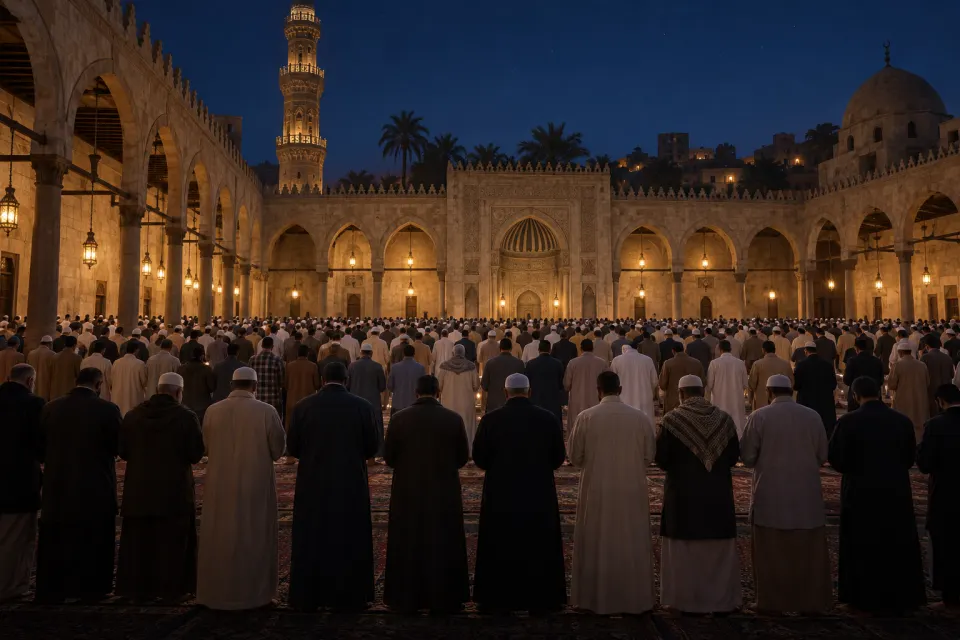
Laylat al-Qadr, the Night of Power, is the night in Ramadan on which Muslims hold that the Qur'an was first sent down. The Qur'an itself calls it better than a thousand months. No source fixes its date: it is sought in the last ten nights of the month, and many Sunnis favour the night of the 27th, while Shia legal manuals recommend a ritual bath on several of the odd nights from the 19th onward. It is kept with prayer, supplication and, for some, retreat in the mosque.[1–7]
Origins
The name is usually translated Night of Power, and Egypt's Dar al-Ifta also calls it the Night of Decree. Chapter 97 of the Qur'an opens by saying that God sent the Qur'an down on this night, and the chapter that takes its name from it declares the night better than a thousand months. Muslims therefore link it with the first revelation to Muhammad, which the tradition places in Ramadan. For those who keep it, worship on this night is worth more than that of a thousand months. Dar al-Ifta's fasting guide lists signs that hadith reports attach to the night, among them that it is bright and neither hot nor cold, and the medieval scholar Ibn al-ʿIrāqī describes it as calm and bright, as though lit by the moon.[1–2, 8–9]
How it came to be
The tradition deliberately leaves the date open. Reports ask believers to seek the night within the last ten days of Ramadan and, among them, the odd nights. The 27th is the night most widely favoured. Ibn al-ʿIrāqī gathered twenty-seven opinions on the timing, and Egypt's fasting guide records that scholars differed. Some explain the concealment as a spur: if no one knows the night, believers will exert themselves through the whole month. Sunni communities most often keep the night of the 27th. Shia legal manuals single out several nights in Ramadan. Ayatollah al-Sistani's rulings recommend a ritual bath on the nights of the 19th, 21st and 23rd of Ramadan, and those of Ayatollah Safi Golpaygani extend the list through the odd nights to the 29th.[3–5, 10–12]
How it is kept

Many Muslims spend the night, or as much of it as they can, in prayer and supplication, and Dar al-Ifta quotes the saying that whoever spends it praying in faith and hoping for reward will be forgiven. Some also withdraw to a mosque for the retreat called iʿtikāf, which is especially recommended in the last ten days of Ramadan.[6–7]
Sources
Each statement above was checked against published sources; the verdict says whether it stood as written, was corrected or was hedged.
- VerifiedQuran.com, Qur'an 97:1; Dar al-Ifta al-Misriyyah, The Night of Power and its virtues.
- VerifiedEncyclopedia.com; Yaqeen Institute for Islamic Research.
- VerifiedDar al-Ifta al-Misriyyah, The Night of Power; Encyclopedia.com; Yaqeen Institute.
- VerifiedDar al-Ifta al-Misriyyah, The Night of Power; Encyclopedia.com; Religion Media Centre (supporting).
- CorrectedOffice of Ayatollah al-Sistani, Islamic Laws, ruling 633; Office of Ayatollah Safi Golpaygani, Islamic Laws.
- VerifiedDar al-Ifta al-Misriyyah, The Night of Power; Encyclopedia.com.
- CorrectedDar al-Ifta al-Misriyyah, The book of fasting; Office of Ayatollah al-Sistani, Islamic Laws, ruling 1720.
- VerifiedEncyclopedia.com; Dar al-Ifta al-Misriyyah, fatwa 22414.
- VerifiedDar al-Ifta al-Misriyyah, The book of fasting; Yaqeen Institute.
- VerifiedDar al-Ifta al-Misriyyah, The Night of Power; Yaqeen Institute.
- VerifiedDar al-Ifta al-Misriyyah, The book of fasting; Yaqeen Institute.
- VerifiedDar al-Ifta al-Misriyyah, The book of fasting; Yaqeen Institute.