Beliefs & ideas · 3 min read
Why Do Muslims Face Mecca? Qibla and Prayer Direction
Explore the Quranic basis of qibla, the Kaaba’s role, the change of direction in hadith, and how mosques mark the prayer orientation.
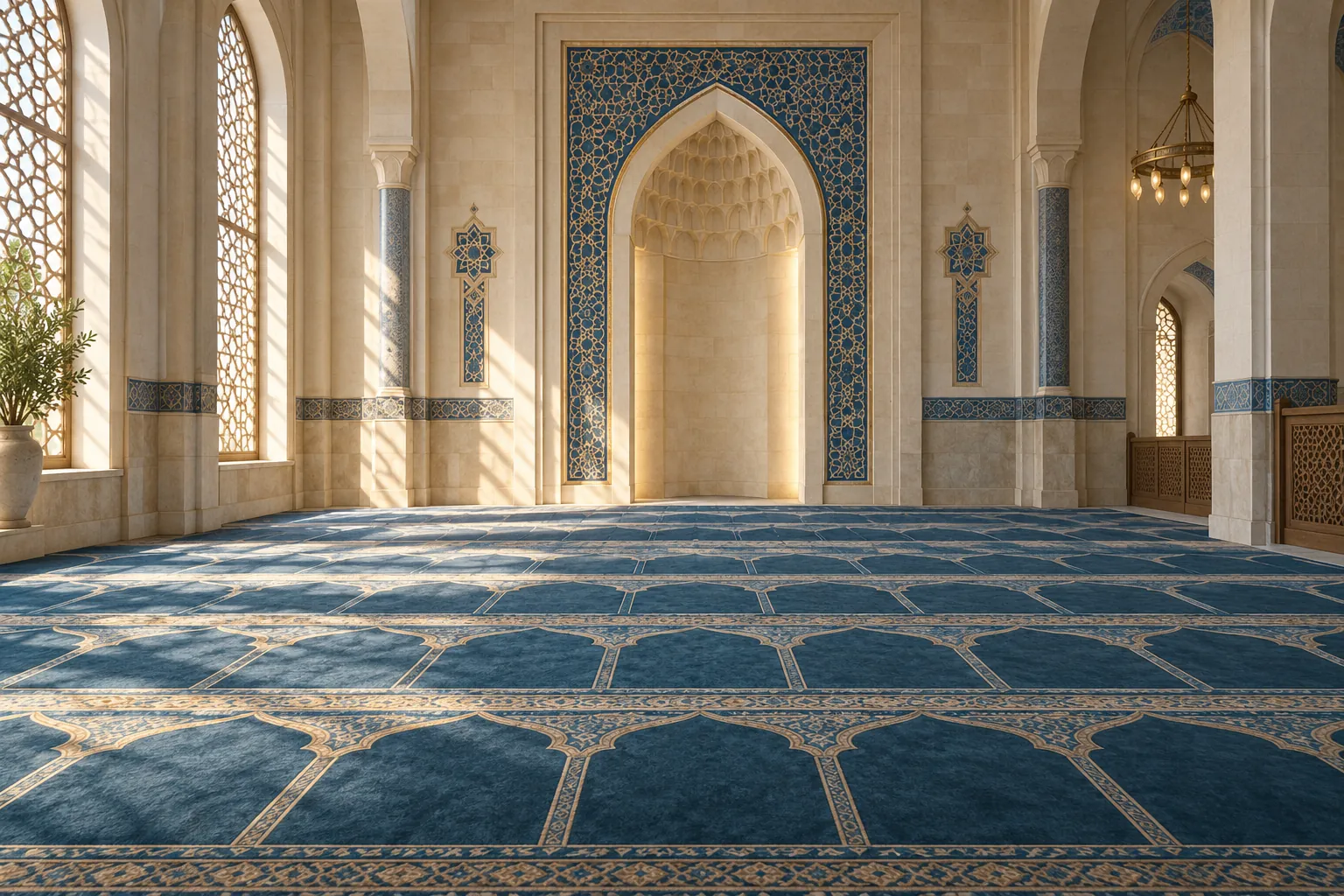
What qibla means
Qibla is the direction Muslims face in prayer, toward the Kaaba in Mecca. In a mosque, this orientation helps organize the building and the people praying within it. The Metropolitan Museum of Art explains the connection between the Kaaba, the qibla wall, and the mihrab, the niche that marks that wall. Qibla is a direction toward a particular place, so it should not be described as simply east from everywhere. [1]
The instruction in the Quran
Quran 2:144 tells the Prophet to turn toward the Sacred Mosque and extends that direction to worshippers wherever they are. This passage supplies a scriptural basis for the practice: it is not merely an architectural convention adopted by later mosque builders. The verse addresses both the Prophet and worshippers in different places. [2]
The repeated reference to worshippers in different places is especially helpful for understanding the question. A shared destination does not mean that everyone points along the same line on a compass. The instruction concerns orientation toward the sanctuary from wherever prayer takes place. It does not offer a claim about Mecca being a physical center of the Earth or possessing a special magnetic property. [2]
Do Muslims worship the Kaaba?
The direction faced and the recipient of worship are different. Quran 106:3 directs worship to the Lord of the Sacred House. In this religious understanding, worship is addressed to God, not to the building's stones. Facing the Kaaba therefore should not be described as worshipping it. [3]
The earlier direction in a hadith account
A report attributed to al-Bara ibn Azib in Sahih al-Bukhari 40 says that Muhammad prayed toward Jerusalem after arriving in Medina, for sixteen or seventeen months, before the direction changed toward the Kaaba. The report describes worshippers turning after receiving news of the new instruction. The uncertainty between sixteen and seventeen belongs to the transmitted account and should not be silently converted into an exact number. [4]
This is a hadith account, a report preserved in Islamic tradition. It helps explain why histories of qibla mention Jerusalem even though present-day descriptions identify Mecca. The same narration recalls concern about prayers performed before the change. Its focus is a transition within the community's prayer practice, rather than a claim that one unchanging orientation was followed throughout the entire prophetic period. [4]
How a mosque makes the direction visible
The qibla wall and mihrab communicate orientation within the prayer space. The Met describes carpets aligned to reinforce that orientation. A mihrab is not a passage into the Kaaba, and it has a different function from a minaret or a minbar. These features help a visitor read the space without confusing the place toward which people pray with the building in which they happen to be gathered. [1]
Finding the direction across distances
A British Museum instrument dated 1582–1583 combines a compass, sundial, and qibla indicator. Made for Istanbul's latitude, it includes a diagram of the Kaaba and names of cities and regions. Its design shows that determining prayer direction was a practical problem addressed with instruments as well as buildings. The museum explicitly describes its city diagram as approximate, so the object should not be treated as a precise modern navigation map. [5]
Direction within a wider religious life
Quran 2:177 says righteousness cannot be reduced to turning east or west, then describes belief, generosity, prayer, almsgiving, keeping commitments, and patience. Reading it alongside the instruction in 2:144 highlights two different questions: the prescribed orientation of prayer and the wider qualities of a faithful life. This comparison does not cancel the direction requirement; it shows why explaining Islam only through a compass bearing would be incomplete. [6][2]
Sources & further reading
The numbered links connect claims to the sources below. Sources checked October 14, 2026 by a separate AI fact-checking agent. This is not human or specialist review. Read our editorial approach.
- The Mosque ↗The Metropolitan Museum of Art · Accessed October 14, 2026
- Qur’an 2:144: direction of prayer ↗Quran Foundation / Quran.com; Dr. Mustafa Khattab, The Clear Quran · Accessed October 14, 2026
- Qur’an 106:3: worship of the Lord of the House ↗Quran Foundation / Quran.com; Dr. Mustafa Khattab, The Clear Quran · Accessed October 14, 2026
- Sahih al-Bukhari 40: changing the prayer direction ↗Sunnah.com · Accessed October 14, 2026
- Compass, sundial, qibla indicator (1921,0625.1) ↗British Museum · Accessed October 14, 2026
- Qur’an 2:177: righteousness and outward direction ↗Quran Foundation / Quran.com; Dr. Mustafa Khattab, The Clear Quran · Accessed October 14, 2026
Found a problem? Send a correction with the passage and a supporting source.
Continue your reading
All articles ↗
Beliefs & ideas · 4 min read
The Five Pillars of Islam: practices, meaning and everyday life
Understand shahadah, prayer, zakat, Ramadan fasting and Hajj, including who is obligated, how the practices differ and what the fivefold list leaves out.
Sacred texts · 3 min read
How the Quran is organized: surahs, ayahs and juz
Understand the Quran’s 114 surahs, verse references, 30 juz divisions and why its standard order is not a chronological narrative.