Beliefs & ideas · 4 min read
The Five Pillars of Islam: practices, meaning and everyday life
Understand shahadah, prayer, zakat, Ramadan fasting and Hajj, including who is obligated, how the practices differ and what the fivefold list leaves out.
What the five pillars describe
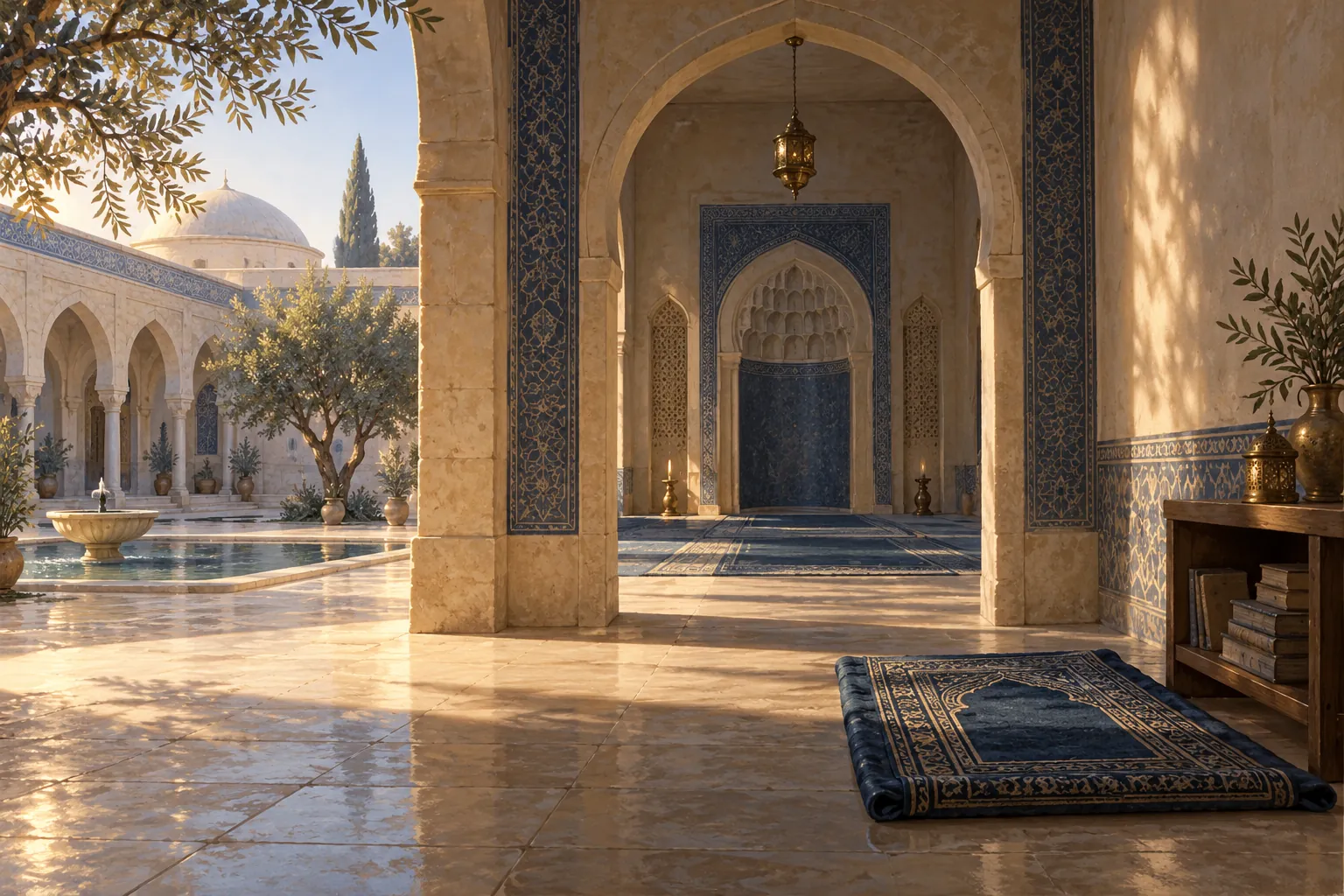
The Five Pillars name a familiar framework of Muslim religious practice: professing faith, performing ritual prayer, giving zakat, fasting in Ramadan and making the Hajj pilgrimage when able. The list brings together commitments with very different rhythms. Prayer shapes a day; Ramadan shapes a month; pilgrimage may be a once-in-a-lifetime obligation. They are not five stages that a person finishes and leaves behind. [1][2]
The fivefold formulation is especially associated with Sunni Islam. Other Muslim traditions share these practices while arranging their teachings and obligations differently. A useful introduction therefore distinguishes the list from an exhaustive definition of every Muslim community. It also distinguishes a religious obligation from a claim that every individual observes it in exactly the same way. [1]
Where the list comes from
A direct textual source is a report attributed to Ibn Umar in Sahih al-Bukhari, a Sunni hadith collection. Hadith 8 names testimony, prayer, zakat, pilgrimage and Ramadan fasting as the foundations on which Islam is built. That is a hadith report about Muhammad’s teaching, rather than a Quranic verse carrying the heading “Five Pillars.” [3]
The report lists pilgrimage before Ramadan fasting. Its numbering is also worth recording when sharing the reference: Sunnah.com identifies it as Sahih al-Bukhari 8 and, within the Book of Belief, as Book 2, Hadith 1. Recording both the collection and the report number helps another reader locate the text instead of relying on an unattributed version of the list. [3]
Faith and prayer
The shahadah expresses belief in the one God and recognition of Muhammad as God’s messenger. It is a profession of faith. Salat, also spelled salah, is ritual prayer at five daily intervals: dawn, noon, afternoon, sunset and night. The Metropolitan Museum’s introduction describes reciting the Quran’s opening chapter during prayer, alongside its account of the direction and daily rhythm of worship. [2]
Muslims direct salat toward the Kaaba in Mecca. A mosque supports communal worship, but prayer is not confined to a mosque building: a suitable clean place can serve. Seeing someone pray at work or while travelling therefore does not make the prayer a different pillar. The daily practice connects religious commitment with ordinary places and schedules. [1]
Zakat is more specific than generosity
Zakat concerns an obligation attached to eligible wealth under specified conditions. Islamic Relief’s guidance explains the nisab threshold and the lunar-year condition for common monetary assets. The familiar 2.5 percent rate applies to particular eligible assets; it is not a universal instruction to give 2.5 percent of everyone’s salary, regardless of circumstances or property type. [4]
The same guidance distinguishes zakat al-mal, associated with wealth, from zakat al-fitr, associated with Ramadan’s conclusion. A short introduction should not turn those distinctions into a personal calculation. Readers calculating an obligation need current, relevant guidance about assets and legal interpretation. Keeping the names separate is already useful: not every charitable payment mentioned around Eid refers to the same obligation. [4]
Ramadan fasting has a daily boundary
The Quran connects fasting with awareness of God and associates Ramadan with the revelation of the Quran. Verses 2:184–185 also address illness and travel, including making up days later. These passages show why a description of fasting needs to include circumstances and exceptions rather than suggesting that every person must fast regardless of their situation. [5]
The daily fast runs from dawn to sunset, not sunrise to sunset. Quran 2:187 distinguishes the hours of fasting from the night, when eating and drinking resume. Thus “fasting for Ramadan” does not mean going an entire month without food or water. For questions about individual exemptions or making up missed days, the verses are a starting point for further interpretation, not a complete practical ruling. [6][5]
Hajj and the limits of a short checklist
Hajj is the pilgrimage to Mecca, undertaken during its appointed season by Muslims who have the physical and financial ability. Its rites include circling the Kaaba and movement between Safa and Marwa. A journey to Mecca is therefore not automatically Hajj simply because it reaches the same destination: the prescribed pilgrimage has a particular ritual setting. [2]
Read the pillars as a way into a larger religious life. A useful next reading pairs one practice with its evidence: the hadith for the fivefold list, the Quranic fasting passages for Ramadan, or a carefully scoped guide to zakat. Note what each source actually explains. A named duty, the detailed rules for carrying it out and the lived experience of a community answer related but different questions.
Sources & further reading
The numbered links connect claims to the sources below. Sources checked October 14, 2026 by a separate AI fact-checking agent. This is not human or specialist review. Read our editorial approach.
- Islamic Practices ↗The Pluralism Project, Harvard University · Accessed October 13, 2026
- The Five Pillars of Islam ↗The Metropolitan Museum of Art · Accessed October 13, 2026
- Sahih al-Bukhari 8 — Belief ↗Sunnah.com · Accessed October 13, 2026
- Zakat | What is Zakat in Islam? ↗Islamic Relief UK · Accessed October 13, 2026
- Qur’an 2:183–185 — Al-Baqarah ↗Quran.com / Quran Foundation · Accessed October 13, 2026
- Qur’an 2:187 — Al-Baqarah ↗Quran.com / Quran Foundation · Accessed October 13, 2026
Found a problem? Send a correction with the passage and a supporting source.
Continue your reading
All articles ↗
Comparisons · 3 min read
Quran vs Hadith: scripture, reports and Sunnah
Learn the difference between the Quran, hadith and Sunnah, including collections, chains of transmission and why reports receive different evaluations.
Holy days · 3 min read
Why Ramadan dates change each year—and by community
Learn why Ramadan moves through the Gregorian calendar and why communities can differ over the first day through sighting and calculation methods.
Comparisons · 3 min read
Sunni vs Shia: origins, shared beliefs and differences
A careful introduction to Sunni and Shia Islam, from succession and religious authority to the diversity within both traditions.