Holy days · 4 min read
Why does Hanukkah last eight days? What the early texts say
Compare the Temple rededication in Maccabees, the connection with Sukkot and the Talmud’s oil miracle to understand Hanukkah’s eight-day observance.
Three sources, more than one explanation
Hanukkah’s eight days are often explained through the Talmud’s story of a small supply of oil that burned miraculously for eight days. Earlier accounts in the books of Maccabees describe an eight-day rededication of the Jerusalem Temple; Second Maccabees connects the celebration with the festival of Booths, or Sukkot. These are distinct textual explanations worth reading alongside one another. [1][2][3]
The Metropolitan Museum places the rededication in 164 BCE and identifies the familiar oil narrative as Talmudic. Keeping those two points separate helps distinguish a historical setting from a religious account of a miracle. It also leaves room to ask why different texts emphasize different aspects of the festival instead of blending them into a single undifferentiated story. [4]
First Maccabees: restoring the sanctuary
First Maccabees 4 describes Judas and his companions entering a damaged and desecrated sanctuary. They restore its arrangements, replace the altar and renew worship. The narrative culminates in a joyful dedication with sacrifices and praise. Its focus is the recovery of a place of worship and the public celebration of that recovery. [1]
The text dates the celebration to the twenty-fifth day of Kislev and says the dedication was celebrated for eight days. It also establishes a recurring annual observance. There is no story in this passage about a single flask supplying eight days of light. That observation describes what the passage contains; it does not by itself prove or disprove the later religious account. [1]
Second Maccabees: a connection with Booths
Second Maccabees 10 also describes purification of the sanctuary and a restoration of sacrifices, incense and lamps. Its explanation of the eight days is more explicit: the people celebrate in a manner associated with Booths, remembering that they had recently spent that festival in mountains and caves. The text mentions branches, palms and hymns of thanksgiving. [2]
This connection explains why Sukkot appears in a discussion of Hanukkah without making the two holidays identical. Second Maccabees presents one celebration through the memory and pattern of another. A careful summary can preserve that relationship while avoiding the claim that every later Hanukkah custom came directly from Sukkot or that modern observers are simply keeping the same festival twice. [2]
The Talmud: a flask of oil
In Shabbat 21b, the Babylonian Talmud asks what Hanukkah commemorates and tells of a search for undefiled oil after the sanctuary is recovered. Only one sealed flask is found, sufficient for a single day. According to the account, a miracle allows it to burn for eight days; the following year those days are established for praise and thanksgiving. [3]
The miracle should be attributed to the Talmud’s account rather than reported as if it had been independently tested by modern historians. The passage itself also should not be made to answer every later question. For example, the familiar explanation that producing replacement oil took exactly eight days is not stated in this particular narrative. An additional explanation needs its own source. [3]
Eight days and the lights of the lamp
The Met describes the familiar increasing sequence: one festival light on the first evening, then another added each evening until eight are lit. Its Hanukkah lamp has receptacles for those eight lights and a separate helper, the shamash. The extra holder is therefore not evidence of a ninth day added to the festival. [4]
The distinction between the duration of the festival and the construction of a lamp is useful when looking at objects or pictures. A date, a ritual sequence and a count of holders are related pieces of information, but they do different work. If an illustration is being used to explain the observance, count the intended festival lights separately from the helper.
A short way to compare the accounts
Read First Maccabees 4:36–59, Second Maccabees 10:1–8 and the Hanukkah discussion in Shabbat 21b. For each, note the setting, the problem being overcome, the reason given for rejoicing and the role of the number eight. Put quotation marks only around words actually present in the edition you are using, and keep a paraphrase visibly separate.
Then ask what each source leaves unstated. An omission is useful evidence about that text’s emphasis, but it is not permission to fill the gap with details from another source without saying so. This approach gives a fuller answer to “why eight days” while respecting both the festival’s historical setting and the religious traditions through which its meaning has been transmitted.
Sources & further reading
The numbered links connect claims to the sources below. Sources checked October 14, 2026 by a separate AI fact-checking agent. This is not human or specialist review. Read our editorial approach.
- 1 Maccabees 4:36–59 ↗Bible Society; Good News Bible · Accessed October 14, 2026
- 2 Maccabees 10:1–8 ↗United States Conference of Catholic Bishops; NABRE · Accessed October 14, 2026
- Babylonian Talmud, Shabbat 21b ↗Sefaria; William Davidson Talmud · Accessed October 14, 2026
- The Hanukkah Menorah ↗The Metropolitan Museum of Art · Accessed October 14, 2026
Found a problem? Send a correction with the passage and a supporting source.
Continue your reading
All articles ↗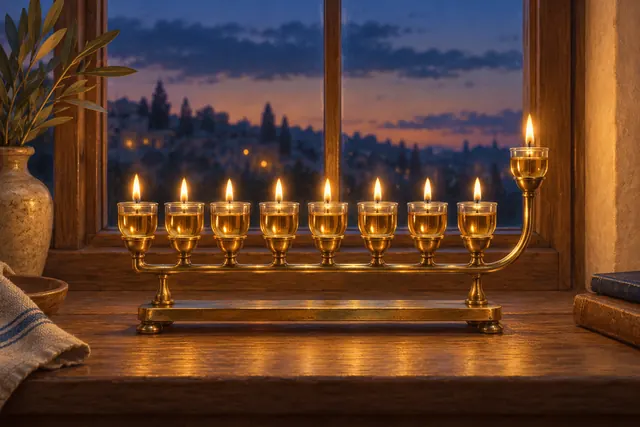
Comparisons · 4 min read
Menorah vs hanukkiah: seven lights, eight nights and the shamash
Learn why a Hanukkah lamp has eight festival lights plus a helper, how it differs from the Temple menorah, and why both can correctly be called menorahs.
Holy days · 9 min read
The etrog: the citron at the heart of Sukkot
What the etrog is, how a citron from Asia became the fruit of Sukkot, what makes one fit to use, and the coins, mosaics, silver boxes and customs it gathered.
Comparisons · 3 min read
Torah vs Tanakh vs Talmud: a guide to the terms
Understand how Torah, Tanakh, Mishnah, Gemara and Talmud relate, and why Torah can mean more than the first five biblical books.