Holy days · 9 min read
The etrog: the citron at the heart of Sukkot
What the etrog is, how a citron from Asia became the fruit of Sukkot, what makes one fit to use, and the coins, mosaics, silver boxes and customs it gathered.
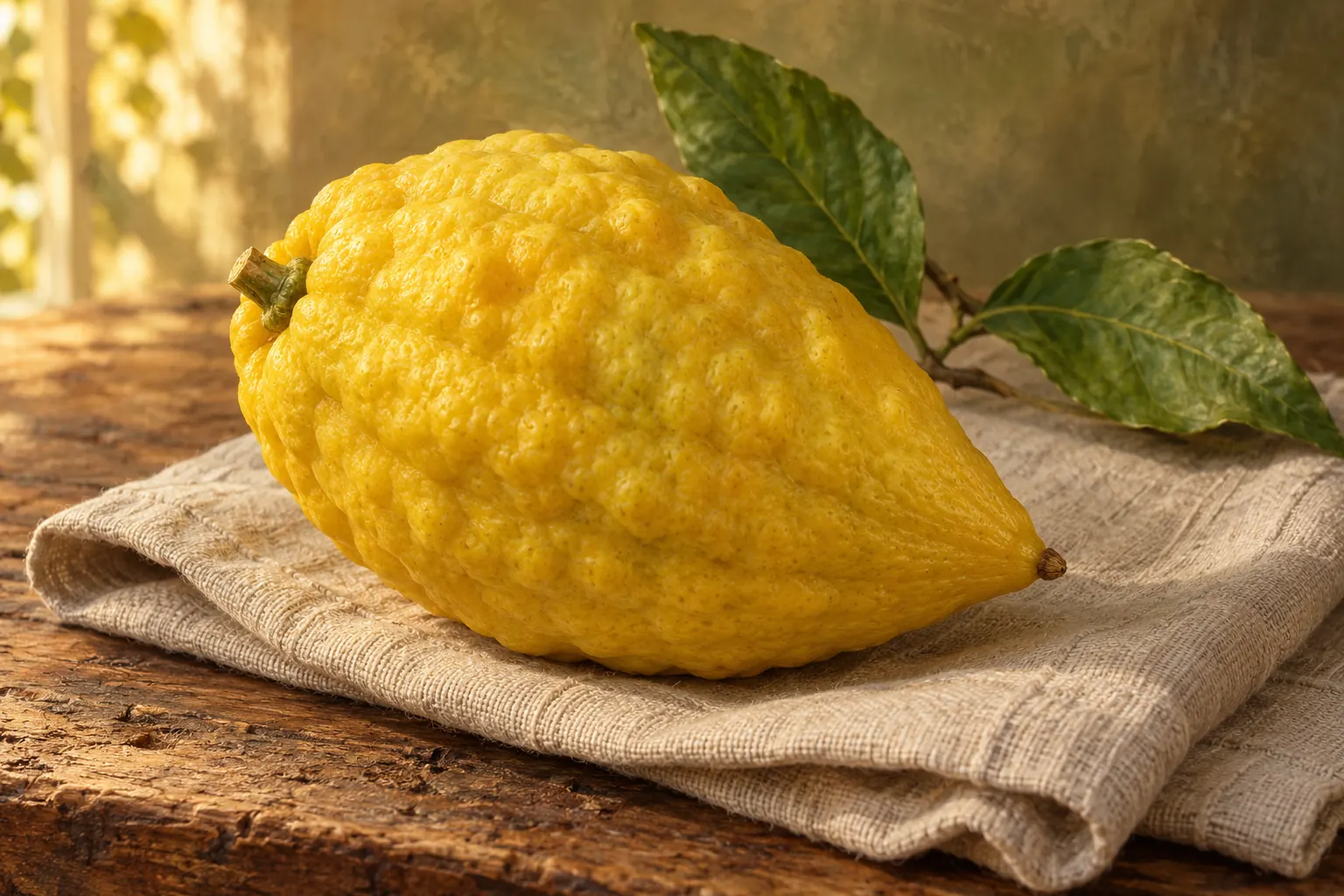
What an etrog is
The etrog is a citron, Citrus medica, a fragrant, thick-skinned citrus fruit. It is one of the four kinds of plants that Jews take in hand during Sukkot, together with the lulav (a palm branch), myrtle and willow. The other three are bound together, and the etrog is held beside them. [13][47][1][32]
The Torah never names the fruit. It commands Israel to take “the fruit of goodly trees” on the first day of the festival, and Jewish tradition has identified that fruit as the citron. So the etrog’s story runs through two histories at once: how interpreters read a single verse, and how a plant from South Asia came to be grown in the Land of Israel. [1][15][13]
From a verse to a fruit
Leviticus 23:40 lists the fruit of hadar trees, palm branches, leafy boughs and willows of the brook, and commands rejoicing for seven days. The Babylonian Talmud asks which tree is meant and gives several answers. One is a tree whose wood tastes like its fruit, which it says is the etrog tree. Rabbi Abbahu rereads hadar as ha-dar, “that which dwells”, a fruit that stays on its tree from year to year. Ben Azzai connects the word with the Greek for water. [1][2]
Outside rabbinic literature, the earliest clear witness is Josephus in the first century CE, who describes worshippers at the festival carrying myrtle, willow and a palm bough “with the addition of the pome citron.” The palynologist Dafna Langgut notes that the Bible itself never mentions the citron and that its link to Leviticus is attested only from the first century CE. [11][15]
A fruit from the east
Botanists count the citron among the three ancestral citrus species, with the pomelo and the mandarin; most other citrus fruits descend from crosses among them. Langgut places its origin in eastern India and southern China and describes it as the first citrus to travel west, apparently through Persia and the southern Levant. In the fourth century BCE the Greek writer Theophrastus called it the “Median” or “Persian apple” and remarked that it was fragrant but not eaten. [19][18][17][20]
The earliest physical evidence in the region comes from Ramat Rahel, just south of Jerusalem. Citron pollen was found preserved in the plaster of a pool in a royal garden of the Persian period, dated to the fifth to fourth centuries BCE. At first it was an exotic plant of splendid gardens; it reached the gardens of wealthy Romans about two centuries later. [16][19][17]
Coins, letters and mosaics
By the late Second Temple period the etrog was part of public worship, and sometimes of public protest. The Mishnah tells of a priest who poured the festival’s water libation over his feet instead of on the altar, and of the crowd pelting him with their etrogs; the Talmud calls him a Sadducee. Josephus tells of a crowd that pelted the Hasmonean king and high priest Alexander Jannaeus with citrons as he stood at the altar at Sukkot, and says that he had about six thousand of them killed in response. [6][4][12]
The fruit then became an emblem of national hope. Bronze coins of the fourth year of the revolt against Rome, 69 CE, show a lulav flanked by two etrogs on one side and, on the other, a chalice with the words “For the redemption of Zion.” Silver coins of the Bar Kokhba revolt, 132 to 135 CE, pair the façade of the Temple with the lulav and etrog. An Aramaic letter written in Bar Kokhba’s name and found in 1960 in a cave near the Dead Sea orders palm branches and citrons sent to his camp for the festival. [21][22][23]
In late antiquity the etrog joined the menorah, the shofar and the incense shovel in a recognisable set of Jewish symbols. The fourth-century mosaic floor of the Hammat Tiberias synagogue shows a lulav and an etrog beneath each of its two menorahs, and the sixth-century mosaic at Beth Alpha places a lulav and etrog to either side of the Ark. The etrog also appears on fourth-century Jewish gold glass, probably from Rome, and in the paintings of a Jewish catacomb at Villa Torlonia. [24][25][26][27]
What makes an etrog fit to use
The Mishnah sets out the basic rules. A stolen or dried-up etrog is invalid, as is one from a tree used for idolatry or from a tree in its first three years (orlah). So is an etrog whose surface is mostly covered by blemishes, whose pitam (the small tip at the top) has been removed, or which has been peeled, split, or pierced so that some of it is missing. The rabbis disagreed about the minimum size: Rabbi Meir said a walnut and Rabbi Judah an egg. [5]
The pitam is not always required. Rabbi Moses Isserles, in his sixteenth-century gloss on the Shulchan Arukh, rules that an etrog that never had one is valid, and a modern halakhic guide adds that such fruit is fully kosher because that is how it grows. What disqualifies is a pitam that grew and was then broken off entirely. [7][28][31]
Grafting is the later question. Commercial citrus is usually grafted onto a hardier rootstock, but the prevailing ruling is that an etrog from a grafted tree is invalid. Authorities give several reasons: the fruit may count as a different species or as an incomplete etrog, or using it may involve a transgression, though some, such as Rabbi Yehuda Amital, have argued that it can be used. Buyers rely on rabbinic certification that the fruit comes from inspected, ungrafted trees. [28][29][46][31]
How it is held, and what it is said to mean
The Talmud rules that the bound lulav is held in the right hand and the etrog in the left. On each day of Sukkot except Shabbat, a blessing is said over the lulav, and the four kinds are brought together and waved in six directions. The order of directions differs between communities. [3][32][33]
Since a blessing should come before the act it accompanies, the Shulchan Arukh suggests saying it before picking up the etrog, or else holding the etrog upside down until the blessing is finished. Some communities follow the second custom, holding the etrog with its tip down and then turning it upright. Chabad’s guide instead has the blessing said over the lulav before the etrog is lifted. [8][34][33][32]
The midrash Leviticus Rabbah reads the four kinds as four kinds of people. The etrog has both taste and fragrance, like Jews who have both Torah learning and good deeds; the willow, with neither, stands for those who have neither, and all are bound together so that each atones for the others. Another passage compares the etrog to the human heart. [9][10]
Choosing a beautiful etrog
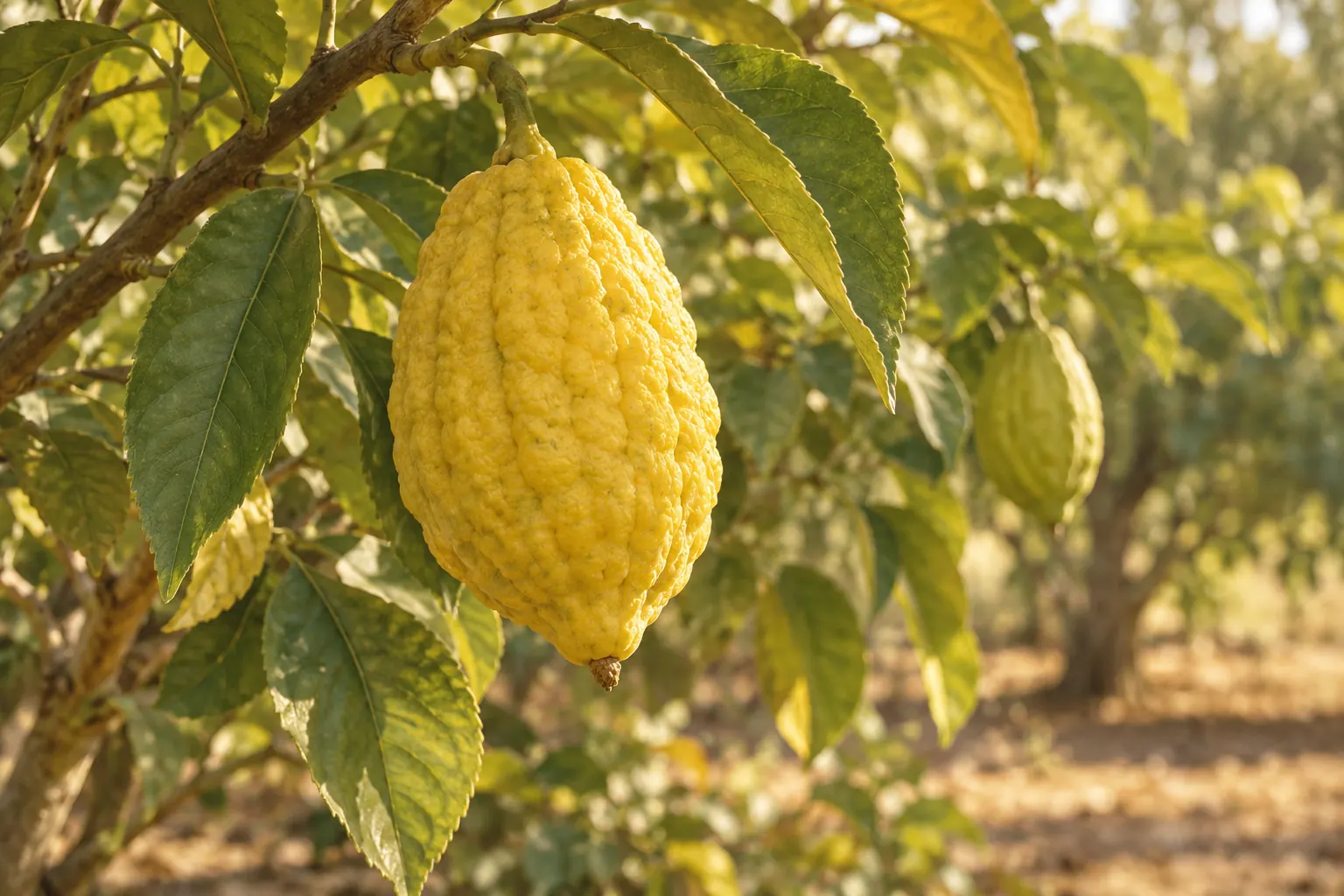
Jewish tradition values hiddur mitzvah, beautifying a commandment, and the Talmud suggests spending up to a third more for it. For the etrog, beauty is part of the commandment itself, since the Torah speaks of the fruit of hadar trees, often understood as beautiful trees. Buyers examine the upper part of the fruit most closely: Chabad’s guide says that in the top third even one bubble or noticeable area of discoloration makes the fruit invalid. It also recommends a somewhat oblong, bumpy fruit with a yellow skin that has not yet turned brown. [37][38][31][30]
These standards make the best fruit scarce. One Israeli grower told a reporter in 2023 that about half his fruit is thrown out on the spot and another 20 to 30 percent later. Prices range widely: a JNS report for Sukkot 2026 gave more than 200 to 300 shekels for an etrog in Hasidic communities and 250 to 1,000 shekels for a Moroccan one, and said complete sets start at about $50. [40][41]
Where etrogim come from
Supply has long been a political matter. In 1744 the Habsburg empress Maria Theresa demanded an annual tax of 40,000 florins from the Jews of Bohemia for importing etrogim. Until the end of the nineteenth century the island of Corfu was the main source for European Jewry. In 1875 Rabbi Isaac Elhanan Spektor of Kovno ruled against Corfu etrogim because of their exorbitant price, and after the anti-Jewish riots that followed a blood libel on Corfu in 1891, a boycott movement turned buyers toward etrogim from Palestine, promoted by supporters of the new Jewish agricultural colonies. [14][13][42][43][44]
Several distinct traditions survive. Calabrian etrogim, from the Riviera dei Cedri on Italy’s southern coast, are preferred by Chabad and others; they are also called Yanover, from the Yiddish name for Genoa, and rabbis travel there each summer to select fruit. The large Yemenite etrog has almost no juicy flesh and usually lacks a pitam. Moroccan etrogim are grown by Berber-speaking farmers in villages of the Atlas mountains around Agadir, and about 600,000 were exported in 2022, according to a local Jewish businessman who runs an etrog farm. Since Corfu’s decline, fruit from the Land of Israel has dominated the international market; in 2014 Israel’s agriculture ministry put the country’s crop at about a million a year, a third of it exported. [35][45][46][13][48][49][44][47]
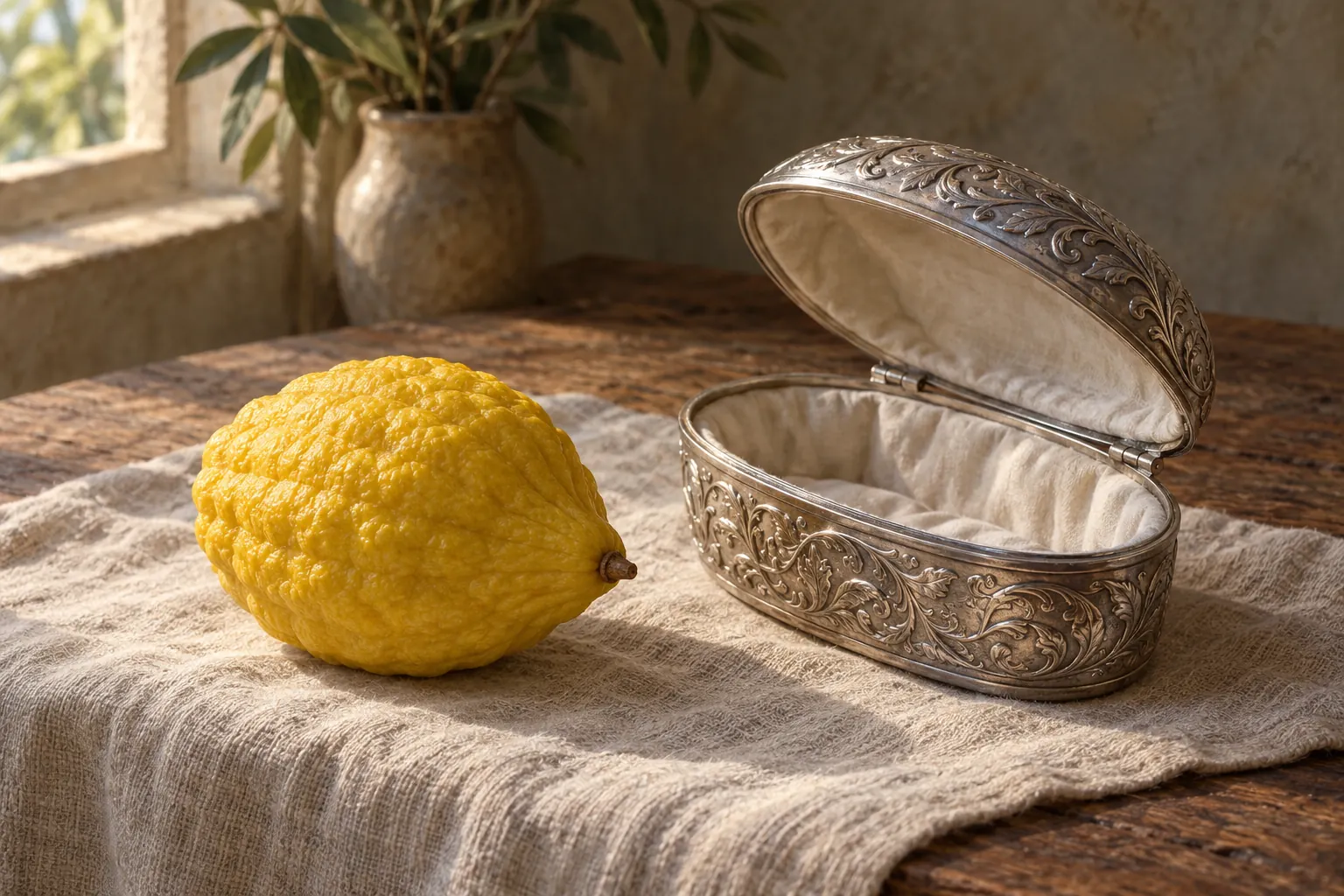
Silver boxes, jam and cloves
Because the fruit is fragile, it is kept in a protective case when not in use. Containers made specifically for the etrog are known from the late seventeenth century; some of the earliest used for it were made for other purposes, such as the costly silver boxes in which the wealthy kept sugar and tea, and some later boxes imitate the ribbed fruit itself. Museums hold many examples, such as a silver-gilt container by Johann Schlatter made in Vienna in 1759, now at the Nelson-Atkins Museum of Art. [38][39]
Once Sukkot ends the etrog is no longer needed for the commandment, and customs grow around what is left. Some boil it with sugar into jam or fry it to eat on Tu BiShvat, the new year of trees. Others stud it with cloves and use it as fragrant spice for Havdalah at the end of Shabbat. Anyone planning to eat one should bear in mind how the crop is grown: a 2014 NPR report on an Israeli orchard said the trees must be sprayed with pesticides twice a day. [50][36][51][47]
One folk custom ties the fruit to childbirth. On Hoshana Rabbah, the last day of Sukkot, some pregnant women would bite off the etrog’s pitam and recite a prayer for an easy birth. The earliest known text describing the practice appears in the Yiddish Tsenah Ur’enah, in its earliest surviving edition, of 1622. [52][50]
Continue exploring
Holymap’s page on Sukkot covers the festival around the etrog: the sukkah, the water-drawing celebration of Temple times and the differences in observance between Israel and the diaspora. The etrog is a small fruit with a long history, from a Persian garden through revolt coins and synagogue floors to the market stalls of today.
Sources & further reading
The numbered links connect claims to the sources below. Sources checked October 13, 2026 by a separate AI fact-checking agent. This is not human or specialist review. Read our editorial approach.
- Leviticus 23:40 ↗Sefaria, JPS Tanakh (1917) and JPS Gender-Sensitive Edition (2023) · Accessed October 13, 2026
- Babylonian Talmud, Sukkah 35a ↗Sefaria, William Davidson Talmud (Koren–Steinsaltz) · Accessed October 13, 2026
- Babylonian Talmud, Sukkah 37b ↗Sefaria, William Davidson Talmud (Koren–Steinsaltz) · Accessed October 13, 2026
- Babylonian Talmud, Sukkah 48b ↗Sefaria, William Davidson Talmud (Koren–Steinsaltz) · Accessed October 13, 2026
- Mishnah Sukkah 3:5–7 ↗Sefaria · Accessed October 13, 2026
- Mishnah Sukkah 4:9 ↗Sefaria · Accessed October 13, 2026
- Shulchan Arukh, Orach Chayim 648:7, with the gloss of R. Moses Isserles ↗Sefaria · Accessed October 13, 2026
- Shulchan Arukh, Orach Chayim 651:5 ↗Sefaria · Accessed October 13, 2026
- Leviticus Rabbah 30:12 ↗Sefaria, The Sefaria Midrash Rabbah (2022) · Accessed October 13, 2026
- Leviticus Rabbah 30:14 ↗Sefaria, The Sefaria Midrash Rabbah (2022) · Accessed October 13, 2026
- Josephus, Antiquities of the Jews 3.10.4 ↗Perseus Digital Library, Tufts University, tr. William Whiston · Accessed October 13, 2026
- Josephus, Antiquities of the Jews 13.372 ↗Perseus Digital Library, Tufts University, tr. William Whiston · Accessed October 13, 2026
- Etrog ↗Encyclopaedia Judaica, Jehuda Feliks, via Encyclopedia.com · Accessed October 13, 2026
- Etrog ↗Jewish Encyclopedia (1906), Cyrus Adler and I. M. Casanowicz · Accessed October 13, 2026
- Prestigious fruit trees in ancient Israel: first palynological evidence for growing Juglans regia and Citrus medica ↗Dafna Langgut, Israel Journal of Plant Sciences (2015) · Accessed October 13, 2026
- Fossil pollen reveals the secrets of the royal Persian garden at Ramat Rahel, Jerusalem ↗Langgut, Gadot, Porat and Lipschits, Palynology 37 (2013) · Accessed October 13, 2026
- The citrus route revealed: from Southeast Asia into the Mediterranean ↗Dafna Langgut, HortScience (2017) · Accessed October 13, 2026
- The Etrog: Celebrating Sukkot with a Persian Apple ↗TheTorah.com, Dafna Langgut, 23 September 2021 · Accessed October 13, 2026
- The Four Species of Sukkot Explained ↗Tel Aviv University · Accessed October 13, 2026
- Enquiry into Plants, Book IV (tr. Arthur Hort, 1916) ↗Theophrastus, Loeb Classical Library, via Internet Archive · Accessed October 13, 2026
- Coin of the Jewish revolt (Year 4) ↗Harvard Art Museums · Accessed October 13, 2026
- Tetradrachm (Selah) of Bar Kokhba depicting the façade of the Temple and the Four Species ↗Judaism and Rome research database · Accessed October 13, 2026
- Simon Bar Kokhba, 132–135 CE: Sukkot ↗Center for Online Judaic Studies · Accessed October 13, 2026
- Hammat Tiberias: the synagogue mosaic floor, top panel ↗University of Michigan, Near Eastern Studies image database · Accessed October 13, 2026
- Ark mosaic, sixth-century CE synagogue at Beth Alpha ↗Biblical Archaeology Society Library · Accessed October 13, 2026
- A Jewish Gold Glass from the Catacombs of Rome ↗Coproduced Religions, Universität Bern, Caroline Bridel, 2024 · Accessed October 13, 2026
- Vaults of Memory: Jewish and Christian imagery in the catacombs of Rome ↗The Catacomb Society · Accessed October 13, 2026
- A Grafted Etrog and the Status of the Pitam ↗Peninei Halakha, Rabbi Eliezer Melamed, Yeshivat Har Bracha · Accessed October 13, 2026
- The Grafted Etrog ↗Torat Har Etzion, Rabbi Yehuda Amital · Accessed October 13, 2026
- Physical Disqualifications of the Etrog ↗Torat Har Etzion, Rabbi Ezra Bick · Accessed October 13, 2026
- How to Select the Best Lulav and Etrog ↗Chabad.org · Accessed October 13, 2026
- Lulav and Etrog: Pictorial Guide ↗Chabad.org · Accessed October 13, 2026
- The Order ↗Chabad.org, Eliyahu Kitov, The Book of Our Heritage · Accessed October 13, 2026
- How to Shake the Lulav and Etrog ↗Exploring Judaism · Accessed October 13, 2026
- Why an Italian Etrog? Getting to the Root of the Grafted Etrog ↗Chabad.org, Yehuda Shurpin · Accessed October 13, 2026
- What Should I Do with My Holiday Lulav and Etrog Set? ↗Chabad.org, Dovid Zaklikowski · Accessed October 13, 2026
- Hiddur Mitzvah: The Case for Beautiful Ritual Objects ↗My Jewish Learning, excerpted from Gates of the Seasons (CCAR) · Accessed October 13, 2026
- The Artistry of the Etrog Box ↗Jewish Action (Orthodox Union), David Olivestone, Fall 2024 · Accessed October 13, 2026
- Etrog Container, Johann Schlatter, 1759 ↗Nelson-Atkins Museum of Art · Accessed October 13, 2026
- The Quest for the Perfect Etrog: Inside the High-Stakes World of Sukkot Citrus ↗The Media Line, Aaron Poris, via Jewish Journal, 29 September 2023 · Accessed October 13, 2026
- Beat the clock: The race to sell Sukkot’s ‘Four Species’ ↗JNS / TPS, David Israel, September 2026 · Accessed October 13, 2026
- Spektor, Isaac Elhanan ↗Jewish Encyclopedia (1906), Peter Wiernik · Accessed October 13, 2026
- Corfu, Greece ↗Encyclopaedia Judaica, Simon Marcus and Yitzchak Kerem, via Jewish Virtual Library · Accessed October 13, 2026
- The Esrog Libel ↗Mishpacha, Cindy Scarr, 13 October 2024 · Accessed October 13, 2026
- In Calabria, rabbis and farmers continue a 2,000-year-old etrog tradition ↗The Times of Israel, Rossella Tercatin, 4 October 2017 · Accessed October 13, 2026
- Etrog citron ↗Givaudan Citrus Variety Collection, University of California, Riverside · Accessed October 13, 2026
- The Birth and Afterlife of Israel’s Precious Etrog Fruit ↗NPR, Emily Harris, via KPBS, 3 October 2014 · Accessed October 13, 2026
- How dear a hadar tree’s fruit can be ↗The Jewish Standard, Abigail Klein Leichman, 23 September 2011 · Accessed October 13, 2026
- This Sukkot, peace and Jewish law have Morocco’s etrog industry blossoming ↗JTA, David I. Klein, via Ynetnews, 2022 · Accessed October 13, 2026
- Etrogim after Sukkot ↗OzTorah, Rabbi Raymond Apple · Accessed October 13, 2026
- Tu B’Shevat: Special Minhagim ↗OU Kosher Halacha Yomis · Accessed October 13, 2026
- Teḥinah upon tearing off the pitom of the etrog on Hoshana Rabba, from the Tsenah Ur’enah (1622) ↗Open Siddur Project, tr. Morris M. Faierstein · Accessed October 13, 2026
Found a problem? Send a correction with the passage and a supporting source.
Continue your reading
All articles ↗
Comparisons · 3 min read
Torah vs Tanakh vs Talmud: a guide to the terms
Understand how Torah, Tanakh, Mishnah, Gemara and Talmud relate, and why Torah can mean more than the first five biblical books.

Holy days · 3 min read
Eid al-Fitr vs Eid al-Adha: dates, meaning and observance
Compare the Eid after Ramadan with the Eid in the Hajj season, including prayer, charitable giving and why their Gregorian dates move.

Holy days · 3 min read
Why Orthodox Easter often falls on a different date
Understand Julian and Gregorian Easter calculations, ecclesiastical full moons and why modern Passover is not an extra universal rule.