Beliefs & ideas · 4 min read
What is langar? The Sikh community kitchen and shared meal
Learn how langar expresses equality and service, who can join the meal, and what to expect when visiting a gurdwara, including access and dietary questions.
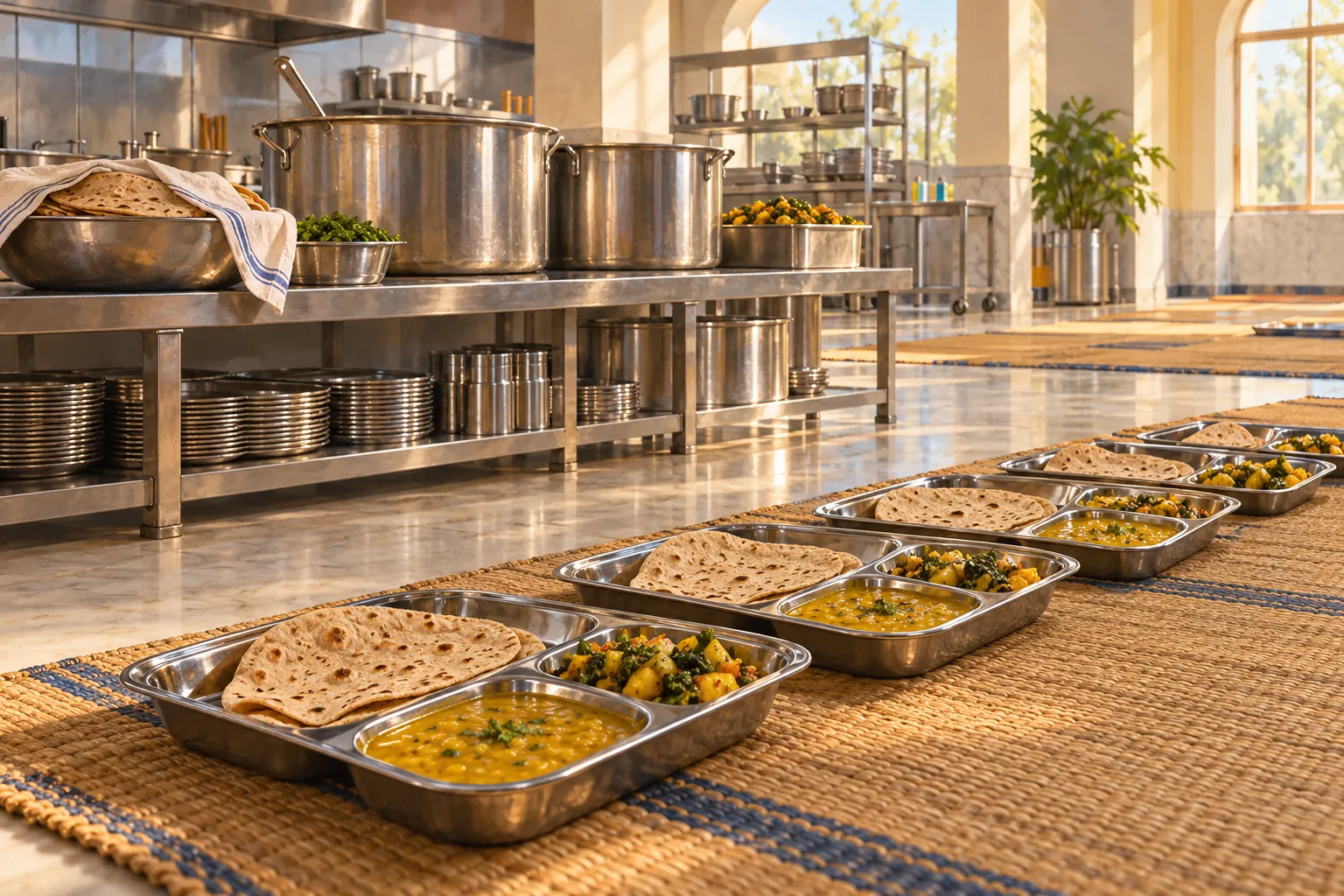
A meal open to everyone
Langar is the community kitchen and shared meal associated with a Sikh gurdwara. The Sikh Coalition’s introduction to the gurdwara describes a meal prepared and served by volunteers without charge. People of every religion are welcome. Eating together expresses equality and service, making the shared meal part of the gurdwara’s social and spiritual life. [5]
That combination matters. A description limited to “free food” leaves out the social and religious meaning of preparing, serving and sharing it. A description limited to a religious ceremony can wrongly suggest that outsiders are excluded. The institution brings hospitality and community service into a practical setting where different people take part in the same meal. [1]
Why sitting and eating together matters
Harvard’s Pluralism Project connects langar with Sikh challenges to caste distinctions and food-based exclusion. Sharing a meal and sitting together at the same level make equality tangible. Its account describes community members of different ages and genders preparing and serving food. The point is not only who receives the meal, but how the work and the space express common membership. [2]
Floor seating is often part of this setting, but it should not become a barrier for someone who cannot use it. The Sikh Coalition explicitly qualifies that practice according to ability. A visitor who needs a chair or another arrangement can ask a host. Describing that qualification accurately preserves the welcoming purpose of the meal instead of turning a visible custom into an exclusionary test. [1]
Roots in the Sikh Gurus’ community
Harvard traces the shared meal to the community around Guru Nanak. SGPC’s institutional account credits Guru Amar Das with strengthening langar and requiring visitors to share the meal before an audience with him. In that account, even the emperor Akbar eats with others. The story expresses the principle that rank should not exempt someone from sharing a common setting. [2][3]
The Akbar episode is best introduced as SGPC’s account or a Sikh traditional narrative, with its source visible. It should not be quietly converted into an unsourced historical anecdote. Nor should the rule described for an audience with Guru Amar Das be presented as an identical contemporary entry requirement at every gurdwara. Historical examples and present visitor instructions answer different questions. [3]
Vegetarian food and dietary questions
Langar commonly offers vegetarian food so the meal can be shared across religious backgrounds. Harvard’s account describes dishes such as lentils, rice, bread, curries and pudding in one American gurdwara. That example illustrates the character of a meal, not a mandatory menu. Vegetarian langar also does not establish that every Sikh is personally vegetarian in every part of daily life. [2]
Vegetarian is not the same as vegan or free of allergens. The Sikh Coalition’s visitor guide says a person may decline food because of allergies or other dietary restrictions and can seek help. Ask about ingredients instead of assuming a dish is suitable because it is part of langar. A clear, polite question helps hosts respond to the actual need. [4]
What to expect on a first visit
The Sikh Coalition’s visitor guidance calls for washing hands, removing footwear and covering the head before entering the prayer hall. Intoxicants do not belong on the premises, and heads remain covered in the langar hall. Its guide distinguishes respectful attendance from compulsory participation: visitors who feel uncomfortable bowing in the prayer hall may attend without doing so. [4]
For meal times, entrances and access arrangements, check with the particular gurdwara. A general account of langar is not evidence that every kitchen serves continuously. Introduce yourself to a host, explain any access or food requirements and ask where to go. This is practical visitor advice, not a new religious rule or a claim that all buildings use the same layout.
Taking part beyond the plate
The Sikh Coalition describes volunteer preparation and serving as part of langar’s collective responsibility. If you would like to help, ask what is useful and follow the kitchen’s instructions. There is no need to assume that the most visible job is the one needed at that moment. Respecting the people organizing the work is part of being a considerate guest. [1]
Keep langar distinct from prashad. The Sikh Coalition’s visitor guide describes prashad as a sweet preparation offered in the prayer hall and then separately introduces the langar meal. A visitor may encounter both during the same visit. Knowing which is being offered helps make sense of the setting without treating every distribution of food as the same part of worship. [4]
Sources & further reading
The numbered links connect claims to the sources below. Sources checked October 14, 2026 by a separate AI fact-checking agent. This is not human or specialist review. Read our editorial approach.
- Frequently Asked Questions ↗The Sikh Coalition · Accessed October 13, 2026
- Langar: The Communal Meal ↗The Pluralism Project, Harvard University · Accessed October 13, 2026
- Sri Guru Amardas Ji ↗Shiromani Gurdwara Parbandhak Committee (SGPC) · Accessed October 13, 2026
- Guide to Visiting a Gurdwara (2025) ↗The Sikh Coalition · Accessed October 13, 2026
- Sikh House of Worship: The Gurdwara and Tradition of Langar ↗The Sikh Coalition · Accessed October 14, 2026
Found a problem? Send a correction with the passage and a supporting source.
Continue your reading
All articles ↗
Sacred texts · 3 min read
What is the Guru Granth Sahib? Scripture, music and Sikh authority
Understand the Guru Granth Sahib as Sikh scripture and living Guru, its compilation, its poetry and music, and its central place in gurdwara worship.

Comparisons · 3 min read
Sikhism vs Hinduism: identity, teachings and scripture
Learn why Sikhism is a distinct religion and compare its Gurus, scripture and ethical teachings with the diversity of Hindu traditions.

Holy days · 3 min read
Diwali and Bandi Chhor Divas: connected season, distinct meanings
Understand Hindu Diwali traditions and Sikh Bandi Chhor Divas, including lights, Guru Hargobind’s release and why the observances should not be conflated.