Holy days · 3 min read
Diwali and Bandi Chhor Divas: connected season, distinct meanings
Understand Hindu Diwali traditions and Sikh Bandi Chhor Divas, including lights, Guru Hargobind’s release and why the observances should not be conflated.
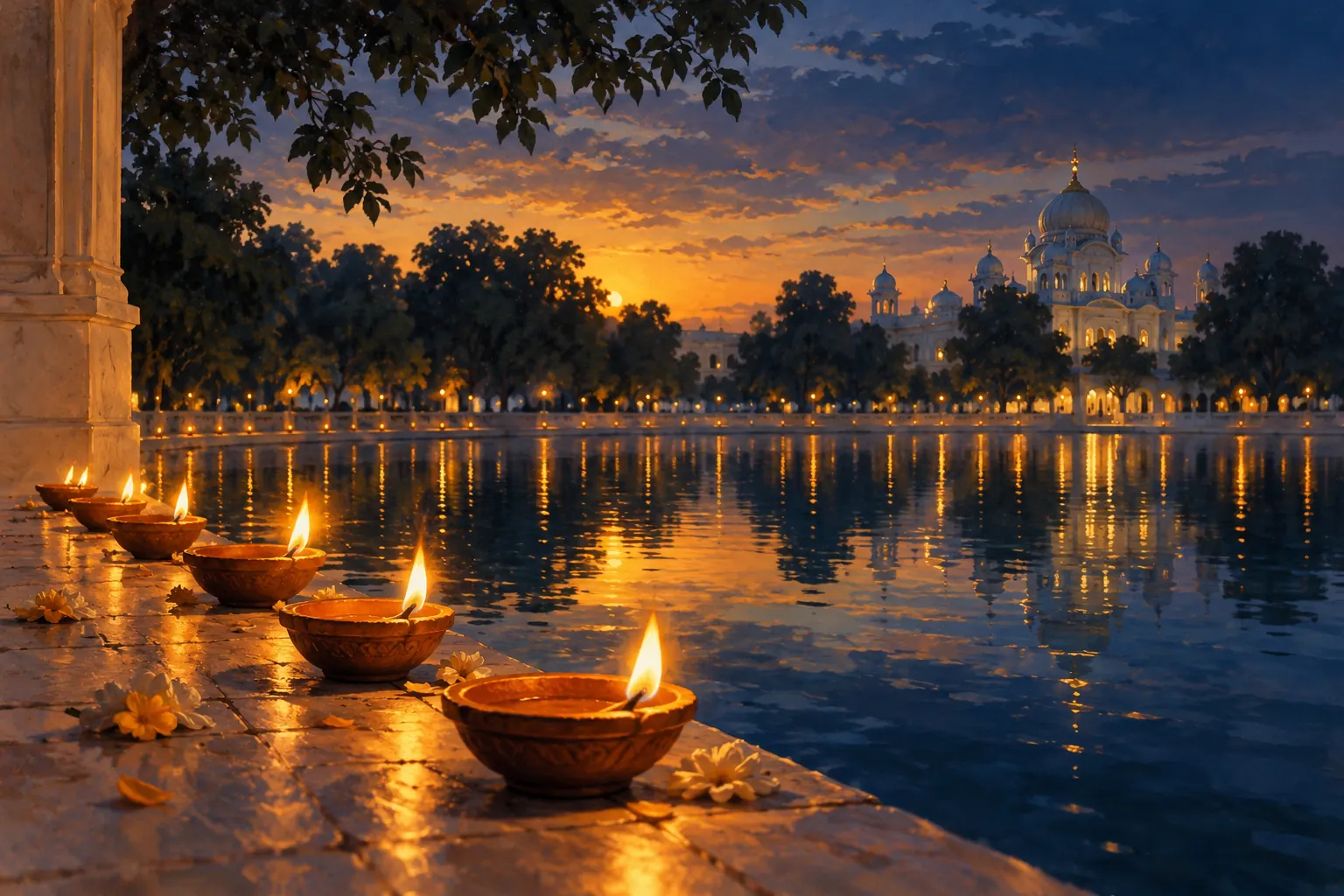
Similar lights do not mean identical observances
Diwali and Bandi Chhor Divas are associated with a shared festival season and celebrations involving light, but they have distinct religious meanings. Hindu Diwali traditions vary by region and community. Sikh Bandi Chhor Divas remembers Guru Hargobind's release from detention and the release of fellow prisoners in Sikh tradition. [1][2][3]
The clearest comparison begins with what is being remembered. A photograph of lamps may show a shared visual form, but cannot by itself identify the full religious meaning of an event. Name the community and observance before interpreting the image.
Diwali has several traditional associations
Royal Museums Greenwich describes Diwali as a festival of lights with varied regional traditions, including widespread devotion to Lakshmi. A Smithsonian account explains the Ramayana association: Rama and Sita's return is welcomed with lights. That account is a religious story and literary tradition, not an independently established historical journey. [1][4]
Avoid presenting one story as the only reason every Hindu celebrates. A useful introduction names a tradition and allows for other regional meanings. If you are describing a particular event, use that community's explanation of which observances and stories it emphasizes.
What Bandi Chhor Divas remembers
Sikh sources connect the commemoration with Guru Hargobind's release from Gwalior and the freedom of fifty-two fellow prisoners, often described as princes. They also associate the remembrance with lights at Amritsar. These accounts explain why the Sikh observance should not be reduced to a generic Hindu festival with a different name. [2][3]
The distinction does not deny a shared cultural setting. It identifies the specific memory and meaning expressed within Sikh tradition. A comparison can acknowledge neighboring celebrations while remaining clear that the religious narratives are different.
Why sources give different release dates
The SGPC account favors detention from 1609 to 1612 and release in 1612. The Encyclopaedia of Sikhism instead suggests a stay of a few months during 1617–19 and says its length cannot be established with certainty. These differing accounts make a single definitive release year inappropriate here. [2][3]
The Encyclopaedia of Sikhism connects the Guru's arrival in Amritsar with the town's illumination and describes the anniversary's lights and fireworks at the Golden Temple. This commemorative practice is clearer in the sources than the exact duration and dates of the earlier detention. [3]
Dates and visiting a celebration
Diwali's timing follows a lunisolar calendar and falls in October or November in the Gregorian calendar. Local programs and observances should be checked with the host community. A general festival date does not guarantee the date or time of every public celebration. [1]
If you are attending, read the organizer's explanation and visitor guidance. When sharing what you learn, identify whether you are describing a Hindu Diwali observance, Sikh Bandi Chhor Divas or an event bringing communities together. That small amount of precision honors the distinct meaning of the occasion and helps others understand it.
Sources & further reading
The numbered links connect claims to the sources below. Sources checked October 13, 2026 by a separate AI fact-checking agent. This is not human or specialist review. Read our editorial approach.
- Diwali dates, celebrations and traditions ↗Royal Museums Greenwich · Accessed October 13, 2026
- Sri Guru Hargobind Sahib Ji ↗Shiromani Gurdwara Parbandhak Committee · Accessed October 13, 2026
- HARGOBIND GURU (1595–1644) ↗The Encyclopaedia of Sikhism, Punjabi University, Patiala · Accessed October 13, 2026
- The Epic that Inspired Diwali ↗Smithsonian National Museum of Asian Art · Accessed October 13, 2026
Found a problem? Send a correction with the passage and a supporting source.
Continue your reading
All articles ↗
Comparisons · 3 min read
Sikhism vs Hinduism: identity, teachings and scripture
Learn why Sikhism is a distinct religion and compare its Gurus, scripture and ethical teachings with the diversity of Hindu traditions.
Holy days · 3 min read
Why Ramadan dates change each year—and by community
Learn why Ramadan moves through the Gregorian calendar and why communities can differ over the first day through sighting and calculation methods.
Beliefs & ideas · 3 min read
What does dharma mean? Context across traditions
Explore dharma as duty, teaching and order, including Hindu, Buddhist and Jain uses, without forcing one English translation onto every passage.