Beliefs & ideas · 3 min read
The Five Ks of Sikhism: Articles of Faith and Khalsa Identity
Learn the five Sikh articles of faith, their relationship to Khalsa initiation, and the religious meaning of the turban and kirpan.
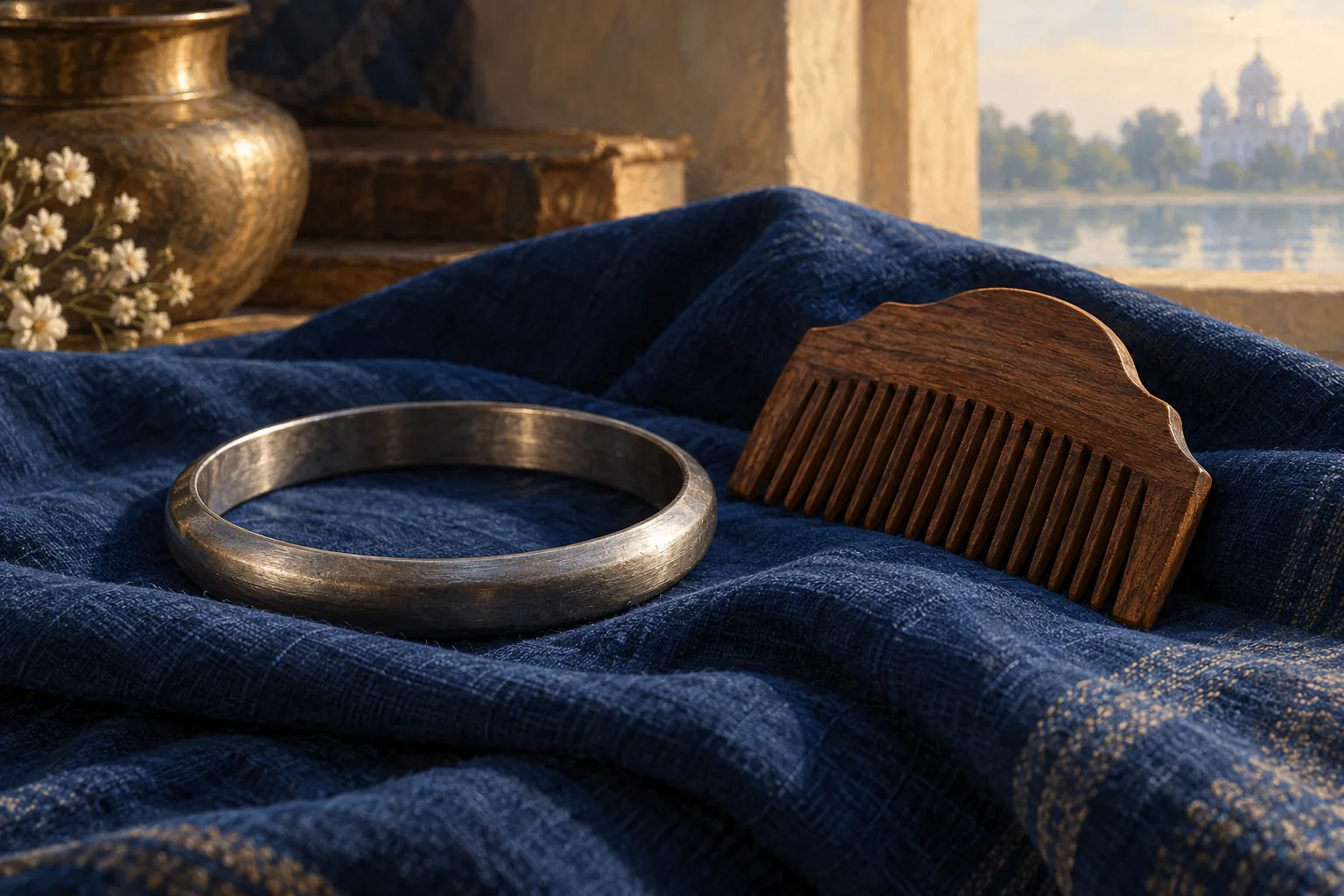
What are the Five Ks?
The Five Ks are Sikh articles of faith whose Punjabi names begin with the same letter: kesh, uncut hair; kanga, a wooden comb; kara, a steel wristband; kachera, an undergarment in the form of shorts; and kirpan, a sword. Spellings in English vary. The list describes articles associated with Khalsa commitment, rather than five separate gods, five books, or five daily prayers. [1]
Harvard's Pluralism Project notes that some Sikhs maintain articles such as uncut hair or the kara without having undergone initiation. This makes the distinction between a religious commitment and a visual identification rule important. Seeing one article does not tell an observer every detail of a person's initiation, practice, or relationship to the tradition. [1]
How the Khalsa enters the story
The Khalsa is associated with Guru Gobind Singh and Baisakhi at Anandpur in 1699. The traditional initiation account centers on the Panj Piare and amrit prepared with water and sugar while a double-edged sword is used. The five people in that account and the Five Ks are related to the same history, but they are not interchangeable terms: one names people, the other articles of faith. [2]
The Pluralism Project connects this initiation with disciplined ethical conduct and the names Singh and Kaur. This setting helps explain why the articles are more than a collection of accessories. They belong to an account of membership, responsibility, and a public commitment to a way of life. A description that stops at their physical appearance misses that context. [2]
What Amritdhari means
The World Sikh Organization of Canada identifies an initiated Sikh as Amritdhari. Its account explicitly includes both women and men in the initiation ceremony and in taking on the articles. It also recalls Guru Gobind Singh asking the first initiates to initiate him. Within that traditional account, commitment is reciprocal: the Guru does not simply impose a practice on others from outside it. [3]
The Five Ks should therefore not be described as an obligation applying only to Sikh men. Amritdhari names a commitment undertaken through initiation, and the WSO account describes women and men participating on the same basis. The term is useful when explaining the relationship between the ceremony and the articles of faith. [3]
Hair, the comb, and the turban
Kesh refers to uncut hair, while the kanga is the comb used in its care. The turban is closely connected with visible Sikh identity, but it is not a replacement for kesh in the five-item list. The Sikh Coalition states that both men and women may wear a turban and links it with a public commitment to compassion, honesty, and service. [4]
How to understand their meaning
The Sikh Coalition describes the articles as cherished gifts from the Guru and cautions against reducing each one to a single practical function or symbolic explanation. A comb can serve the care of hair, yet its religious significance is not exhausted by that function. Likewise, a steel wristband should not be understood merely as jewelry because it shares a material or shape with an ordinary bracelet. [4]
Harvard's account connects the kirpan with protection of the oppressed. That is an ethical explanation of its place in the tradition, not a claim that every kirpan is only decorative. Physical description and religious purpose answer different questions. Recognizing both helps explain why initiated Sikhs can regard the articles as inseparable from their commitment, rather than optional props used only during a ceremony. [1]
Sources & further reading
The numbered links connect claims to the sources below. Sources checked October 14, 2026 by a separate AI fact-checking agent. This is not human or specialist review. Read our editorial approach.
- The Five K’s ↗Harvard University Pluralism Project · Accessed October 14, 2026
- The Khalsa ↗Harvard University Pluralism Project · Accessed October 14, 2026
- What is the Sikh faith? ↗World Sikh Organization of Canada · Accessed October 14, 2026
- Identity ↗The Sikh Coalition · Accessed October 14, 2026
Found a problem? Send a correction with the passage and a supporting source.
Continue your reading
All articles ↗
Sacred texts · 3 min read
What is the Guru Granth Sahib? Scripture, music and Sikh authority
Understand the Guru Granth Sahib as Sikh scripture and living Guru, its compilation, its poetry and music, and its central place in gurdwara worship.
Beliefs & ideas · 4 min read
What is langar? The Sikh community kitchen and shared meal
Learn how langar expresses equality and service, who can join the meal, and what to expect when visiting a gurdwara, including access and dietary questions.