People & places · 3 min read
What Is a Bahá’í House of Worship? Nine Sides, Prayer, and Service
Learn who can enter a Bahá’í House of Worship, why it has nine sides, how devotional gatherings work, and how architecture varies.
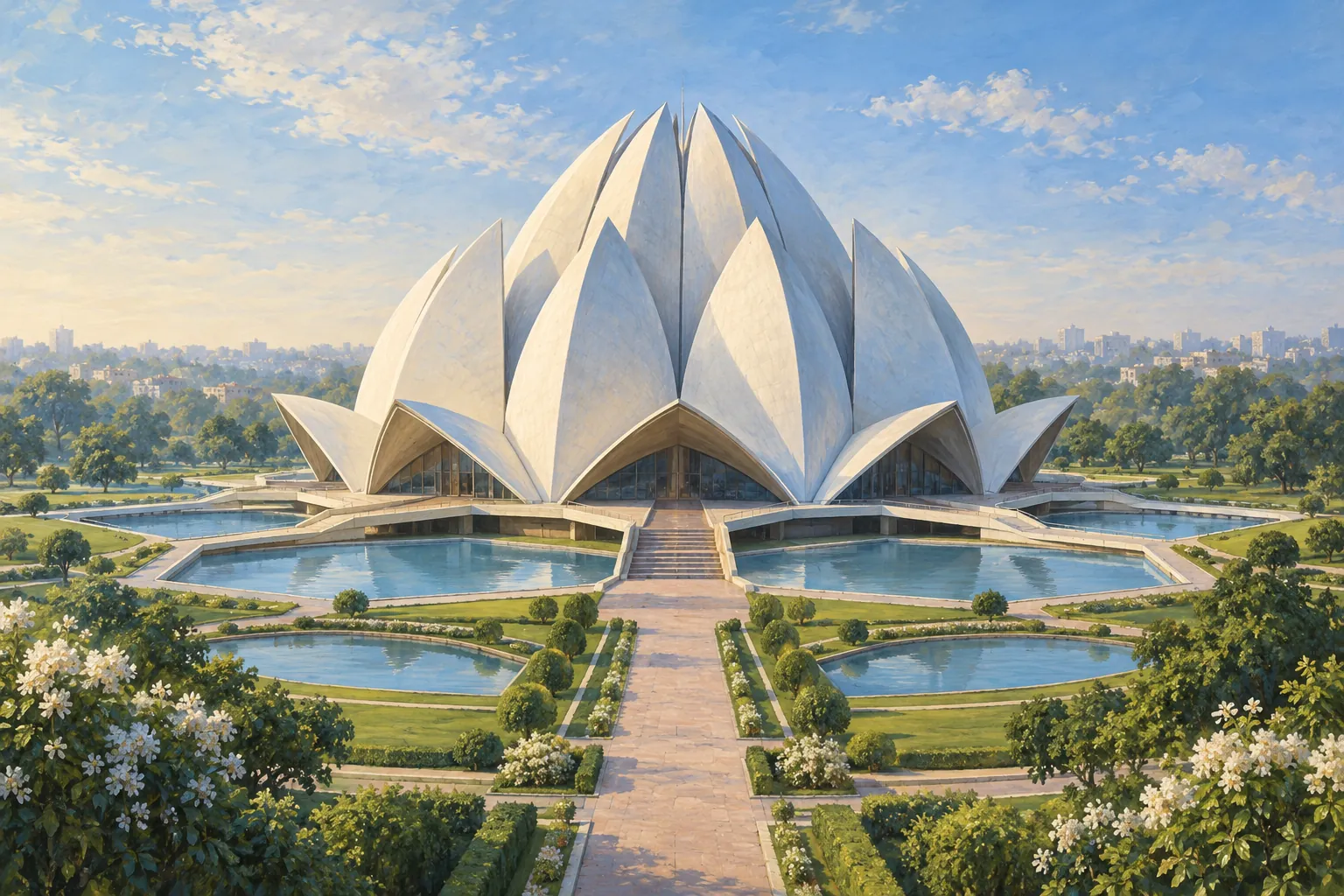
An institution joining worship and service
A Bahá’í House of Worship belongs to the institution called Mashriqu'l-Adhkar, associated with a dawning place for the mention of God. The worldwide Bahá’í community explains it through the relationship between devotion and service. Community prayer and activities of service can develop before a dedicated temple is built. The building is an important expression of the institution, but not its entire meaning. [1]
The same account envisions educational, health, and other facilities around the central devotional building, developing gradually according to circumstances. This is an institutional aim, not a claim that every existing House of Worship already includes a school or hospital. Describing the relationship as a gradual development keeps the religious ideal distinct from the facilities present at a particular location. [1]
Who can participate?
Encyclopaedia Iranica describes worship as open to people regardless of religious affiliation or background. Readings and chants can draw on Bahá’í and other religious scriptures in different languages. Devotional services have no clergy or formal sermons, and choirs may sing without instrumental accompaniment. These features describe the worship setting; they do not make it an unrestricted venue for every kind of event. [2]
The same account distinguishes a movable lectern from a pulpit and describes a worship space without altars, statues, or images. A nine-sided plan is required, but a dome is not essential. This leaves room for substantially different architectural forms. A visitor should therefore not expect every Bahá’í temple to reproduce the silhouette of a familiar example. [2]
Why nine sides?
An explanation in the Bahá’í Reference Library connects nine with completeness and unity, as well as the numerical value of the letters in Baha. It advises against explaining the temple's nine sides as a count of nine existing religions. The number is a theological and numerical symbol, rather than a count or ranking of the world's faiths. [3]
A building, a gathering, and a wider complex
Moojan Momen's Iranica entry explains related uses of Mashriqu'l-Adhkar for devotional gatherings, a dedicated building, and a wider complex. It also distinguishes the House of Worship from an ordinary Bahá’í administrative or meeting center. This helps resolve a practical confusion: a community may hold prayer gatherings without every building it uses being a purpose-built House of Worship. [4]
The early temple at Ashgabat illustrates why construction dates require care. The entry dates the start to 1902, exterior completion to 1907, ornamentation to 1917, and gardens and portico to 1919. The building was later expropriated and eventually demolished in 1963. A single label saying 'completed' can conceal several different stages in a building's history. [4]
Wilmette: ornament and structure
For the House of Worship in Wilmette, Illinois, Louis Bourgeois's design was selected in 1920. The US Bahá’í community describes John Earley's development of ornamental cast-concrete panels using white cement and crushed quartz, supported by a steel structure. Gardens and reflecting pools extend the setting outside. The temple opened on May 2, 1953. Its appearance is the result of specific design and construction decisions, not a universal material requirement. [5]
Chile: a different approach to light
A 2016 Bahá’í World News Service account describes Siamak Hariri's Chile temple through nine wing-like forms, cast glass outside, and white marble inside. The design brief included nine entrances, while daylight and evening illumination shaped the intended architectural effect. Comparing this account with Wilmette shows how a shared institutional purpose and nine-sided requirement can produce different buildings. The descriptions concern architectural intentions, not a guarantee that every visitor will experience the space in the same way. [6]
Sources & further reading
The numbered links connect claims to the sources below. Sources checked October 14, 2026 by a separate AI fact-checking agent. This is not human or specialist review. Read our editorial approach.
- The Mashriqu’l-Adhkár — Bahá’í Houses of Worship ↗Bahai.org — the worldwide Baha'i community · Accessed October 14, 2026
- BAHAISM ix. Bahai Temples ↗Encyclopaedia Iranica · Accessed October 14, 2026
- Directives from the Guardian — 141: Nine (Number) ↗Baha'i Reference Library · Accessed October 14, 2026
- MAŠREQ AL-AḎKĀR ↗Encyclopaedia Iranica · Accessed October 14, 2026
- Architecture ↗Baha'is of the United States — National Spiritual Assembly · Accessed October 14, 2026
- Where spirit and form fuse: Reflections on the architecture of the Chile Temple ↗Baha'i World News Service · Accessed October 14, 2026
Found a problem? Send a correction with the passage and a supporting source.
Continue your reading
All articles ↗
People & places · 3 min read
Which countries are most religiously diverse? How to read the index
Learn what Pew’s religious diversity index measures, why Singapore ranks first in its 2020 data, and what national rankings leave out.
People & places · 3 min read
Stupa vs Pagoda: Buddhist Architecture and Overlapping Names
Understand stupas and pagodas through Sanchi, Horyuji, Shwedagon, miniature Japanese pagodas, and Borobudur.