Comparisons · 4 min read
Advent vs Lent: how the two Christian seasons differ
Compare Advent and Lent in Western Christian traditions: their purposes, lengths, colors and practices, with careful distinctions about fasting and calendars.
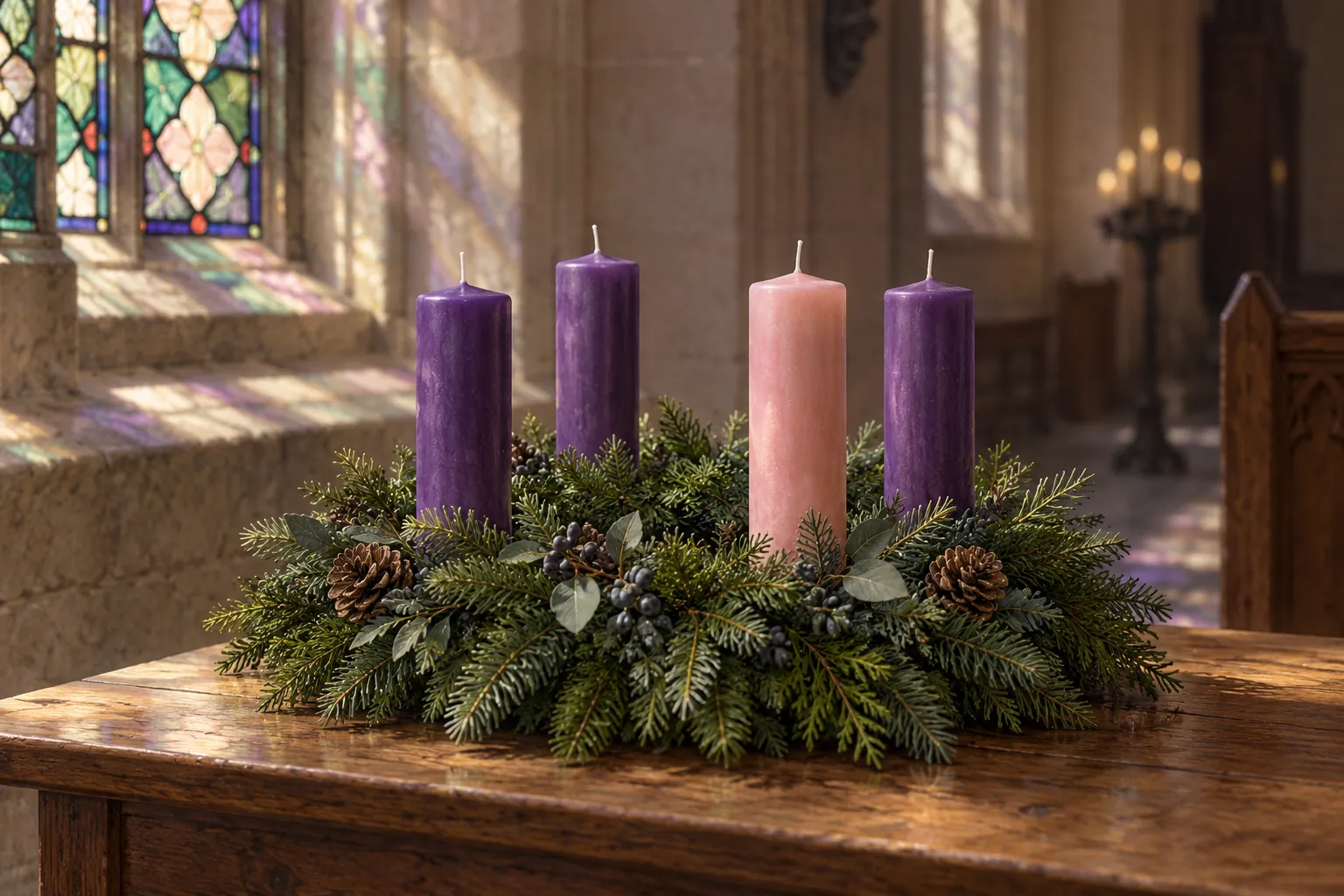
Two seasons of preparation
In Roman Catholic teaching, Advent prepares for Christmas and looks toward Christ’s return; Lent prepares for Easter through penitence, prayer and renewed commitment. The comparison below also draws on Church of England guidance. It concerns named Western traditions; Christians do not all follow one uniform liturgical calendar. [1][4]
The distinction is more useful than “Advent is happy and Lent is sad.” Expectation, self-examination, hope and disciplined preparation can appear in both seasons. The Church of England’s description gives Advent an emphasis on expectation, while its account of Lent connects repentance with reconciliation and preparation for Easter. Their different emphases do not require an absolute opposition of emotions. [3][2]
Advent has four Sundays, not always four full weeks
The United States Conference of Catholic Bishops describes Advent as a season containing four Sundays. Its Roman Rite norms place the beginning with the evening prayer that opens the Sunday on or nearest November 30, and its end before Christmas begins liturgically. Because Christmas can fall on different weekdays, four Sundays does not always mean twenty-eight complete days. [1]
The Church of England likewise describes Advent through the four Sundays before Christmas. That church calendar is not identical to the familiar commercial calendar with twenty-four doors running from December 1 to December 24. For a particular year, check the relevant church’s calendar rather than assuming that the first day of December is always the liturgical beginning. [3]
Lent and the forty-day calculation
In the Roman Rite, Lent begins on Ash Wednesday and ends on Holy Thursday before the Easter Triduum. USCCB guidance distinguishes the liturgical season from the traditional calculation of a forty-day fast. Sundays are part of the season even when they are not counted as fasting days in that calculation. Confusing those categories produces misleading calendar arithmetic. [4]
Church of England material connects the number forty with Jesus’ time in the wilderness and acknowledges variation in the historical calculation and observance. Its practical emphasis includes study, self-examination and preparation for Easter. A comparison should therefore specify whether “forty days” refers to a symbolic pattern, a fasting calculation or a church’s defined liturgical period. [2]
Colors can resemble one another
Purple or violet is familiar in Roman Catholic Advent, and rose may be used on the third Sunday, called Gaudete Sunday. The USCCB’s wreath guidance describes the familiar arrangement of three purple candles and one rose candle, while also allowing white candles. A wreath’s appearance is a practice associated with the season, not its definition. [1]
Church of England Lent guidance names violet as traditional and also allows the unbleached fabrics known as Lenten Array. These examples show why color is a useful clue but an unreliable universal test. Two services with purple hangings need not belong to the same season, and a church using a different permitted arrangement is not necessarily observing a different festival. [2]
Practices and their purposes
Catholic Lent guidance centers prayer, fasting and almsgiving, alongside baptismal preparation and renewal. Lent is therefore more than choosing something enjoyable to stop doing. Its disciplines belong to a wider preparation for Easter and to the community’s worship. Detailed fasting obligations depend on the relevant church and its rules; a general comparison should not turn one jurisdiction’s instructions into a command for all Christians. [4]
The Church of England presents the Christian year as a sequence through which events and themes are encountered in worship. Reading Advent or Lent within that sequence helps explain why a community may change its prayers, readings or atmosphere over time. It also helps distinguish a season of preparation from the celebration toward which it points. [3]
An Eastern comparison needs different terms
The Orthodox Church in America describes a forty-day Nativity Fast leading toward Christmas. Its account includes fasting, anticipation and reflection on Christ’s first and second coming. This is an important example of preparation for the Nativity outside the four-Sunday Western Advent pattern. It should not simply be relabelled as the same calendar under another name. [5]
For a practical comparison, identify the church first, then ask what event the season prepares for, when that community begins it and which practices its guidance describes. Avoid assuming that December means winter for all English-language readers, or that every Christian church uses the same fasting rules. Precise scope makes a short comparison more informative than a supposedly universal chart.
Sources & further reading
The numbered links connect claims to the sources below. Sources checked October 14, 2026 by a separate AI fact-checking agent. This is not human or specialist review. Read our editorial approach.
- What is Advent? ↗United States Conference of Catholic Bishops · Accessed October 14, 2026
- Common Worship: Lent ↗The Church of England · Accessed October 14, 2026
- The Liturgical Year ↗The Church of England · Accessed October 14, 2026
- What is Lent? ↗United States Conference of Catholic Bishops · Accessed October 14, 2026
- Reflection on the Beginning of the Nativity Fast ↗Orthodox Church in America; Metropolitan Tikhon · Accessed October 14, 2026
Found a problem? Send a correction with the passage and a supporting source.
Continue your reading
All articles ↗
Comparisons · 3 min read
Catholic vs Protestant: beliefs, authority and worship
Compare Catholic and Protestant Christianity on Scripture, church authority, sacraments and salvation, with careful attention to differences among Protestants.

Holy days · 3 min read
Why Orthodox Easter often falls on a different date
Understand Julian and Gregorian Easter calculations, ecclesiastical full moons and why modern Passover is not an extra universal rule.

Comparisons · 3 min read
Orthodox vs Catholic: what separates the churches?
Understand Eastern Orthodox and Catholic Christianity, including papal authority, the Filioque, shared traditions and the gradual East–West separation.