Comparisons · 3 min read
Orthodox vs Catholic: what separates the churches?
Understand Eastern Orthodox and Catholic Christianity, including papal authority, the Filioque, shared traditions and the gradual East–West separation.
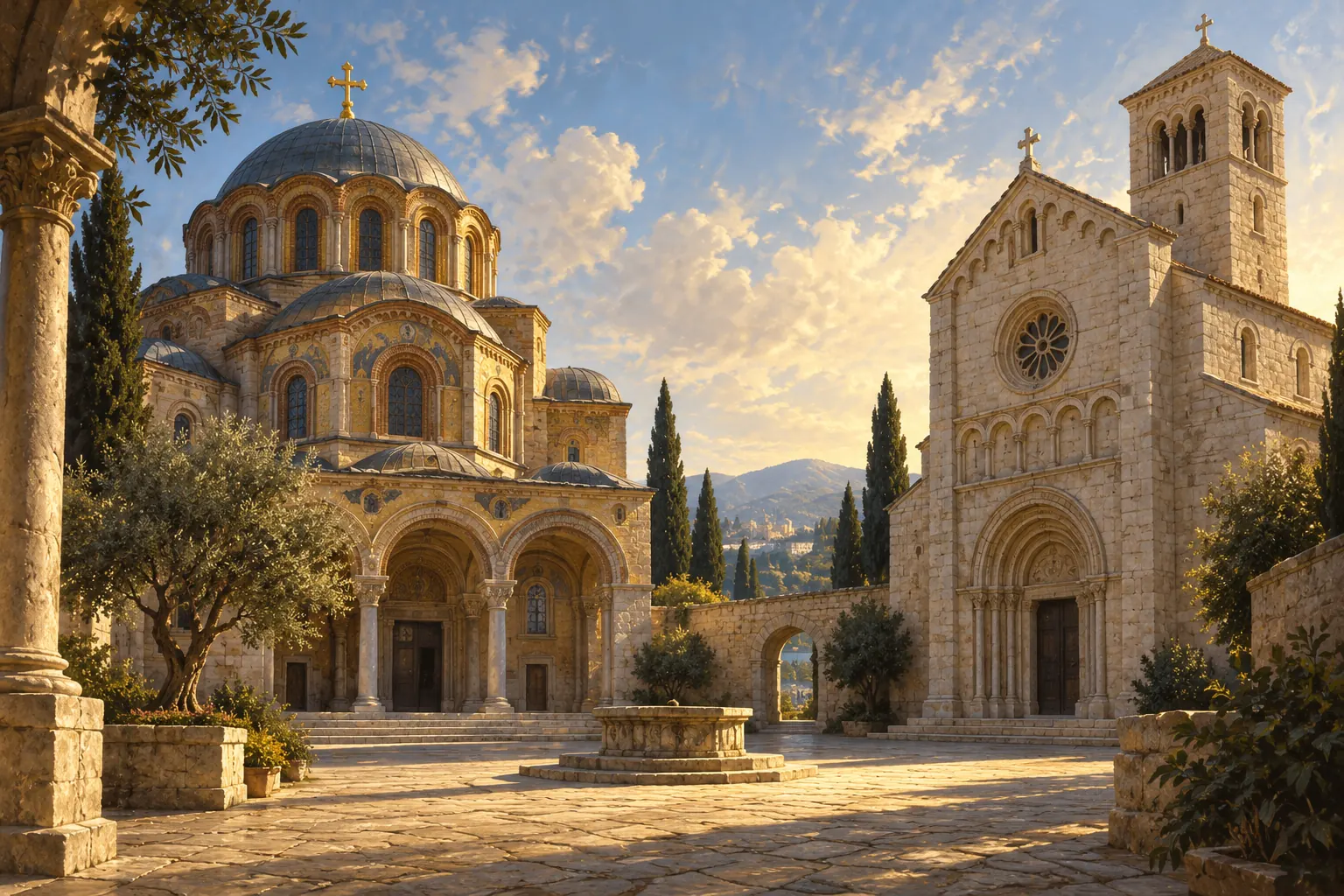
Which Orthodox churches does this mean?
Here, Orthodox means Eastern Orthodox. Eastern Orthodoxy and Roman Catholicism share much of the early Christian inheritance, but disagree over church authority and some theological formulations. Oriental Orthodox churches form a different family and should not be silently folded into an Eastern Orthodox comparison. [2][3]
The first practical step is to identify the actual community. A church's location, language or architectural style is not enough to establish its communion. Keep the name of the church alongside any observation about worship so that a local custom does not become an unsupported claim about an entire tradition.
Why the pope matters
Catholic teaching assigns the bishop of Rome a distinctive universal role in the Church. Eastern Orthodox objections concern the scope of that authority, including universal jurisdiction and definitions made under the Catholic understanding of papal infallibility. The disagreement is more precise than simply saying one side has leaders and the other does not. [1][3]
It helps to distinguish three ideas. Primacy concerns a leading place in the Church; jurisdiction concerns authority to govern. Catholic papal infallibility applies to definitive teaching on faith or morals under specified conditions, not to every papal statement. The OCA source explains Orthodox objections, while the Catholic Compendium states Catholic doctrine. [3][1]
The Filioque and differences in church practice
The Filioque concerns the addition of words meaning “and the Son” to the creed's account of the Holy Spirit's procession. The controversy involves both theology and the authority to alter a shared creed. Treating it as a mere translation preference misses why churches considered the question consequential. [3]
Both traditions have bishops, priests and deacons, but clergy discipline requires a careful comparison. Eastern Orthodoxy ordains married men as priests while choosing unmarried bishops. The Latin Catholic Church normally ordains celibate men to the priesthood; Eastern Catholic churches also have married priests. This is why 'Orthodox priests marry, Catholic priests do not' is too broad: marriage ordinarily precedes ordination in the Eastern practice. [4][5]
Was there a single split in 1054?
The year 1054 is a conventional landmark because of mutual excommunications. The separation itself developed over centuries through disputes and estrangement. It is inaccurate to imagine two fully unified blocs that suddenly became entirely separate overnight, with every later difference already fixed. [2][3]
That longer chronology also helps explain why a modern comparison cannot be reduced to a single event. Use 1054 as a signpost when building a timeline, then ask which disagreement a particular source is actually discussing. Political relationships, communion between churches and theological arguments are related layers of history.
Worship does not map neatly onto East and West
Icons and theosis—the transformation of human life through participation in divine life—are important in Eastern Orthodox spirituality. Eastern Catholic churches also preserve Eastern liturgical traditions while remaining in communion with Rome. A visually Eastern service therefore does not, by itself, identify a congregation as Eastern Orthodox. [2]
Our suggestion is to begin with the community's official identity, then compare its liturgy and doctrine. Use the separate calendar guide for questions about Easter. For biblical books, consult the particular church's stated canon and the edition being used. Keep those questions separate from the question of communion with Rome.
Sources & further reading
The numbered links connect claims to the sources below. Sources checked October 13, 2026 by a separate AI fact-checking agent. This is not human or specialist review. Read our editorial approach.
- Compendium of the Catechism of the Catholic Church ↗Libreria Editrice Vaticana / Holy See · Accessed October 13, 2026
- Orthodox Christian Churches ↗Harvard University, The Pluralism Project · Accessed October 13, 2026
- Essential Orthodox Christian Beliefs ↗Orthodox Church in America · Accessed October 13, 2026
- The Orthodox Faith: Holy Orders ↗Orthodox Church in America · Accessed October 13, 2026
- Catechism of the Catholic Church, 1577–1580: Who Can Receive This Sacrament? ↗Holy See · Accessed October 13, 2026
Found a problem? Send a correction with the passage and a supporting source.
Continue your reading
All articles ↗
Comparisons · 3 min read
Catholic vs Protestant: beliefs, authority and worship
Compare Catholic and Protestant Christianity on Scripture, church authority, sacraments and salvation, with careful attention to differences among Protestants.

Holy days · 3 min read
Why Orthodox Easter often falls on a different date
Understand Julian and Gregorian Easter calculations, ecclesiastical full moons and why modern Passover is not an extra universal rule.

Sacred texts · 3 min read
How many books are in the Bible? Why counts differ
Compare Protestant, Catholic, Orthodox and Jewish collections, and understand why 66, 73 and 24 describe different canons or counting conventions.