
Overview
Sumerian religion is the oldest religious tradition known from written sources, practiced in the city-states of southern Mesopotamia from shortly after 3000 BCE until Sumerian ceased to be a living language around 1900 BCE, with each city centered on the temple of its own patron god. Sumerian myths and ritual forms passed almost intact to the Akkadians, Babylonians and Assyrians, who preserved them in cuneiform for another two millennia.[1–2, 7–8]
History

City-states around the temple c. 3300–2334 BCE
Sumerian speakers were established in southern Mesopotamia by about 3300 BCE, and shortly after 3000 BCE Mesopotamia's recorded history begins; by the third millennium the land held at least a dozen walled city-states, each built around the temple of its own patron god.[1–2]
Akkad and the Third Dynasty of Ur c. 2334–2004 BCE
Sargon of Akkad conquered the Sumerian city-states and built the first Mesopotamian empire; after his dynasty's fall, the Third Dynasty of Ur briefly reunified the south, and it was in this age that most surviving Sumerian literature took the written form in which it survives.[9]
Absorbed into a wider tradition c. 2000–1900 BCE
Sumer's political unity ended when Ur fell around 2000 BCE, and Sumerian ceased to be a living spoken language soon after, even as Sumerian religious vocabulary and temple culture carried on among Akkadian-speaking successors.[7–8]
Key moments
- c. 3300 BCEThe temples of Uruk · Uruk, southern Iraq
- c. 2300 BCEEnheduanna, the first named author · Ur, southern Iraq
- c. 2100 BCEThe Ziggurat of Ur · Ur, southern Iraq
Beliefs
Enlil · En-líl
lord wind
Enlil was worshipped at Nippur's Ekur temple as the god with effective rule over the earth; myth credits him with giving humans the hoe and with sending plague, drought and flood.[4]
Inanna · Inanna
Inanna, goddess of Venus and of Uruk's Eanna temple, is the protagonist of the myth of her descent to the netherworld; the Akkadians worshipped her as Ishtar.[5]
Practice
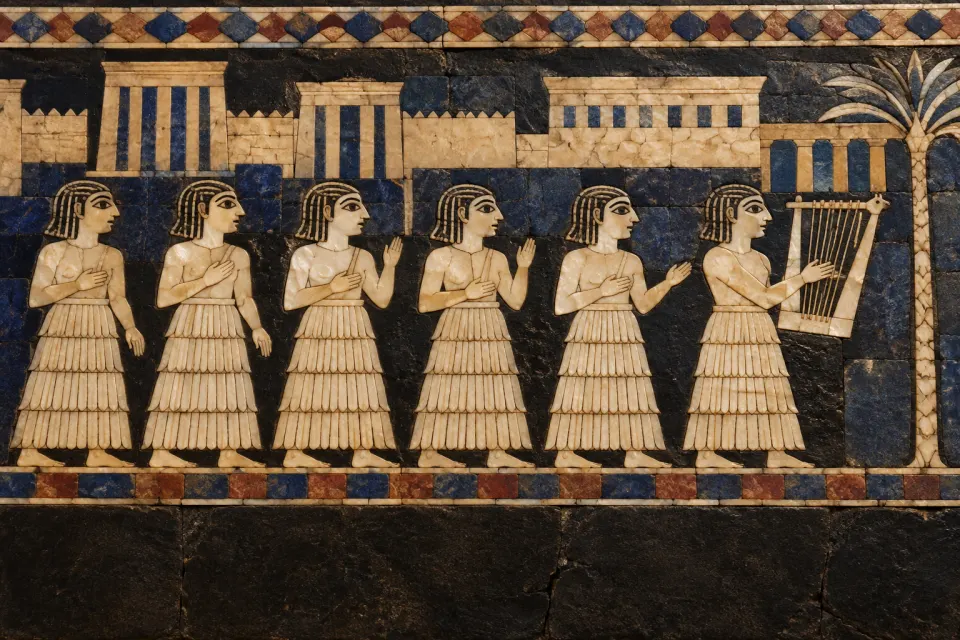
Praise and lament
Professional singers, the encomiast, sang hymns of praise, while a separate class, the elegist, sang laments over destroyed temples and dying fertility gods.[10]
Scripture
The Epic of Gilgamesh
Separate Sumerian poems about the legendary king Gilgamesh of Uruk circulated before being woven, centuries later, into the longer Akkadian epic.[11]
Art & objects
Public-domain objects from museum collections. Select one to see it at the museum.
 Statue of GudeaMesopotamia, Neo-Sumerian, Iraq, Girsu, c. 2144–2124 BCE
 Amulet Seal in the Form of a BullMesopotamia, Sumerian, Iraq, Early Bronze Age I (c. 3300–3000 BCE), c. 3250 BCE
 Bull Procession CupSumerian, Iraq, c. 3100–2900 BCE
 Striding GoatSumerian, Iraq, c. 3200–3000 BCE
 "Foundation Nail" of GudeaMesopotamia, Neo-Sumerian, Iraq, probably Lagash, c. 2100 BCE
 Votive cone with cuneiform inscription of GudeaNeo-Sumerian, Neo-Sumerian, ca. 2090 BCE
 Standing male worshiperSumerian, Early Dynastic I-II, ca. 2900–2600 BCE
 Cuneiform tablet: Sumerian dedicatory(?) inscription from Ekur, the temple of the god EnlilKassite, Kassite, ca. 16th–15th century BCE
 Votive bowlSumerian, Early Dynastic III, ca. 2600–2350 BCE
 Votive cone with cuneiform inscription of Lipit-EshtarIsin-Larsa, Isin-Larsa, ca. 1934–1924 BCE
 Foundation cone with cuneiform inscription of Enmetena of LagashSumerian, Early Dynastic IIIb, ca. 2500–2350 BCE
 Foundation figure of Ur-Namma holding a basketNeo-Sumerian, Ur III, ca. 2112–2095 BCE
 Statue of Gudea, named “Gudea, the man who built the temple, may his life be long”Neo-Sumerian, Neo-Sumerian, ca. 2090 BCE
 Standing female worshiperSumerian, Early Dynastic IIIa, ca. 2600–2500 BCE
How we know
How we know
Knowledge of Sumerian religion rests almost entirely on archaeology and cuneiform tablets excavated since the nineteenth century; most literary copies come from Old Babylonian scribal schools centuries after the texts were first composed.[12]
Common misconceptions
Myth Sumerian ziggurats were tombs, like Egyptian pyramids.
Fact A ziggurat was a stepped temple tower topped by a shrine; kings and commoners were normally buried elsewhere, not inside the ziggurat itself.[6]
Glossary
- ziggurat
- A stepped temple tower, built of mud brick, that rose above a Mesopotamian city as the house of its patron god.[6]
- cuneiform
- The wedge-shaped script, pressed into clay with a reed stylus, used to write Sumerian, Akkadian and other Mesopotamian languages.[13]
- Ekur
- "Mountain house," the temple of the god Enlil at Nippur.[4]
- Sumerian King List
- An ancient Mesopotamian text recording cities and kings believed to have ruled from before a legendary flood onward.[9]
Sources
Each statement above was checked against published sources; the verdict says whether it stood as written, was corrected or was hedged.
- VerifiedBritannica, Sumer; UNESCO World Heritage, The Ahwar of Southern Iraq; Britannica, Mesopotamian religion.
- VerifiedBritannica, Sumer; Encyclopedia.com.
- VerifiedEncyclopedia.com; Britannica, Mesopotamian religion.
- VerifiedEncyclopedia.com; Britannica, Mesopotamian religion.
- VerifiedEncyclopedia.com; Britannica, Mesopotamian religion.
- VerifiedBritannica, Mesopotamian religion; UNESCO World Heritage, Ashur.
- VerifiedBritannica, Sumerian language; Encyclopedia.com.
- VerifiedBritannica, Mesopotamian religion; UNESCO World Heritage, Babylon.
- VerifiedBritannica, Sumer; Encyclopedia.com; Encyclopedia.com.
- VerifiedBritannica, Mesopotamian religion; Encyclopedia.com.
- VerifiedBritannica, Mesopotamian religion; Encyclopedia.com.
- VerifiedBritannica, Mesopotamian religion; UNESCO World Heritage, Babylon.
- VerifiedBritannica, Mesopotamian religion; UNESCO World Heritage, The Ahwar of Southern Iraq.
Last fact-checked 5 October 2026.