
Overview
Babylonian and Assyrian religion carried on the religious tradition of Sumer among Mesopotamia's later Semitic-speaking populations, as Marduk of Babylon and Ashur of Assyria each rose to head their own state's pantheon. Marduk's rise is told in the Enuma Elish, recited yearly at Babylon's Akitu festival, while much of what survives of this tradition comes down through the library the Assyrian king Ashurbanipal assembled at Nineveh.[2–7]
History

From Sumer to Babylon and Assyria c. 2000–1750 BCE
After Sumerian political unity ended around 2000 BCE, Babylon in the south and Ashur in the north emerged as successor states inheriting Sumerian religion largely intact, and Babylon's king Hammurabi built the city into a lasting power, his law code showing him before the sun god Shamash.[6, 8]
Neo-Babylonian height and the end of native rule 626 BCE – 1st century CE
Nebuchadnezzar II rebuilt Babylon and its temples at the height of Neo-Babylonian power before Persia's Cyrus took the city in 539 BCE, after which Mesopotamia passed through Achaemenid, Seleucid and Parthian rule into the early centuries CE.[1, 9]
Key moments
- c. 2300 BCEEnheduanna, the first named author · Ur, southern Iraq
- c. 2100 BCEThe Ziggurat of Ur · Ur, southern Iraq
- c. 1800 BCEThe Epic of Gilgamesh · Babylonia
- c. 575 BCEBabylon's New Year festival · Babylon, Iraq
- 539 BCEThe Cyrus Cylinder · Babylon, Iraq
- c. 79 CEThe last cuneiform tablet · Uruk, Iraq
Practice
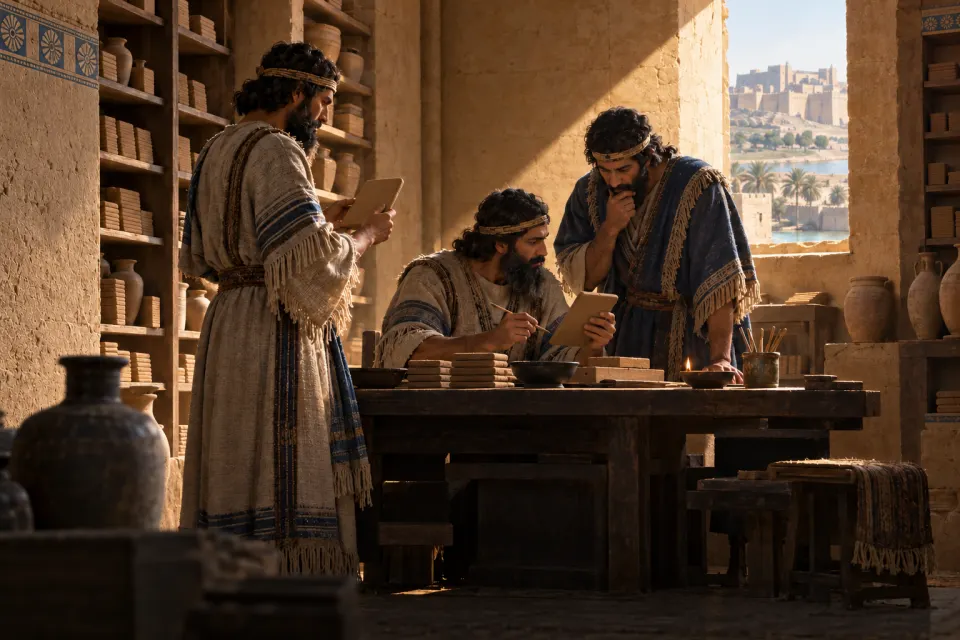
Omens and scholarship
Priests and scribes compiled large collections of omen texts, treating unusual events as divine messages; this scholarly activity is attested in the cuneiform archives of cities such as Ashur and Nineveh.[10]
Scripture
Enuma Elish · Enūma Eliš
attested by the 12th century BCE
Babylon's creation epic names Marduk supreme among the gods after his defeat of the chaos-monster Tiamat.[4]
Places
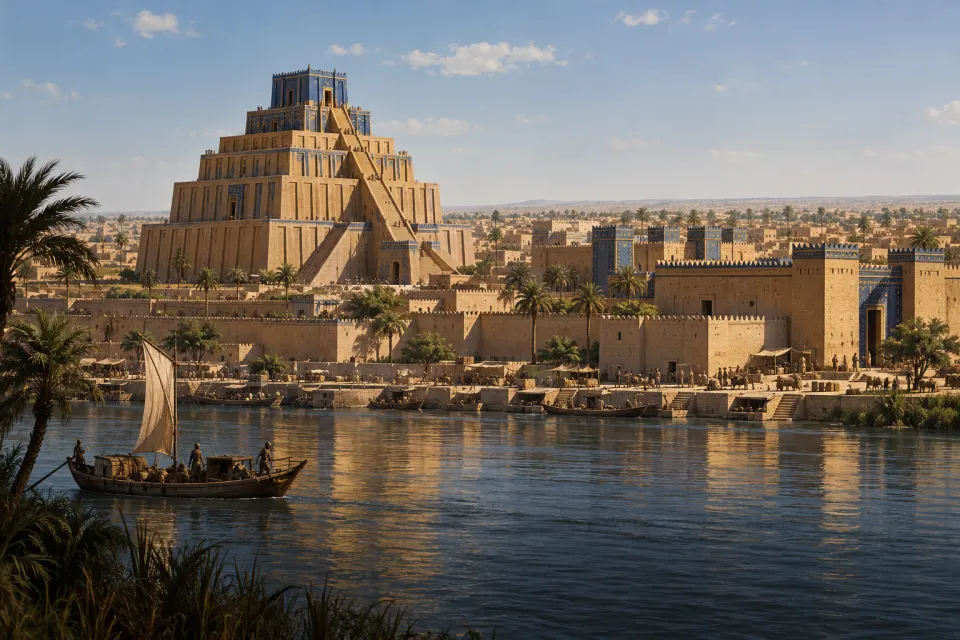
Babylon (Esagila and Etemenanki)
IRQ · UNESCO World Heritage, 2019
Babylon's temple complex housed the Esagila, Marduk's sanctuary, beside the ziggurat Etemenanki, likely the model behind the Tower of Babel story.[11]
Art & objects
Public-domain objects from museum collections. Select one to see it at the museum.
 Relief Showing the Head of a Winged GeniusNimrud, Neo–Assyrian Period, reign of King Ashurnasirpal II (883–859 BCE)
 Saluting Protective SpiritNeo-Assyrian (911–609 BCE), Iraq, Nimrud, Northwest Palace, reign of Ashurnasirpal II (883–859 BCE), 883–859 BCE
 Amulet with fighting demons; on reverse: Ishtar enthroned and worshiperAssyrian, Neo-Assyrian, ca. 8th–7th century BCE
 Stamp seal (octagonal pyramid) with cultic sceneAssyro-Babylonian, Neo-Assyrian / Neo-Babylonian, late 8th–7th century BCE
 Cuneiform tablet: Old Babylonian balag to the mother goddess AruruBabylonian, Old Babylonian, ca. 19th–16th century BCE
 Cuneiform tablet: Gula incantationBabylonian or Achaemenid, Neo-Babylonian or Achaemenid, ca. mid- to late 1st millennium BCE
 Cuneiform tablet: a-she-er gi-ta, balag to Innin/IshtarSeleucid or Parthian, Seleucid or Parthian, ca. 2nd–1st century BCE
 Cuneiform tablet: hymn to MardukBabylonian (?), Neo-Babylonian (?), 1st millennium BCE
 Cuneiform tablet: Atra-hasis, Babylonian flood mythBabylonian or Achaemenid, Neo-Babylonian or Achaemenid, ca. 7th–6th century BCE
 Cast reconstruction of Babylonian Flood Tablet19th century, after 7th century BCE original
 Panel with striding lionBabylonian, Neo-Babylonian, ca. 604–562 BCE
 Apkallu figure: bird-headed, winged figure carrying a bucketAssyrian, Neo-Assyrian, ca. 9th–8th century BCE
 Cylinder seal and modern impression: goddess leading a worshiper to a seated deity; bull godOld Assyrian Trading Colony, Middle Bronze Age–Old Assyrian Trading Colony, ca. 20th–19th century BCE
 Cylinder seal and modern impression: suppliant goddess and offering bearer approaching Ishtar, three columns of inscriptionBabylonian, Old Babylonian, ca. early 2nd millennium BCE
Common misconceptions
Myth The Tower of Babel was a real building called "Babel" that collapsed.
Fact The biblical story is widely thought to draw on Babylon's real ziggurat, the Etemenanki; there is no record of such a tower collapsing.[11]
Glossary
- Akitu · akitu
- Babylon's eleven-day New Year festival in spring, centered on Marduk and Nabu.[5]
- Enuma Elish · Enūma Eliš
- "When on high," the Babylonian creation epic recounting Marduk's defeat of Tiamat and rise to supreme kingship among the gods.[4]
- Esagila
- Marduk's main temple at Babylon, beside the ziggurat Etemenanki.[11]
- Bel
- "Lord," a later title for Marduk.[2]
Sources
Each statement above was checked against published sources; the verdict says whether it stood as written, was corrected or was hedged.
- VerifiedUNESCO World Heritage, Babylon; Britannica, Mesopotamian religion.
- VerifiedBritannica, Marduk; Encyclopedia.com.
- VerifiedUNESCO World Heritage, Ashur; Britannica, Mesopotamian religion.
- VerifiedBritannica, Marduk; Encyclopedia.com.
- VerifiedEncyclopedia.com; Britannica, Marduk.
- VerifiedBritannica, Mesopotamian religion; UNESCO World Heritage, Babylon.
- VerifiedBritannica, Mesopotamian religion; Encyclopedia.com.
- VerifiedBritannica, Mesopotamian religion; UNESCO World Heritage, Babylon.
- VerifiedUNESCO World Heritage, Babylon; Britannica, Marduk.
- VerifiedBritannica, Mesopotamian religion; UNESCO World Heritage, Ashur.
- VerifiedBritannica, Marduk; UNESCO World Heritage, Babylon.
Last fact-checked 5 October 2026.