
Overview
Inca religion was the state religion of Tawantinsuyu, the Inca empire centred on Cuzco in the Peruvian Andes, from the 15th century until the Spanish conquest of 1532–72. It combined animism, ancestor veneration and the worship of nature gods under a state sun cult: Inti the sun was the divine ancestor of the ruling dynasty, honoured alongside the creator god Viracocha, the earth mother Pachamama, and countless local huacas, sacred places, objects or mummies. The emperor ruled as the Sun's living descendant, and priests ran sacrifice, divination and confession across a network of temples radiating from Cuzco's Coricancha. The conquest and a Spanish campaign against "idolatry" dismantled the state cult, but Quechua-speaking Andean communities today still blend Catholicism with reverence for Pachamama and local huacas.[1–2, 4–5, 8–10]
History

Origins at Cuzco 12th–14th century
By Inca tradition, their ancestors emerged from Paqari-tampu near Cuzco under the founder Manco Cápac, who led them to found the city, Tawantinsuyu's future capital, around 1200. For generations the Inca differed little from other small Andean societies; according to Spanish-era chronicles, they had no system of writing and left their early history to memory rather than record.[7, 11]
Pachacuti and the state sun cult 1438–1493
Pachacuti Inca Yupanqui became emperor in 1438 after organizing Cuzco's defence against the invading Chanca and winning a decisive victory over them; he then rebuilt Cuzco and went on to conquer south to Lake Titicaca and far to the north. Subject peoples had to honour the sun and serve the state, but their own local gods and huacas were generally tolerated rather than suppressed.[12–13]
Spanish conquest 1532–1533
A bitter succession war between the half-brothers Huáscar and Atahualpa, based respectively at Cuzco and Quito, had weakened the empire and was close to being settled in Atahualpa's favour when Francisco Pizarro's small Spanish force, fewer than 200 men, reached Cajamarca in 1532. The Spanish captured Atahualpa there and executed him in 1533, then took Cuzco and began a campaign against Inca religious institutions, destroying temples and idols as "idolatry."[14–15]
Suppression and continuity 1533–present
A remnant Inca state held out at Vilcabamba until 1572. Despite the dismantling of the state cult and official campaigns against native worship, rural Andean communities kept some practices alive in secret through the colonial period. Today, Quechua-speaking Andean communities remain a major part of Peru's population, and their religion is generally Roman Catholicism combined with the older hierarchy of spirits and deities.[9, 16]
Key moments
- c. 1450 CEMachu Picchu and the Inca gods · Andes, Peru
Beliefs
Inti
The sun god, held to be the divine ancestor of the ruling Inca dynasty; the emperor's title drew legitimacy from being called a child of the sun, and farmers prized Inti's warmth for ripening crops.[5, 10]
Viracocha
The creator god and culture hero, credited with shaping the earth, humans and animals, destroying and remaking peoples, and teaching skills before departing westward.[17]
huaca
A sacred place, object, or ancestor, which could be a mountain, spring, stone, bridge or mummy bundle; huacas were bound up with local identity, since families and communities traced descent from their own huaca, and travellers left small stone offerings at sacred passes.[4, 18]
Practice
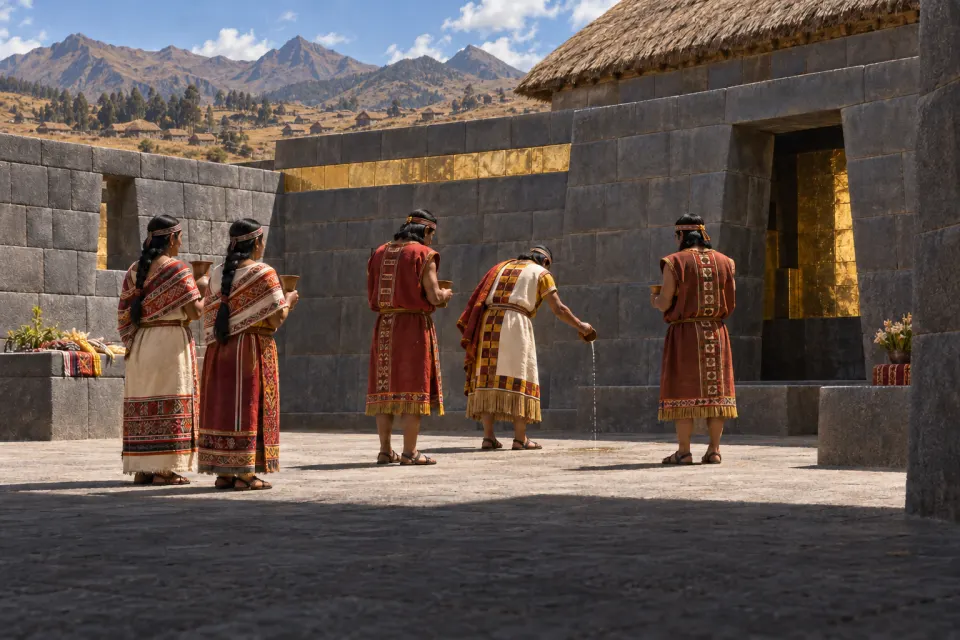
State sun cult at the Coricancha
Priests and the Chosen Women served at temples such as Cuzco's Coricancha, the empire's chief shrine, where communion rites with the sun helped bind the empire's many peoples to Cuzco.[3, 8]
Sacrifice
Llamas, guinea pigs, coca leaves and chicha, a corn beer, were offered on ordinary occasions, but human sacrifice, including of children, marked extreme crises such as famine or a new ruler's accession; sacrificial victims were required to be physically unblemished, and many were drawn from conquered provinces as a form of tribute.[19]
Divination and confession
Priests called umu practised divination before any important decision, reading the lungs of sacrificed llamas, watching spiders or coca leaves, or consulting oracles housed at huacas; ritual error, hocha, had to be confessed and atoned for, since the Inca believed unconfessed wrongdoing could bring drought or disaster on the community.[20]
People
Inti
deity
The sun god and head of the Inca pantheon, represented as a human face on a golden, ray-splayed disk and worshipped as the divine ancestor of the ruling dynasty.[10]
Viracocha
deity
Creator god of the Inca and of the peoples before them, a culture hero credited with shaping and reshaping humanity before departing westward across the Pacific.[17]
Pachacuti Inca Yupanqui
ruler · r. 1438–1471
The Inca ruler who defeated the invading Chanca and became emperor in 1438, then rebuilt Cuzco and conquered south to Lake Titicaca and far to the north.[12]
Felipe Guamán Poma de Ayala
scholar · c. 1535–after 1616
An Indigenous Andean chronicler whose illustrated manuscript, El primer nueva corónica y buen gobierno, is a major source for the Inca religious calendar and festivals, written from inside Andean culture though addressed to the Spanish king.[21]
Scripture
El primer nueva corónica y buen gobierno
completed c. 1615
An illustrated chronicle by the Andean nobleman Felipe Guamán Poma de Ayala, addressed to the Spanish king, describing Inca government, the religious calendar and festivals in detail; translated in abridgement as Letter to a King, it is a key source precisely because it was written by someone raised within Andean tradition.[21]
Comentarios Reales de los Incas
published 1609–1617
A history by Garcilaso de la Vega, son of an Inca noblewoman and a Spanish captain, drawing on his mother's teaching and Inca oral tradition to describe Inca religion and government for a European readership; later readers have found its idealised, almost utopian picture of Inca rule as telling as its facts.[22]
Places
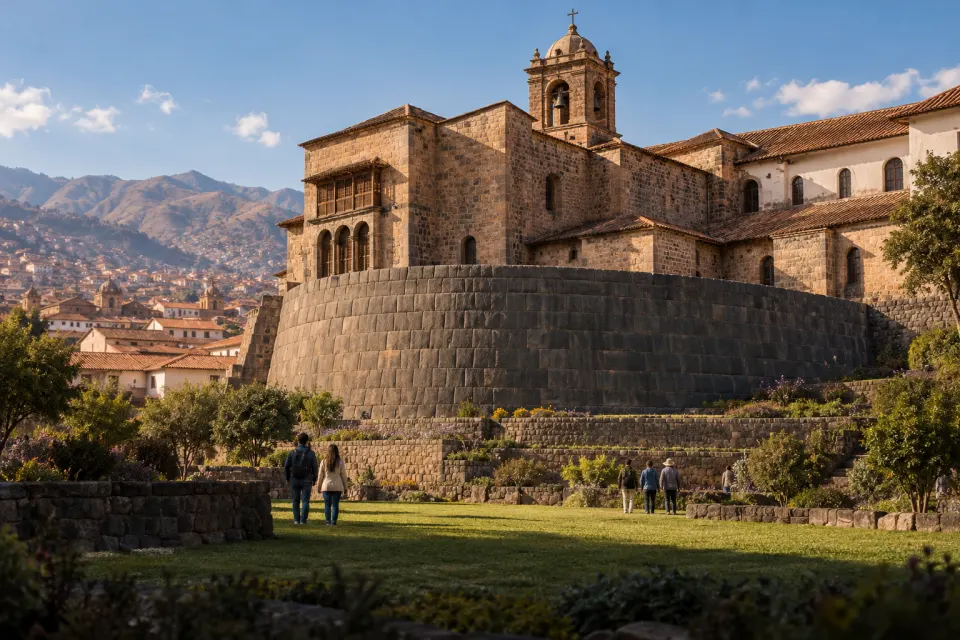
Coricancha, Cuzco
PER · UNESCO World Heritage, 1983
The "Golden Enclosure," chief temple of the Inca state religion, dedicated to Viracocha and Inti and once sheathed in gold and silver; after the conquest the Spanish built the church of Santo Domingo over its foundations, which are still visible today.[3, 23]
Machu Picchu
PER · UNESCO World Heritage, 1983
A royal estate and religious, ceremonial and astronomical centre built in the 15th century, probably under Pachacuti, high in the Andes; abandoned after the Spanish conquest and unknown outside Peru until its rediscovery in 1911.[24]
Art & objects
Public-domain objects from museum collections. Select one to see it at the museum.
 Female FigurinePeru, 1450–1532
 Offering Vessel in the Form of an AlpacaCuzco, 1450–1532
 Paccha Representing a Woman Carrying a Vessel and Nursing a ChildPeruvian North Coast, 1200–1450
 Inka Khipu (Fiber Recording Device)Peru, Inca Period, 15th-16th Century, c. 1400–1532
 Seated FigurinePeru, Inca, 15th-16th century, c. 1400–1540
 Alpaca Offering Container (Canopa)Peru, Inka style (1400-1532), 1400–1532
 Miniature male effigyInca, 1400–1535 CE
 Miniature female effigyInca, 1400–1535 CE
 Miniature camelid effigyInca, 1400–1535 CE
 Funerary staffInca, 1400–1535 CE
 Funerary staffInca, 1400–1535 CE
 Kero (beaker)Inca, 1400–1535 CE
 Paccha (ritual vessel)Inca, 1400–1535 CE
 Votive checkerboard tunicInca, 1460–1626
How we know
No writing, and chroniclers' bias
The Inca, like other Andean cultures, left no system of writing; their knotted-cord quipu recorded numbers and accounts, not narrative. Almost everything known about Inca religion was written down after the conquest by Spanish or mixed-heritage chroniclers working from oral tradition and official Spanish investigations ordered in 1549 and the 1570s, so modern historians treat each account's distance from events, and its author's own agenda, as part of the evidence.[7, 25]
Archaeology and the chroniclers compared
Standing remains help test the chronicles: the Coricancha's foundations beneath Cuzco's Santo Domingo church and the ruins of Machu Picchu confirm the scale and religious function described by Spanish-era writers, while ongoing excavation continues to refine or correct details the chroniclers could not have known or recorded accurately.[23–24]
Common misconceptions
Myth The Inca worshipped only the sun god.
Fact Inti headed the state cult, but Inca religion also honoured the creator Viracocha, the earth mother Pachamama, and countless local huacas; conquered peoples were required to honour the sun and serve the state but were generally allowed to keep their own gods alongside it.[2, 4, 13]
Myth Inca religion vanished completely after the Spanish conquest.
Fact Despite the destruction of the state cult and temples, rural Andean communities kept elements of the old religion alive through the colonial period in secret, and Quechua-speaking communities today still combine Catholic worship with reverence for Pachamama and local huacas.[9, 16]
Glossary
- Inti
- The Inca sun god, held to be the divine ancestor of the ruling dynasty and head of the state pantheon.[10]
- Viracocha
- The Inca and pre-Inca creator god and culture hero, credited with shaping humanity and the world.[17]
- Pachamama
- The earth mother, still widely honoured in Andean communities today alongside Catholic worship.[2, 9]
- huaca
- A sacred place, object or ancestor, such as a mountain, spring, stone or mummy bundle, bound up with local and family identity.[4]
- quipu · khipu
- A device of knotted and coloured cords used by Inca officials to record numbers and accounts; it did not record narrative text.[25]
- Sapa Inca
- The title of the Inca emperor, understood as a living descendant of the sun god Inti.[5]
- ayllu
- A basic Andean social and landholding unit, whose members' ritual conduct was believed to affect the group's wellbeing.[20]
Sources
Each statement above was checked against published sources; the verdict says whether it stood as written, was corrected or was hedged.
- VerifiedBritannica, Inca; Encyclopedia.com, Inca Religion.
- VerifiedBritannica, Inca religion; Encyclopedia.com, Inca Religion.
- VerifiedBritannica, Cuzco; UNESCO, City of Cuzco.
- VerifiedBritannica, Inca religion; Encyclopedia.com, Inca Religion.
- VerifiedBritannica, Inca religion; Encyclopedia.com, Inca Religion.
- VerifiedBritannica, Inca; UNESCO, Historic Sanctuary of Machu Picchu.
- VerifiedBritannica, Inca; Museo Larco, Inca Quipus.
- VerifiedBritannica, Inca religion; Encyclopedia.com, Inca Religion.
- CorrectedBritannica, Inca; Encyclopedia.com, Inca Religion.
- VerifiedBritannica, Inca religion; Encyclopedia.com, Inca Religion.
- VerifiedBritannica, Inca; Encyclopedia.com, Manco Capac.
- CorrectedBritannica, Inca; Encyclopedia.com, Incas, The; Metropolitan Museum of Art, Central and Southern Andes, 1400–1600 A.D.; EBSCO, Pachacuti (supporting).
- VerifiedBritannica, Inca; Metropolitan Museum of Art, Central and Southern Andes, 1400–1600 A.D.; Encyclopedia.com, Incas, The; EBSCO, Pachacuti (supporting).
- CorrectedBritannica, Inca; Metropolitan Museum of Art, Central and Southern Andes, 1400–1600 A.D.; Encyclopedia.com, Atahualpa; Encyclopedia.com, From the Conquest Through Independence; EBSCO, Pizarro Conquers the Incas in Peru (supporting).
- VerifiedBritannica, Inca; Encyclopedia.com, Atahualpa; Encyclopedia.com, Cuzco; Encyclopedia.com, Inca Religion; EBSCO, Pizarro Conquers the Incas in Peru (supporting).
- VerifiedBritannica, Inca; Encyclopedia.com, Inca Religion.
- VerifiedBritannica, Inca religion; Encyclopedia.com, Inca Religion.
- VerifiedBritannica, Inca religion; Encyclopedia.com, Inca Religion.
- VerifiedBritannica, Inca religion; Encyclopedia.com, Inca Religion.
- VerifiedBritannica, Inca religion; pmc.ncbi.nlm.nih.gov.
- VerifiedBritannica, Inca religion; Encyclopedia.com, Guaman Poma de Ayala, Felipe.
- VerifiedEncyclopedia.com, Inca Garcilaso de la Vega; Britannica, Cuzco.
- VerifiedBritannica, Cuzco; UNESCO, City of Cuzco.
- VerifiedUNESCO, Historic Sanctuary of Machu Picchu; Britannica, Machu Picchu.
- VerifiedBritannica, Inca; Museo Larco, Inca Quipus.
Last fact-checked 4 October 2026.