
Overview
Ibadi Islam traces back to a moderate current within the Khārijite movement that arose from the disputes following the Prophet's death, and it is the only branch of that movement to survive into the present, alongside Sunni and Shia Islam. Formed in Basra under the scholar Jābir ibn Zayd, Ibadis rejected the violent tactics of other Khārijites and, unlike them, never declared other Muslims unbelievers for disagreeing. Ibadis hold that any believer of upright character may be elected imam, regardless of tribe or ancestry. From Basra the tradition spread to Oman, where it has shaped political and religious life for over a thousand years, and to pockets of North Africa and East Africa, where small Ibadi communities remain today.[1–6]
History
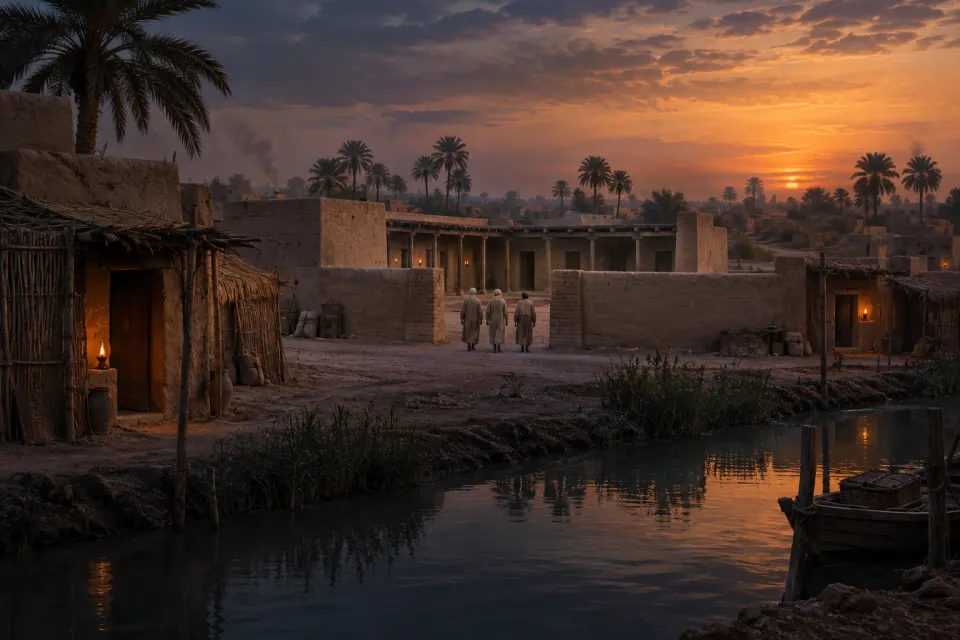
Origins in Basra 7th century
After the First Civil War that followed the killing of the caliph ʿUthmān, a hard-line faction, the Khārijites, broke away in protest over the arbitration that ended the fighting. A quietist current among them, centred in Basra, rejected the armed insurrection and political killing favoured by more militant Khārijites and came to be called Ibāḍiyya, after its political figurehead ʿAbdallāh ibn Ibāḍ. Its spiritual leader, the scholar Jābir ibn Zayd, who died around 712, was respected for his learning even by mainstream Muslim jurists.[1–2, 5]
Oman's Ibadi imamate mid-8th century–1970
From the mid-eighth century, Oman was governed by elected Ibadi imams who combined religious and political authority, though hereditary dynasties periodically displaced the elective principle. In 1749 Aḥmad ibn Saʿīd, having driven out Persian occupiers, was elected imam and founded the Āl Bū Saʿīd dynasty that rules Oman to this day. His successors increasingly styled themselves sultans based on the coast while rival imams periodically arose in the interior, and the two strands of authority were not fully reconciled until Sultan Qābūs took power in 1970.[7–10]
Ibadis beyond Oman 18th century–today
Omani Ibadis carried their tradition across the Indian Ocean: from 1698 Oman controlled Zanzibar, and after 1840 the Āl Bū Saʿīd sultans ruled an East African empire there until 1964. Zanzibar's sultans employed Ibadi qadis alongside Shafiʿi ones. Far smaller Ibadi communities have persisted in North Africa since the early centuries of Islam, in the Mzab valley of Algeria, the Nafūsa mountains of Libya, and the island of Jerba in Tunisia.[4, 11–12]
Beliefs
The elected imamate
Ibadis hold that leadership of the community belongs to whichever believer is most upright and learned, regardless of tribe, lineage or ethnicity, and that an unjust imam may be deposed. This stands apart from the hereditary claims made within Shia Islam and from the broader communal consensus Sunnis look to.[3]
A moderate middle position
Unlike other Khārijite groups, who regarded disagreement as unbelief, Ibadis have always considered Muslims who reject their teaching to remain within the Islamic community. Ibadi doctrine differs from Sunni teaching mainly on technical points of theology and law, with little effect on everyday religious practice.[6]
Practice

Coexistence in Oman
Ibadi, Sunni and Shia Omanis have long lived and worshipped side by side, and Oman's modern state, especially under Sultan Qābūs, has promoted religious tolerance at home, including freedom of worship for other faiths, as a hallmark of national identity.[13]
People
Jābir ibn Zayd · جابر بن زيد
founder · d. c. 712
A Basra-based scholar of Omani descent, Jābir ibn Zayd became the Ibadi movement's first imam and spiritual guide, valued for his learning on law and religion even by Muslims outside Khārijite circles.[2]
ʿAbdallāh ibn Ibāḍ · عبدالله بن إباض
other
The movement's political figurehead in Basra during the late 7th century, ʿAbdallāh ibn Ibāḍ gave the Ibadiyya its name, though its intellectual leadership rested with Jābir ibn Zayd.[2]
Places

Basra
IRQ
The Iraqi garrison city where the quietist Khārijite current later known as Ibadiyya took shape under Jābir ibn Zayd in the late 7th century.[1–2]
Stone Town, Zanzibar
TZA · UNESCO World Heritage, 2000
Capital of the Omani Āl Bū Saʿīd sultans who ruled Zanzibar from 1840 to 1964, Stone Town's mixed Arab, African, Indian and European heritage reflects the Ibadi sultanate's long reach across the Indian Ocean.[11]
Common misconceptions
Myth Ibadis are simply another Khārijite sect, prone to the violent extremism associated with that name.
Fact Ibadis descend from the quietist wing of the Khārijite movement, which from the outset rejected the armed insurrection and political killing of more militant Khārijites, and Ibadi doctrine has never anathematised other Muslims as unbelievers for disagreeing with it.[5–6]
Myth Ibadi Islam exists only in Oman.
Fact While Oman is the only country where Ibadis form a large share of the population, communities with centuries of continuous history survive in Algeria's Mzab valley, Libya's Nafūsa mountains and the Tunisian island of Jerba, and the Ibadi tradition shaped Zanzibar for over a century under Omani rule.[4]
Glossary
- Ibāḍiyya · الإباضية
- The school descending from the quietist wing of the Khārijite movement, named for ʿAbdallāh ibn Ibāḍ; the only Khārijite-descended tradition to survive to the present.[1]
- Khārijite · خوارج
- "Those who went out": the broad movement that broke from the mainstream community after the First Civil War over the arbitration ending it; most of its branches have since disappeared.[1]
- Imamate (elected) · إمامة
- In Ibadi doctrine, leadership held by whichever believer is most pious and learned, open to any lineage, and revocable if the imam proves unjust.[3]
- Mzab · مزاب
- A valley in central Algeria where an Ibadi community has lived continuously since the early centuries of Islam.[4]
- Jebel Nafūsa · جبل نفوسة
- A mountain range in northwestern Libya with a long-standing Ibadi population.[4]
- Jerba · جربة
- A Tunisian island with a historic Ibadi community.[4]
Sources
Each statement above was checked against published sources; the verdict says whether it stood as written, was corrected or was hedged.
- VerifiedEncyclopedia.com, Ibadiyya; Oxford Bibliographies, The Kharijites and Contemporary Scholarship.
- VerifiedOxford Bibliographies, The Kharijites and Contemporary Scholarship; Encyclopedia.com, Ibadiyya.
- VerifiedEncyclopedia.com, Ibadiyya; Britannica, Oman: Restoration of Omani rule, extract.
- VerifiedEncyclopedia.com, Ibadiyya; Britannica, North Africa: The Rustamid state of Tahart, extract.
- VerifiedOxford Bibliographies, The Kharijites and Contemporary Scholarship; Encyclopedia.com, Ibadiyya.
- VerifiedOxford Bibliographies, The Kharijites and Contemporary Scholarship; Encyclopedia.com, Ibadiyya.
- VerifiedBritannica, Oman: Restoration of Omani rule, extract; Encyclopedia.com, Ibadiyya.
- VerifiedBritannica, Aḥmad ibn Saʿīd, extract; Cambridge University Press, Jones & Ridout, A History of Modern Oman, ch. 1 Oman and the Al Bu Said; Encyclopedia.com, Worldmark Encyclopedia of Nations, Oman; EBSCO Research Starters, Sa'id Becomes Ruler of Oman (supporting).
- VerifiedBritannica, Oman: Restoration of Omani rule, extract; Encyclopedia.com, Worldmark Encyclopedia of Nations, Oman; EBSCO Research Starters, Sa'id Becomes Ruler of Oman (supporting).
- VerifiedBritannica, Qaboos bin Said, extract; Encyclopedia.com, Sultan of Oman Qaboos bin Said.
- VerifiedBritannica, Oman: Restoration of Omani rule, extract; Encyclopedia.com, Zanzibar, Saʿidi Sultanate of.
- VerifiedBritannica, Oman: Restoration of Omani rule, extract; Encyclopedia.com, Zanzibar, Saʿidi Sultanate of.
- VerifiedBritannica, Qaboos bin Said, extract; Encyclopedia.com, Sultan of Oman Qaboos bin Said.
Last fact-checked 3 October 2026.