
Overview
Hittite religion was practised across Bronze Age Anatolia under the Hittite kingdom and empire until about 1200 BCE, and is known mainly from royal clay-tablet archives unearthed at the capital, Hattusa, from 1907. Rather than merge the gods of the many peoples it ruled, the Hittite state worshipped them side by side, so that Hattian, Hurrian, Luwian and Indo-European Hittite deities together produced an unusually crowded pantheon. At its head stood a weather god, paired with a sun goddess based at Arinna, with the king and queen serving as her high priest and priestess. Religious life combined grand seasonal festivals led by the king, strict divination to diagnose divine anger, and myths recited in cult or used in protective magic, several closely resembling later Greek stories of the gods. In the empire's final century the state cult absorbed still more Hurrian deities and ritual.[1–5, 7]
History
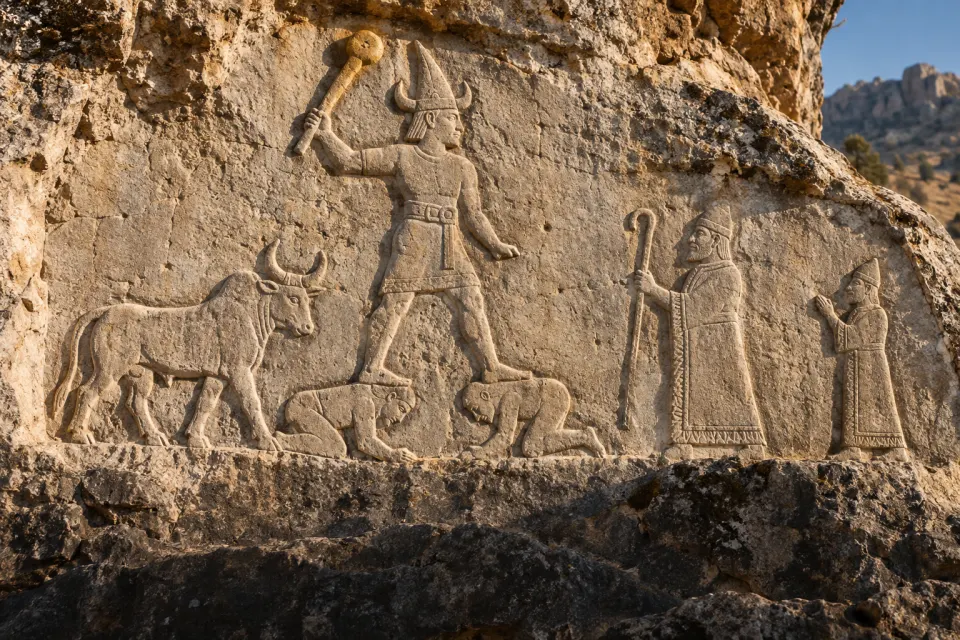
A pantheon inherited from conquered peoples To c. 1400 BCE
As Hittite kings built a kingdom across central Anatolia, they absorbed the existing gods of the Hattians, who had lived there before them, together with Hurrian, Luwian and other deities, worshipping each under its own local name rather than merging them into one system. At the head of this crowded pantheon stood the weather god — called Taru in Hattian, Tarhun in Hittite and Luwian, Teshub in Hurrian — honoured as the deity who granted kingship and victory in war. His consort, the sun goddess of Arinna, addressed in one text as "queen of heaven and earth ... queen of all the countries," was patroness of the state, served by the king and queen as her high priest and priestess.[2–4]
Kings, festivals and divination c. 1400–1250 BCE
The king bore personal responsibility for the state cult, touring the kingdom's main sanctuaries every year and presiding over a dense annual cycle of festivals in which the gods, like honoured masters, were ritually fed, clothed and entertained before receiving libations and a shared cultic meal. When a god's anger seemed to have caused drought, plague or defeat, specialists sought the cause through divination — chiefly augury, reading the flight of birds, and haruspicy, examining the entrails of sacrificed animals, a technique borrowed from Babylon. King Mursili II's prayers show how far royal guilt could reach: he traced a disaster to his father's sin, and asked the gods' forgiveness as a servant confessing to his master.[5–6, 8]
Hurrian gods rise at Hattusa c. 1350–1200 BCE
During the empire's final century, Hurrian religion reshaped the official cult: theologians identified the sun goddess of Arinna with the Hurrian goddess Hebat and the weather god's son with Hebat's son Sharruma. At the rock sanctuary of Yazılıkaya outside Hattusa, sixty-four relief carvings name this blended pantheon in Hittite hieroglyphic script. Myths recited at festivals or used in healing magic, such as the storm god's battle with the dragon Illuyanka and the Hurrian-derived story of Kumarbi's struggle for the kingship of heaven, closely parallel later Greek myths of Zeus against Typhon and the succession of sky-gods in Hesiod's Theogony — evidence of a shared Anatolian-Aegean mythical tradition.[7, 9–10]
Key moments
- c. 1350 BCEIndo-Aryan gods in a Hittite treaty · Hattusa, Anatolia
- c. 1259 BCEPuduhepa seals the peace with Egypt · Hattusa (Boğazköy), Anatolia, and Karnak, Egypt
Places

Hattusa
TUR · UNESCO World Heritage, 1986
The Hittite capital, where royal archives, temple precincts for the Hittite and Hurrian pantheon, and the nearby rock sanctuary of Yazılıkaya were excavated from 1907. Its fortifications run more than 8 kilometres, and it is inscribed as a UNESCO World Heritage Site.[1, 11]
Art & objects
Public-domain objects from museum collections. Select one to see it at the museum.
 Libation Dish-Jar StopperSyria, Hittite (?) or Middle Iron Age, Tell Ahmar, Djezizeh, 1600–700 BCE
 Priest-King or DeityHittite, North Syria, c. 1600 BCE
 Stag PoletopEastern Anatolia, Hittite, 1400–1200 BCE
 Relief: bearded figure holding staff; hieroglyphic inscriptionHittite, Neo-Hittite, ca. early 1st millennium BCE
 Orthostat relief: seated figure holding a lotus flowerHittite, Neo-Hittite, ca. 10th−9th century BCE
 Orthostat relief: winged human-headed lionHittite, Neo-Hittite, ca. 10th−9th century BCE
 Vessel terminating in the forepart of a stagHittite, Hittite Empire, ca. 14th–13th century BCE
 Vessel terminating in the forepart of a bullHittite, Hittite Empire, ca. 14th–13th century BCE
 Seated goddess with a childHittite, Hittite Empire, ca. 14th–13th century BCE
 Winged deityHittite, Hittite Empire, ca. 14th–13th century BCE
How we know
Reconstructed from a royal archive
Almost everything known about Hittite religion comes from the clay-tablet archives of the royal capital, Hattusa (modern Boğazköy/Boğazkale), discovered in 1907 and still being studied. Because the tablets are state and temple records — treaties, festival instructions, prayers and myths used in ritual — the picture that survives is weighted toward official, palace-centred religion; the everyday beliefs of ordinary Hittites are far harder to recover.[1, 11]
Common misconceptions
Myth The Hittites worshipped one unified pantheon under a single "chief god" the way later Greeks organised their Olympians.
Fact Hittite kings deliberately kept the separate gods of each people they absorbed — Hattian, Hurrian, Luwian and others — worshipping them under their own names in their own cult centres rather than merging them into a single ranked system, which is why texts list a bewildering number of divine names rather than one tidy pantheon.[2]
Myth Hittite myths of gods battling dragons and fighting for the sky are unrelated to Greek mythology.
Fact Several Hittite and Hurrian myths, such as the storm god's fight with the dragon Illuyanka and the Hurrian Kumarbi's struggle against Anu and Teshub for kingship over the gods, closely parallel Greek stories of Zeus against Typhon and the Ouranos-Kronos-Zeus succession in Hesiod, pointing to a shared mythical tradition across Bronze Age Anatolia and the Aegean.[9–10]
Glossary
- Tarhun / Teshub
- The weather god, chief of the official Hittite pantheon under his Hittite/Luwian name Tarhun or Hurrian name Teshub, credited with granting kingship and victory in war.[3]
- Sun goddess of Arinna
- The weather god's consort and patroness of the Hittite state, served by the king and queen as her high priest and priestess; later identified with the Hurrian goddess Hebat.[4, 7]
- Telipinu
- A Hattic vegetation god whose myth tells how his disappearance in anger withered the land until the goddess Hannahanna's bee found him and he was coaxed back.[12]
- Haruspicy
- Divination by examining the entrails of a sacrificed animal, a technique the Hittites borrowed from Babylon to learn which god's anger had caused a misfortune.[6]
- Yazılıkaya
- A rock sanctuary near Hattusa whose sixty-four relief carvings, naming gods in Hittite hieroglyphs, record the Hurrian-influenced pantheon of the empire's last century.[7]
- Illuyanka
- A dragon defeated by the weather god in a myth recited at the Purulli spring festival, after an initial defeat was reversed by trickery.[9]
Sources
Each statement above was checked against published sources; the verdict says whether it stood as written, was corrected or was hedged.
- CorrectedBritannica, Anatolian religion; UNESCO, Hattusha: the Hittite Capital.
- VerifiedBritannica, Anatolian religion; Encyclopedia.com, Hittite and Hurrian Religions.
- VerifiedBritannica, Anatolian religion; Encyclopedia.com, Hittite and Hurrian Religions.
- VerifiedEncyclopedia.com, Hittite and Hurrian Religions; Britannica, Anatolian religion.
- VerifiedEncyclopedia.com, Hittite and Hurrian Religions; Britannica, Anatolian religion.
- VerifiedBritannica, Anatolian religion; Encyclopedia.com, Hittite and Hurrian Religions.
- VerifiedBritannica, Anatolian religion; UNESCO, Hattusha.
- VerifiedEncyclopedia.com, Hittite and Hurrian Religions; Britannica, Anatolian religion.
- VerifiedBritannica, Anatolian religion; Encyclopedia.com, Hittite and Hurrian Religions.
- VerifiedBritannica, Anatolian religion; Encyclopedia.com, Hittite and Hurrian Religions.
- VerifiedUNESCO, Hattusha; Britannica, Anatolian religion.
- VerifiedBritannica, Anatolian religion; Encyclopedia.com, Hittite and Hurrian Religions.
Last fact-checked 6 October 2026.