
Overview
The Ghost Dance was a revivalist religious movement among Native American peoples of the western United States in the late nineteenth century, built around a round dance believed to hasten the return of the dead and the restoration of traditional ways of life; an earlier version, led by the Northern Paiute prophet-dreamer Wodziwob from 1869, spread through Nevada, California and Oregon before fading. A second, better-known version began in 1889 when another Northern Paiute, Wovoka, had a vision during a solar eclipse and began teaching the dance as a path to a promised renewal, which spread rapidly among the Lakota and other Plains nations, whose version added "ghost shirts" believed to protect wearers from bullets. U.S. fears of the movement culminated in the killing of several hundred Lakota men, women and children by the U.S. Army at Wounded Knee Creek in December 1890.[1–5, 7]
History

Wodziwob's Ghost Dance, 1869–73 1869–73
The first Ghost Dance movement began in 1869 on the Walker Lake Reservation in Nevada, led by the Northern Paiute prophet-dreamer Wodziwob, who taught that a trance vision had shown him the dead would soon return and the old tribal life would come back, hastened by a round dance in which men and women joined hands and stepped sideways in a circle. The movement spread to tribes in California and Oregon in the early 1870s before dying out or transforming into other local variants within a few years.[2]
Wovoka's vision and the second Ghost Dance 1889–90
The second, more widely known Ghost Dance began when Wovoka (c. 1856–1932), son of one of Wodziwob's followers, fell into a trance during a solar eclipse, probably on 1 January 1889, and was shown a vision of a coming reunion of the living and the deceased, to be hastened by a round dance performed on several consecutive nights together with a moral code resembling Christian teaching that forbade warfare; emissaries carried his message from Nevada as far as the Missouri River, the Canadian border and northern Texas, and it was adopted by the Arapaho, Cheyenne, Lakota, Kiowa and Caddo, among others. The Lakota added "ghost shirts," believed to protect wearers from bullets, and in some cases came to see the movement as a path to driving out white settlers, a reading Wovoka himself had not intended.[1, 3–4, 7]
Wounded Knee and after December 1890–20th century
Fearing the Ghost Dance as a threat to its authority over the already-suffering Lakota, the U.S. government sent troops to the Dakotas in late 1890; the Lakota leader Sitting Bull was killed in a related confrontation on 15 December, and on 29 December the U.S. 7th Cavalry killed an estimated 150 to 300 Lakota men, women and children at Wounded Knee Creek, South Dakota, after intercepting Chief Spotted Elk's band on its way to Pine Ridge. Enthusiasm for the Ghost Dance declined sharply afterward, though a few communities, including Canadian Dakota and Wind River Shoshoni groups, continued performing versions of it as late as the 1950s.[5–6, 8]
Key moments
- 1889 CEThe Ghost Dance · Nevada to the Great Plains
People
Wovoka
prophet · c. 1856–1932
A Northern Paiute prophet in Mason Valley, Nevada, also known as Jack Wilson, whose 1889 vision launched the second and larger Ghost Dance movement.[1]
Black Elk
other · 1863–1950
An Oglala Lakota holy man who took part in a Ghost Dance near Wounded Knee Creek and later gave a widely read account of the movement and its end.[9]
Scripture
Places
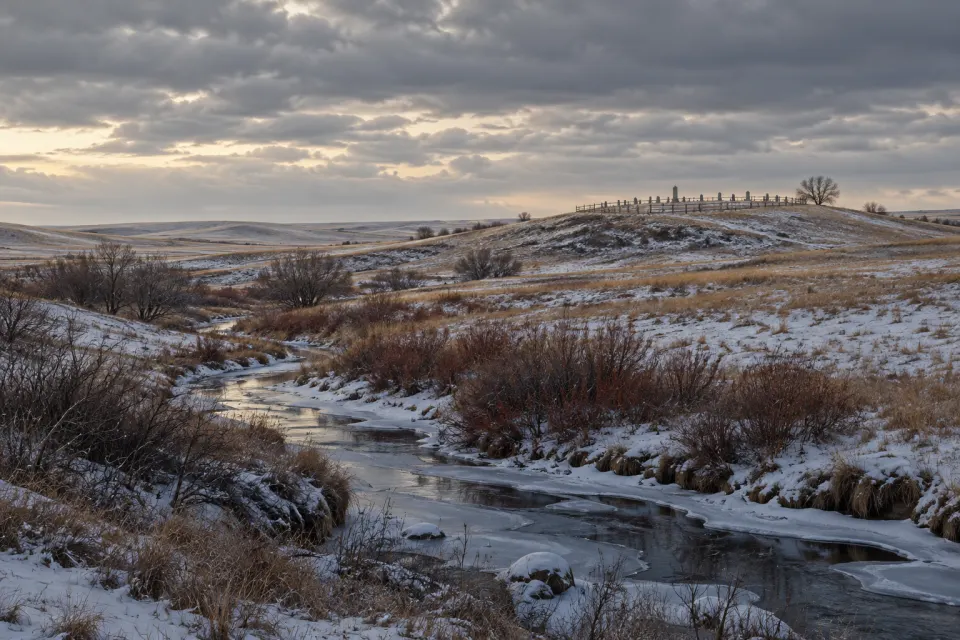
Wounded Knee Creek
USA
Site of the 29 December 1890 massacre of an estimated 150–300 Lakota men, women and children by the U.S. 7th Cavalry, which effectively ended the second Ghost Dance movement.[5]
How we know
A movement documented by outsiders and survivors
Much of what is known about the Ghost Dance comes from U.S. government and military records made during and after the 1890 crisis, alongside accounts gathered from Native participants and leaders such as the Oglala Lakota holy man Black Elk, read against a background that scholars describe as the loss of land, the disappearance of the buffalo, and the banning of Native American religious ceremonies under U.S. policy of the period.[9–10]
Common misconceptions
Myth The Ghost Dance was a call to war against white settlers.
Fact Wovoka's own teaching forbade warfare against either Native Americans or whites and presented him as a prophet rather than a war leader; U.S. officials wrongly blamed the movement for a wider uprising, and it was this fear, not Ghost Dance teaching, that led to the Wounded Knee Massacre.[3, 5]
Sources
Each statement above was checked against published sources; the verdict says whether it stood as written, was corrected or was hedged.
- VerifiedBritannica, Ghost Dance; Hultkrantz, Ghost Dance, via Encyclopedia.com.
- VerifiedBritannica, Ghost Dance; Hultkrantz, Ghost Dance, via Encyclopedia.com.
- VerifiedBritannica, Ghost Dance; Hultkrantz, Ghost Dance, via Encyclopedia.com.
- VerifiedBritannica, Ghost Dance; Hultkrantz, Ghost Dance, via Encyclopedia.com.
- VerifiedNPS, Bigfoot Pass Overlook; Britannica, Ghost Dance.
- VerifiedBritannica, Ghost Dance; Hultkrantz, Ghost Dance, via Encyclopedia.com.
- VerifiedBritannica, Ghost Dance; Hultkrantz, Ghost Dance, via Encyclopedia.com.
- VerifiedNPS, Bigfoot Pass Overlook; Hultkrantz, Ghost Dance, via Encyclopedia.com.
- VerifiedNPS, Black Elk; Britannica, Black Elk Speaks.
- VerifiedNPS, Black Elk; Hultkrantz, Ghost Dance, via Encyclopedia.com.
Last fact-checked 6 October 2026.