
Overview
The Ahmadiyya Muslim Community was founded in 1889 by Mirza Ghulam Ahmad, who taught in Qadian, Punjab, and claimed to be the Mahdi and the Messiah Muslims and Christians alike were awaiting. Ahmadis consider themselves Muslims in the ordinary sense: they keep the Qur'an and the five pillars and honour Muhammad as God's final law-bearing prophet. What sets the community apart, and what the great majority of other Muslims and several states reject, is their belief that Ghulam Ahmad held a subordinate, non-law-bearing prophetic office. Pakistan's law formally bars Ahmadis from calling themselves Muslim, and the community has faced violent attacks there and been declared non-Muslim elsewhere. Led by an elected khalīfa, based in Britain since 1984, the community describes itself as spanning tens of millions of members worldwide.[5, 8, 10–11, 13, 15]
History
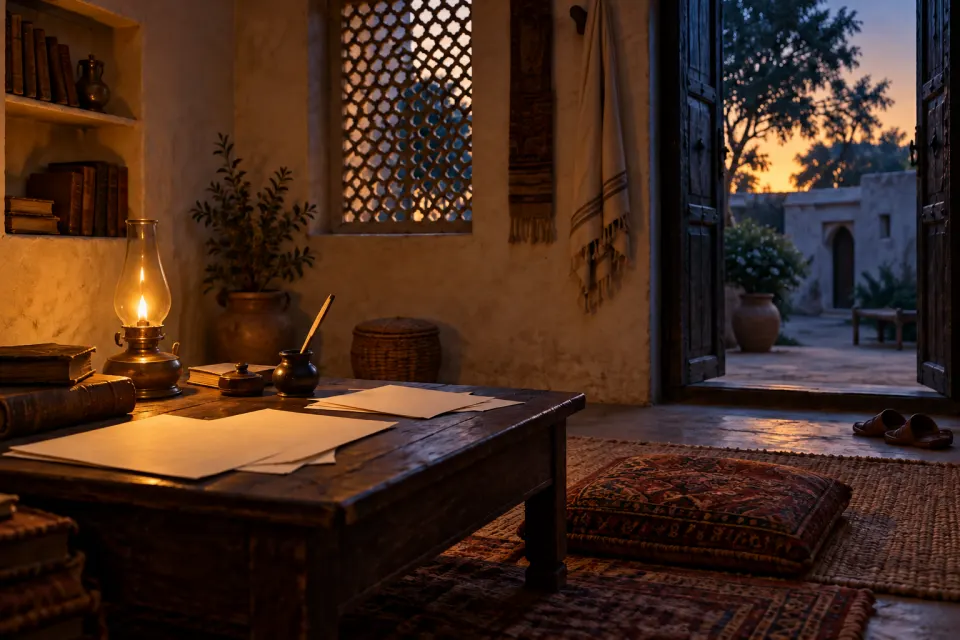
Mirza Ghulam Ahmad and the founding 1830s–1908
Mirza Ghulam Ahmad was born in Qadian, Punjab, in 1835 or about 1839 (sources differ). After attracting followers through his writing in the 1880s, he took an oath of allegiance from his first disciples in 1889, founding what became the Ahmadiyya movement. He claimed to be the promised Mahdi and the Messiah awaited within Islamic and Christian tradition, and, controversially, to hold a subordinate prophetic office under Muhammad. He died in 1908, having built a following chiefly in British India.[3–7, 16]
Succession and the Lahore split 1908–1914
Ghulam Ahmad's successor as leader, Ḥakīm Nūr-ud-Dīn, held the community together as its first khalīfa until his death in 1914. A dispute then split the movement: the majority kept the khilāfat system and continued to hold Ghulam Ahmad a prophet, while a smaller Lahore Ahmadiyya group regarded him only as a reformer and rejected the claim to prophethood.[1–2, 17]
Exclusion under Pakistani law 1974–1984
In 1974, after riots targeting Ahmadis, Pakistan's parliament passed a constitutional amendment declaring them non-Muslim for all legal purposes. A decade later, General Zia-ul-Haq's Ordinance XX of 1984 went further, making it a criminal offence, punishable by up to three years in prison, for Ahmadis to call themselves Muslim or use Islamic terms of worship in public, and barring them from calling their places of worship mosques. Facing these restrictions, the Ahmadiyya khalīfa relocated the community's international headquarters to the Fazl Mosque in London that same year.[11, 15, 18–20]
Violence and continued growth 2010–today
On 28 May 2010, gunmen attacked two Ahmadi mosques in Lahore during Friday prayers, killing somewhere between ninety and a hundred worshippers in one of the deadliest assaults on the community. Pakistan has continued to enforce its laws against Ahmadis, and religious authorities in several other Muslim-majority countries have likewise declared them non-Muslim or heretical. Despite this, the community reports continued missionary and humanitarian growth worldwide under its fifth khalīfa, Mirza Masroor Ahmad, elected in 2003.[12, 21–22]
Key moments
- 1889 CEThe Ahmadiyya movement · Qadian, Punjab
Beliefs
Promised Messiah and Mahdī
Ahmadis hold that Mirza Ghulam Ahmad fulfilled end-times prophecies shared by Muslims, Christians and others, appearing as both the Mahdī awaited in Islamic tradition and the Messiah awaited by Christians, to revive true faith rather than to found a new religion.[6–7]
Subordinate prophethood
Ahmadis affirm, as other Muslims do, that Muhammad was God's final law-bearing prophet, but hold that Ghulam Ahmad received a subordinate, non-law-bearing prophetic office beneath him. The great majority of Muslims regard any claim to prophecy after Muhammad as contradicting the finality of his prophethood, and reject this distinction as a difference without force.[8, 10, 16]
Practice
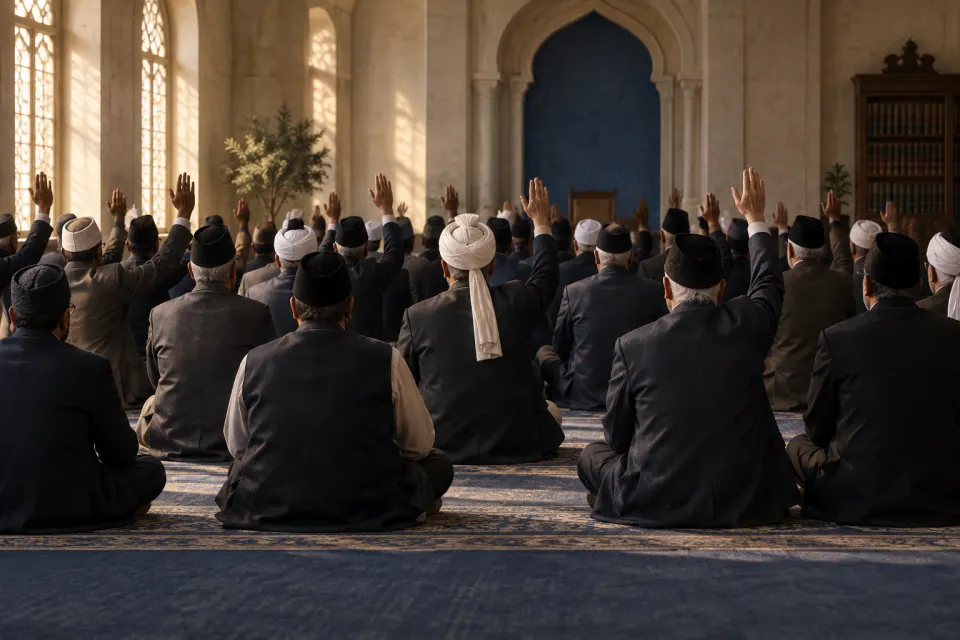
The khilāfat · خلافت
The Ahmadiyya Muslim Community is led by an elected khalīfa, chosen for life by senior members shortly after his predecessor's death, a structure Ahmadis see as continuing the model of the early caliphate.[1, 23]
People
Mirza Ghulam Ahmad · مرزا غلام احمد
founder · 1835 or c. 1839 – 1908
A religious teacher in Qadian, Punjab, Ghulam Ahmad founded the Ahmadiyya movement in 1889, claiming to be the promised Mahdi and Messiah and to hold a subordinate prophetic office, claims that remain the central point of dispute between Ahmadis and other Muslims.[5–7, 16]
Places

Qadian
IND
The Punjabi town where Mirza Ghulam Ahmad taught and founded the Ahmadiyya movement in 1889, Qadian gives the community its common name, "Qadiani".[1, 5]
Fazl Mosque, London
GBR
Built in 1926 as London's first purpose-built mosque, the Fazl Mosque became the Ahmadiyya khalīfa's residence and the community's de facto international headquarters after Pakistan's 1984 Ordinance XX made open practice there impossible.[15, 25]
Numbers
- Ahmadis worldwide
- 12 million or more (2009) to "tens of millions"[13–14]
The "tens of millions" figure is attributed to the community's own advocates; the lower figure is a published scholarly estimate for 2009.
National censuses
| Country | Year | Count | Share |
|---|---|---|---|
| New Zealand Ahmadiyya Muslim | 2018 | 369 | 0.0% |
Source: Stats NZ, 2018 Census, licensed by Stats NZ for re-use under the Creative Commons Attribution 4.0 International licence.
Common misconceptions
Myth Ahmadis do not consider themselves Muslims.
Fact Ahmadis firmly identify as Muslims: they pray toward Mecca, observe the five pillars and the Qur'an, and revere Muhammad as God's final law-bearing prophet. The dispute with other Muslims is specifically over Mirza Ghulam Ahmad's own claimed subordinate prophetic status, not over whether Ahmadis practise Islam.[8–10]
Myth Non-recognition of Ahmadis as Muslims is only an informal, scattered religious disagreement.
Fact In Pakistan it is written into the constitution and the criminal code: a 1974 amendment declared Ahmadis non-Muslim, and Ordinance XX of 1984 criminalises their calling themselves Muslim or using Islamic terms of worship, with violent attacks, including the 2010 Lahore mosque killings, following in its wake.[11, 18, 21]
Glossary
- Khalīfa · خليفة
- "Successor": the elected head of the Ahmadiyya Muslim Community, chosen for life.[23]
- Qadiani · قادیانی
- A common name, from the founder's town of Qadian, for the majority Ahmadiyya Muslim Community that holds Ghulam Ahmad to be a prophet; used by critics as well as, at times, neutrally.[1]
- Lahore Ahmadiyya · احمدیہ انجمن اشاعت اسلام
- The smaller branch that split off in 1914, holding Ghulam Ahmad to be a reformer rather than a prophet.[2]
- Ordinance XX
- A 1984 Pakistani law criminalising Ahmadis' public use of Islamic terms, titles and the word "mosque".[18–19]
Sources
Each statement above was checked against published sources; the verdict says whether it stood as written, was corrected or was hedged.
- VerifiedBritannica, Aḥmadiyyah, read directly; Encyclopedia.com, Ahmadiyya.
- VerifiedBritannica, Aḥmadiyyah, read directly; Encyclopedia.com, Ahmadiyya.
- CorrectedBritannica, Aḥmadiyyah, read directly; Encyclopedia.com, Ahmadiyya.
- VerifiedEncyclopedia.com, Ahmadiyya; EBSCO Research Starters (supporting); Britannica, Aḥmadiyyah, read directly; Bernhard Platzdasch, Religious Freedom in Contemporary Indonesia: The Case of the Ahmadiyah, in Yew-Foong Hui.
- VerifiedBritannica, Aḥmadiyyah, read directly; Encyclopedia.com, Ahmadiyya.
- VerifiedBritannica, Aḥmadiyyah, read directly; Encyclopedia.com, Ahmadiyya.
- VerifiedBritannica, Aḥmadiyyah, read directly; Encyclopedia.com, Ahmadiyya.
- VerifiedEBSCO Research Starters (supporting); Encyclopedia.com, Aḥmadīy(y)a; Abdul Rashid Moten, Ahmadiyya: Growth and Development of a Persecuted Community, Malaysian Journal of International Relations 6.
- VerifiedBritannica, Aḥmadiyyah, read directly (supporting); EBSCO Research Starters (supporting); Bernhard Platzdasch, Religious Freedom in Contemporary Indonesia: The Case of the Ahmadiyah, in Yew-Foong Hui; Abdul Rashid Moten, Ahmadiyya: Growth and Development of a Persecuted Community, Malaysian Journal of International Relations 6.
- VerifiedEncyclopedia.com, Aḥmadīy(y)a; EBSCO Research Starters (supporting); Abdul Rashid Moten, Ahmadiyya: Growth and Development of a Persecuted Community, Malaysian Journal of International Relations 6.
- VerifiedEncyclopedia.com, Ahmadiyya; Loyola of Los Angeles International and Comparative Law Journal, Ahmadis and the Law.
- VerifiedImmigration and Refugee Board of Canada; Al Islam.
- CorrectedAl Islam; US Commission on International Religious Freedom, Factsheet: Persecution of Ahmadiyya Muslims.
- CorrectedEBSCO Research Starters (supporting); US Commission on International Religious Freedom, Factsheet: Persecution of Ahmadiyya Muslims, read directly; Abdul Rashid Moten, Ahmadiyya: Growth and Development of a Persecuted Community, Malaysian Journal of International Relations 6.
- VerifiedHistoric England, British Islamic heritage celebrated by Historic England; Immigration and Refugee Board of Canada.
- VerifiedEncyclopedia.com, Aḥmadīy(y)a; EBSCO Research Starters (supporting); Abdul Rashid Moten, Ahmadiyya: Growth and Development of a Persecuted Community, Malaysian Journal of International Relations 6.
- VerifiedEncyclopedia.com, Ahmadiyya; Britannica, Aḥmadiyyah, read directly.
- VerifiedEncyclopedia.com, Ahmadiyya; Loyola of Los Angeles International and Comparative Law Journal, Ahmadis and the Law.
- VerifiedEncyclopedia.com, Ahmadiyya; Loyola of Los Angeles International and Comparative Law Journal, Ahmadis and the Law.
- VerifiedLoyola of Los Angeles International and Comparative Law Journal, Ahmadis and the Law; Encyclopedia.com, Ahmadiyya.
- VerifiedEBSCO Research Starters (supporting); The University of Chicago Divinity School, Pakistan's Ahmadi Religious Minority: Attacked, Impoverished and Ghettoized, by Ali Usman Qasmi, ; (supporting) Human Rights Watch, Pakistan: Massacre of Minority Ahmadis (supporting); (supporting) Al Jazeera, Deaths in Pakistan mosques raids (supporting); US Department of State, Office of the Coordinator for Counterterrorism, Country Reports on Terrorism 2010, South and Central Asia Overview.
- CorrectedEBSCO Research Starters (supporting); The University of Chicago Divinity School, Pakistan's Ahmadi Religious Minority, by Ali Usman Qasmi, read directly; (supporting) Human Rights Watch and Al Jazeera, as above, give 94 (supporting); Abdul Rashid Moten, Ahmadiyya: Growth and Development of a Persecuted Community, Malaysian Journal of International Relations 6.
- VerifiedEncyclopedia.com, Ahmadiyya; Immigration and Refugee Board of Canada.
- VerifiedHistoric England, British Islamic heritage celebrated by Historic England; Al Islam.
- VerifiedHistoric England, British Islamic heritage celebrated by Historic England; Encyclopedia.com, Ahmadiyya.
Last fact-checked 3 October 2026.