Overview
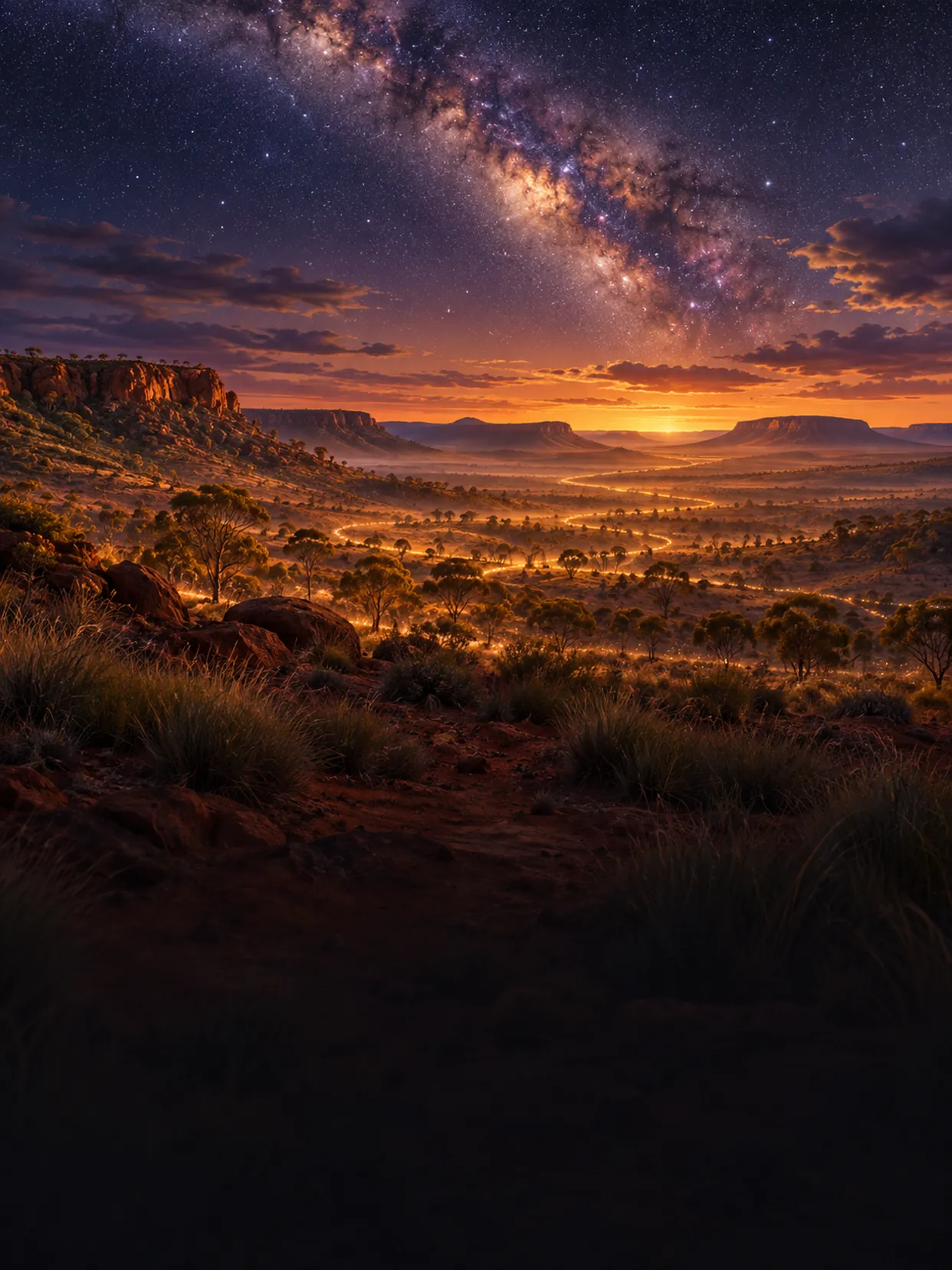
Aboriginal Australian religions are not one faith but hundreds of related traditions, each belonging to a distinct nation among the many hundreds that lived across the Australian continent before and after British colonization. Nearly all share a central idea that English speakers call the Dreaming, though each language group has its own name and telling of it: a creative era, continuing into the present, in which ancestral beings shaped the land, made people, animals and plants, and set down the law for how to live. Knowledge of the Dreaming passes on through story, song, dance, ceremony and art rather than scripture, and some of it is restricted to initiated people and never shared publicly.[7–9]
History
Deep time At least 65,000 years ago – 1788 CE
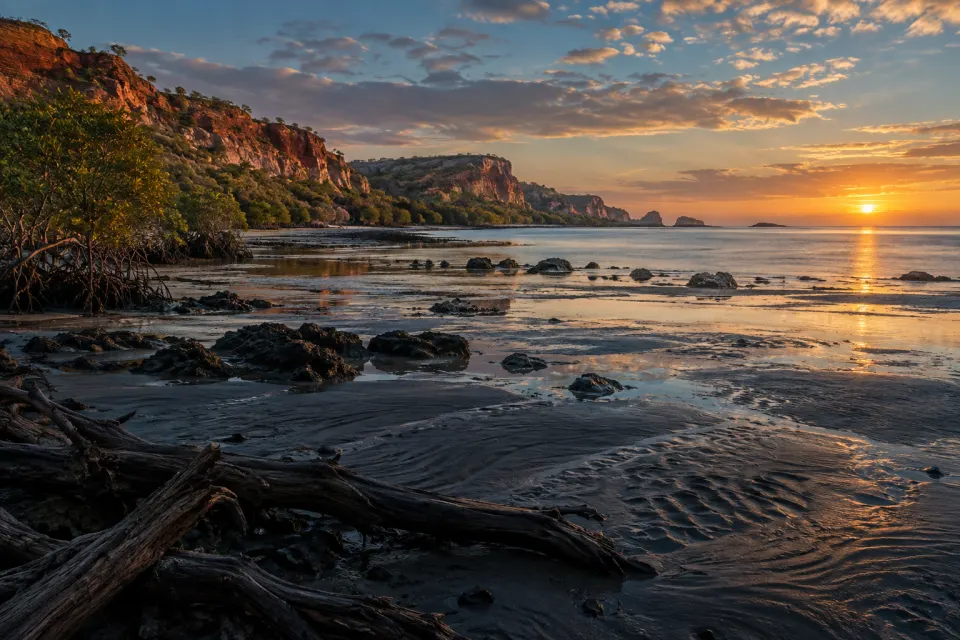
Aboriginal peoples have occupied the Australian continent for at least 65,000 years, having arrived from Southeast Asia using some of the world's earliest known seafaring, and by about 35,000 years ago had settled the whole continent, including Tasmania. By the time of British settlement in 1788, several hundred distinct, named groups, commonly called nations, were spread across Australia, speaking more than 200 languages between them and adapted to every environment from tropical rainforest to the driest deserts.[10–11]
Invasion and dispossession 1788–1880s
British settlement from 1788 cost Aboriginal peoples their land and autonomy. Colonists treated the continent as terra nullius, land belonging to no one, and claimed it without treaty; conflict, introduced disease and the desecration of sacred sites followed as settlement expanded inland. In what is sometimes called the period of pacification by force, which lasted until about the 1880s, large numbers of Aboriginal people were killed resisting the invasion or were driven from their country.[12–13]
Reserves, missions and removal 1850s–1960s
From 1856 in Victoria, Australian colonies and later states passed laws confining many Aboriginal people to reserves and missions and restricting where they could live and work. Through the twentieth century, governments forcibly removed many children of mixed descent from their families, a policy whose victims are now called the Stolen Generations. Traditional life continued longest away from the coasts; it was only in the 1960s that the last nomadic groups from the Great Sandy Desert moved into settlements.[14–16]
Rights and recognition 1930s–today
Aboriginal activists have organized for their rights since at least the 1938 Day of Mourning protest, building a land rights and native title movement that grew from the 1960s onward. In February 2008 Prime Minister Kevin Rudd formally apologized for the past mistreatment of Aboriginal people by Australian governments. Communities today combine ongoing cultural revival with a continuing push for recognition; in 2023 a referendum to create an Indigenous body to advise Parliament was rejected by voters nationally.[17–19]
Key moments
- c. 26,000 BCERock art of Arnhem Land · Kakadu and Arnhem Land, Northern Territory, Australia
- c. 4600 BCEThe eel traps of Budj Bim · Budj Bim (Mount Eccles), Victoria, Australia
Beliefs
The Dreaming
Nearly every Aboriginal nation holds some version of what English speakers call the Dreaming: an era, continuing into the present, when ancestral beings travelled the land, shaping its hills, rivers and waterholes, creating people, plants and animals, and laying down the law for how to live. Each language group has its own name and telling of it.[20–21]
Totems
Through totems, people, families, clans and whole nations are linked to particular animals, plants or other natural objects connected with an ancestral being. A person typically carries several totems, received at birth and later in life, and the group that shares a totem is responsible for learning about it, teaching it, and protecting it and its habitat.[22]
Country
Land, usually called Country, is at the centre of Aboriginal spirituality: specific places are sacred because ancestral beings acted there during the Dreaming, and people hold spiritual responsibility for the Country of their nation or clan. This relationship to land, in which it cannot simply be owned or sold, differed sharply from European ideas and was widely misunderstood by colonists.[23–24]
Practice

Ceremony
Religious life is expressed above all through ceremony: dances, songs and rituals reenact the actions of the Dreaming beings to keep the land and its people strong. Much ceremonial life, especially for initiated adults, is secret-sacred and kept from outsiders and from the uninitiated, though other ceremonies, called corroborees, are also held more openly for wider teaching and entertainment.[25–26]
Passing on the Dreaming
Dreaming knowledge is handed down orally and through art rather than any written scripture: in storytelling, song and dance, and in paintings on rock, bark, the body and the ground. Learning its fuller layers is a lifelong process, with deeper knowledge shared only as a person is initiated further into adult responsibilities.[27]
Caring for Country
Looking after sacred sites and the Dreaming tracks that join them is a central religious responsibility, traditionally held by the group whose Country includes those sites. Communities today continue and revive this responsibility alongside an ongoing effort to protect sacred sites from damage and development.[28]
People
The Rainbow Serpent
deity
One of the most widely known ancestral beings, appearing in Dreaming stories across many, though not all, Aboriginal nations as a giant snakelike creator associated with water, rain and the shaping of rivers and waterholes. Particular songs and details about the Rainbow Serpent belong to specific communities, and some are restricted, but its general role is widely and publicly described.[29]
Places
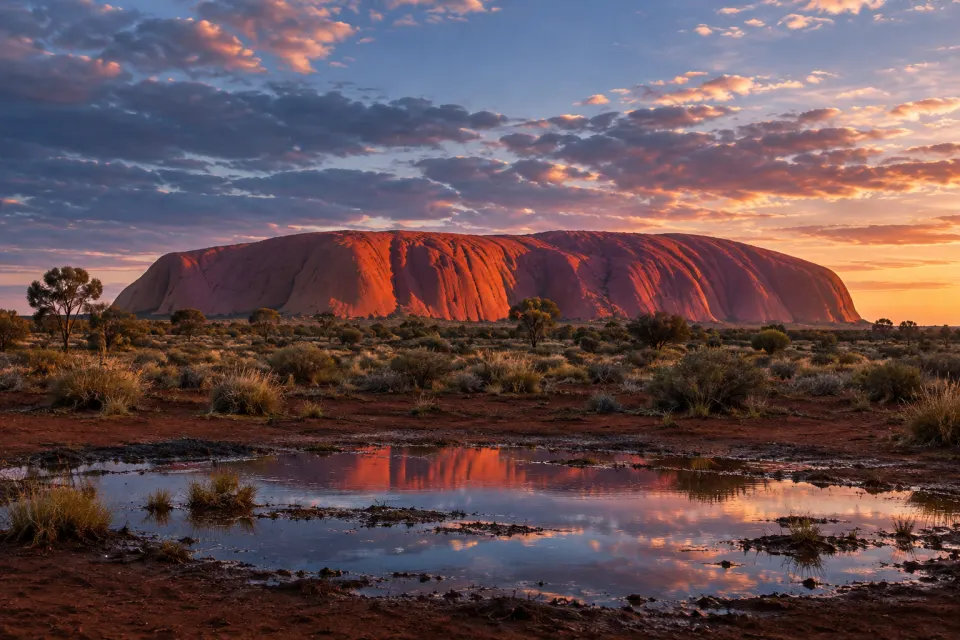
Uluru
AUS · UNESCO World Heritage, 1987
A sandstone monolith sacred to the local Anangu, who call the Dreaming-based belief system that explains its features Tjukurpa. The Australian government returned legal title to the Anangu in 1985, and the surrounding national park holds a dual UNESCO listing for both natural and cultural significance.[30–31]
Kakadu National Park
AUS · UNESCO World Heritage, 1981
A vast area of the Northern Territory holding some 5,000 recorded Aboriginal rock art sites, some tens of thousands of years old, many of religious and ceremonial significance; it is jointly managed by the Australian government and Aboriginal traditional owners.[32]
Art & objects
Public-domain objects from museum collections. Select one to see it at the museum.

Numbers
National censuses
| Country | Year | Count | Share |
|---|---|---|---|
| Australia Australian Aboriginal Traditional Religions | 2021 | 7,887 | 0.0% |
Source: Australian Bureau of Statistics, Census of Population and Housing 2021, 'Religious affiliation in Australia' (Table 4), CC BY 4.0.
Common misconceptions
Myth Aboriginal Australians share one unified religion with a single set of gods and stories.
Fact There is no single Aboriginal religion. Several hundred distinct nations, speaking more than 200 languages, each hold their own version of the Dreaming under their own name, and specific stories, ancestral beings and ceremonies vary widely between regions and communities.[33]
Myth The Dreaming is just an old myth or legend, like a story from the ancient past.
Fact The Dreaming is not only a story of the past: Aboriginal peoples hold that it continues into the present and future, providing living law and values rather than describing a closed, finished history.[34]
Myth All Aboriginal religious knowledge and ceremony can be freely learned and shared by anyone.
Fact Much ceremonial knowledge, particularly material linked to initiation, is secret-sacred: it belongs to initiated members of particular communities and is deliberately not shared outside them or published for a general audience.[35]
Glossary
- Dreaming
- The English term for the creative era, continuing into the present, in which ancestral beings shaped the land and set down the law; each Aboriginal language has its own name for it.[36]
- Country
- Land, sea and sky bound up with a people's identity and spiritual responsibility, not merely property to be owned.[37]
- Totem
- An animal, plant or other natural object linking a person, family, clan or nation to an ancestral being; a person usually holds several.[38]
- Corroboree
- A ceremonial gathering with singing and dancing that reenacts Dreaming stories, sometimes open to outsiders and sometimes restricted.[39]
- Secret-sacred
- Religious knowledge, objects or ceremonies restricted to initiated people within a particular community and not shared more widely.[40]
- Elder
- A senior, respected member of a community recognized as holding and able to teach cultural and religious knowledge.[41]
- Nation
- A language-named Aboriginal group tied to a particular territory; there were several hundred such groups across Australia at the time of British settlement.[42]
Sources
Each statement above was checked against published sources; the verdict says whether it stood as written, was corrected or was hedged.
- VerifiedBritannica, Australian Aboriginal peoples; Britannica Kids, The Dreaming (supporting); Australian Museum, Indigenous Australians exhibition.
- VerifiedBritannica Kids, The Dreaming (supporting); Britannica, Australian Aboriginal peoples – Beliefs and aesthetic values; Australian Museum, Indigenous Australians exhibition.
- VerifiedNational Museum of Australia, Evidence of first peoples; Britannica, Australian Aboriginal peoples.
- CorrectedBritannica, Australian Aboriginal peoples – Beliefs and aesthetic values; Australian Museum, Indigenous Australians exhibition; Britannica Kids, The Dreaming (supporting).
- VerifiedBritannica, Australian Aboriginal peoples; Britannica Kids, The Dreaming (supporting); National Museum of Australia, Handback of Uluru.
- VerifiedBritannica, Australian Aboriginal peoples – Beliefs and aesthetic values; Britannica Kids, The Dreaming (supporting); Australian Museum, Indigenous Australians exhibition.
- VerifiedBritannica, Australian Aboriginal peoples; Australian Museum, Indigenous Australians exhibition.
- VerifiedBritannica Kids, The Dreaming (supporting); Britannica, Australian Aboriginal peoples; National Museum of Australia, Evidence of first peoples.
- CorrectedBritannica, Australian Aboriginal peoples – Beliefs and aesthetic values; Australian Museum, Indigenous Australians exhibition.
- VerifiedNational Museum of Australia, Evidence of first peoples; Britannica, Australian Aboriginal peoples.
- VerifiedBritannica, Australian Aboriginal peoples; Australian Museum, Indigenous Australians exhibition.
- VerifiedBritannica, Australian Aboriginal peoples – Beliefs and aesthetic values; Australian Museum, Indigenous Australians exhibition.
- VerifiedBritannica, Australian Aboriginal peoples – Beliefs and aesthetic values; Australian Museum, Indigenous Australians exhibition.
- VerifiedBritannica, Australian Aboriginal peoples – Beliefs and aesthetic values; Australian Museum, Indigenous Australians exhibition.
- VerifiedAustralian Museum, Indigenous Australians exhibition; Britannica, Australian Aboriginal peoples – Beliefs and aesthetic values.
- VerifiedBritannica, Australian Aboriginal peoples – Beliefs and aesthetic values; National Museum of Australia, Handback of Uluru.
- CorrectedNational Museum of Australia, Day of Mourning; Britannica, Australian Aboriginal peoples – Beliefs and aesthetic values; National Museum of Australia, Handback of Uluru (supporting).
- CorrectedBritannica, Australian Aboriginal peoples – Beliefs and aesthetic values; National Museum of Australia, National Apology.
- CorrectedBritannica, Australian Aboriginal peoples – Beliefs and aesthetic values; Australian Electoral Commission, 2023 Referendum National results.
- CorrectedBritannica, Australian Aboriginal peoples; National Museum of Australia, Evidence of first peoples; Britannica Kids, The Dreaming (supporting).
- CorrectedBritannica Kids, The Dreaming (supporting); Britannica, Australian Aboriginal peoples – Beliefs and aesthetic values; Australian Museum, Indigenous Australians exhibition.
- VerifiedBritannica Kids, The Dreaming (supporting); Britannica, Australian Aboriginal peoples – Beliefs and aesthetic values; Australian Museum, Indigenous Australians exhibition.
- CorrectedBritannica, Australian Aboriginal peoples – Beliefs and aesthetic values; Australian Museum, Indigenous Australians exhibition; Britannica Kids, The Dreaming (supporting).
- VerifiedAustralian Museum, Indigenous Australians exhibition; Britannica, Australian Aboriginal peoples.
- VerifiedBritannica, Australian Aboriginal peoples – Beliefs and aesthetic values; Britannica, Australian Aboriginal peoples; National Museum of Australia, Evidence of first peoples.
- VerifiedBritannica, Australian Aboriginal peoples – Beliefs and aesthetic values; Australian Museum, Indigenous Australians exhibition.
- VerifiedBritannica Kids, The Dreaming (supporting); Britannica, Australian Aboriginal peoples – Beliefs and aesthetic values; Australian Museum, Indigenous Australians exhibition.
- CorrectedBritannica, Australian Aboriginal peoples; National Museum of Australia, Handback of Uluru; Britannica Kids, The Dreaming (supporting).
- CorrectedNational Museum of Australia, Yawkyawk sculptures; Australian Museum, Indigenous Australians exhibition; Britannica Kids, The Dreaming (supporting).
- VerifiedNational Museum of Australia, Handback of Uluru; Britannica, Uluru/Ayers Rock.
- VerifiedNational Museum of Australia, Handback of Uluru; Britannica, Uluru/Ayers Rock.
- VerifiedBritannica, Kakadu National Park; Australian Museum, Indigenous Australians exhibition.
- VerifiedBritannica, Australian Aboriginal peoples; Australian Museum, Indigenous Australians exhibition.
- CorrectedBritannica, Australian Aboriginal peoples; National Museum of Australia, Evidence of first peoples; Britannica Kids, The Dreaming (supporting).
- VerifiedBritannica, Australian Aboriginal peoples – Beliefs and aesthetic values; Australian Museum, Indigenous Australians exhibition.
- CorrectedBritannica Kids, The Dreaming (supporting); Britannica, Australian Aboriginal peoples – Beliefs and aesthetic values; Australian Museum, Indigenous Australians exhibition.
- CorrectedBritannica, Australian Aboriginal peoples – Beliefs and aesthetic values; Australian Museum, Indigenous Australians exhibition; Britannica Kids, The Dreaming (supporting).
- VerifiedBritannica Kids, The Dreaming (supporting); Britannica, Australian Aboriginal peoples – Beliefs and aesthetic values; Australian Museum, Indigenous Australians exhibition.
- VerifiedBritannica, Australian Aboriginal peoples; Britannica, Australian Aboriginal peoples – Beliefs and aesthetic values; Australian Museum, Indigenous Australians exhibition.
- VerifiedBritannica, Australian Aboriginal peoples – Beliefs and aesthetic values; Australian Museum, Indigenous Australians exhibition.
- CorrectedNational Museum of Australia, Seats of segregation; Australian Museum, Indigenous Australians exhibition; Britannica Kids, The Dreaming (supporting).
- VerifiedBritannica, Australian Aboriginal peoples; Australian Museum, Indigenous Australians exhibition.
Last fact-checked 4 October 2026.