
The story behind the day
Tu BiShvat, the fifteenth of the month of Shevat, is the Jewish New Year of the Trees. It began as a date in the tithing calendar, the point from which the fruit of a tree was counted to the new year, in midwinter, when most of the rain in the land of Israel has fallen. It is a minor festival, with no fasting, marked by eating fruit, especially fruit of Israel. Kabbalists added a fruit seder, and in modern times the day became a tree-planting festival in Israel and among Jews abroad.[1–7]
Origins
The Mishnah, in the tractate Rosh Hashanah, lists four new years, each for a different purpose, and one of them belongs to the trees. The House of Hillel set it on the fifteenth of Shevat. The purpose is legal: fruit trees were tithed, and the Torah forbids the fruit of a tree's first three years, so each tree's fruit had to be assigned to a year. Fruit that forms after the date counts toward the next year. The date falls at the point when most of the winter rains have already come in the land of Israel.[1–2, 8–10]
What it marks
The day names a turning in the farming year rather than a historical event. It is a minor festival: penitential prayers are omitted and fasting is not allowed. The tradition praises Israel for seven kinds of produce, listed in Deuteronomy as wheat and barley, vines, figs, pomegranates, olives and honey, and these shape what is eaten.[3–4, 11]
How it came to be
In Europe, Ashkenazi communities ate many kinds of fruit on the day, preferring fruit from Israel. Inspired by the Safed kabbalists of the sixteenth and seventeenth centuries, the day gained a ritual meal modelled on the Passover seder, with readings gathered in an eighteenth-century pamphlet, Pri Etz Hadar. Zionism gave it new life. After agricultural settlement in the land of Israel began in the late nineteenth century, the New Year of the Trees became a symbol of the land's revival.[5–6, 12]
How it is kept
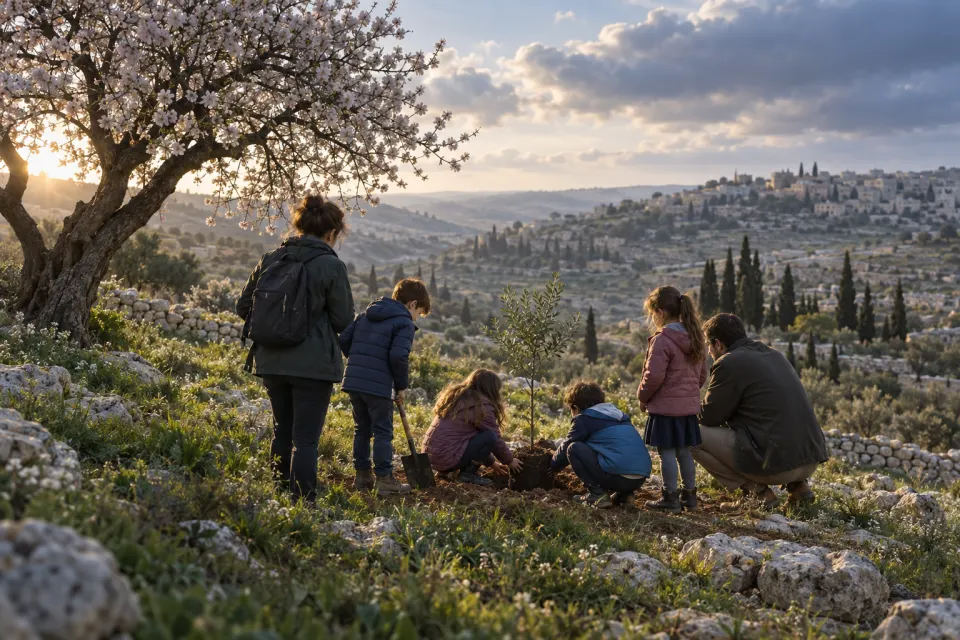
Most observance is a matter of eating: many kinds of fruit, with the produce of the land of Israel given pride of place, and a seder for those who keep the kabbalistic custom. In Israel, schoolchildren plant trees in ceremonies connected with the Jewish National Fund, and Jews elsewhere plant or fund trees in honour of friends and relatives. Reform and Conservative writers now describe the day as an environmental holiday, even a Jewish Arbor Day.[5–7, 13–14]
Sources
Each statement above was checked against published sources; the verdict says whether it stood as written, was corrected or was hedged.
- VerifiedEncyclopedia.com; Chabad.org, What Are the Four Jewish New Years?; Union for Reform Judaism, Tu BiShvat: History; ExploringJudaism.org.
- CorrectedChabad.org, Tu B'Shevat: Basics; Encyclopedia.com.
- VerifiedChabad.org, 15 Shevat - The New Year for Trees; Union for Reform Judaism, Tu BiShvat.
- VerifiedEncyclopedia.com; Chabad.org, Tu B'Shevat: Basics.
- CorrectedEncyclopedia.com; Chabad.org, Tu B'Shevat: Basics; Union for Reform Judaism, Tu BiShvat.
- CorrectedEncyclopedia.com; Fitzwilliam Museum, University of Cambridge, Happy birthday to trees; Chabad.org, Tu B'Shevat: Basics; Union for Reform Judaism, Tu BiShvat: Customs and Rituals.
- VerifiedEncyclopedia.com; Union for Reform Judaism, Tu BiShvat.
- VerifiedSefaria, Mishnah Rosh Hashanah 1:1, William Davidson Edition; Chabad.org, What Are the Four Jewish New Years?; Union for Reform Judaism, Tu BiShvat: History.
- VerifiedSefaria, Mishnah Rosh Hashanah 1:1, William Davidson Edition; Encyclopedia.com.
- VerifiedSefaria, The JPS Tanakh: Gender-Sensitive Edition; Chabad.org, What Are the Four Jewish New Years?.
- VerifiedSefaria, The JPS Tanakh; Chabad.org, Tu B'Shevat: Basics.
- VerifiedEncyclopedia.com; Union for Reform Judaism, Tu BiShvat: History.
- VerifiedUnion for Reform Judaism, Tu BiShvat; ExploringJudaism.org.
- VerifiedUnion for Reform Judaism, Tu BiShvat: Customs and Rituals; ExploringJudaism.org.