
The story behind the day
Rosh Hashanah, the Jewish New Year, falls on the first of Tishri, in the autumn, and is kept for one or two days depending on the community. Its roots are a biblical day of rest and horn-blowing on the first of the seventh month, which the rabbis of the Mishnah turned into the opening of the year and a day of judgment. Today it is marked above all by hearing the shofar, the ram's horn, in synagogue, and by sweet foods and wishes for a good year. It begins ten days of repentance that end with Yom Kippur.[1–7]
Origins
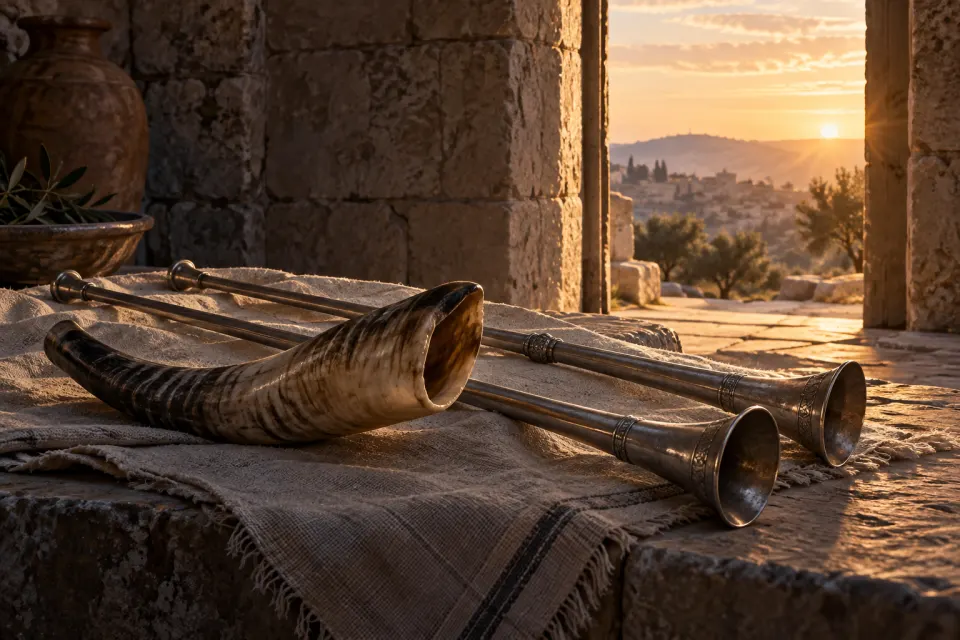
The Torah marks the opening day of the seventh month with complete rest and a sacred gathering announced by blasts (Leviticus 23, Numbers 29). It does not call the day a New Year, and one of its scriptural names is Yom Teruah, the day of sounding. The name Rosh HaShanah, "head of the year", appears later, in the Mishnah. Some scholars suggest the festival first marked the turn of the agricultural year in autumn.[1, 8, 10–11]
What it marks
The Mishnah counts four separate beginnings of the year, each for its own legal purpose, and the first of Tishri is the one from which years are counted. Jewish tradition links the day with the creation of the world. The rabbis also teach that every person is judged on it: three books are opened, the thoroughly righteous are written down for life at once, the thoroughly wicked are struck out, and those in between have until Yom Kippur to repent. The ten days between the two festivals are therefore a season of repentance.[2–3, 9, 12]
How it came to be
The Torah prescribes a single day. Orthodox tradition holds that the Sages added a second because the month began only when witnesses reported the new moon, so the court's date could be uncertain even close to Jerusalem. In that account the second day stayed after the calendar came to be fixed by calculation, and it applies in the land of Israel as well as abroad.[4, 13]
How it is kept

The central rite is hearing the shofar, a duty fulfilled in synagogue during the morning service. Its calls are the long tekiah, the three short wails of the shevarim and the staccato teruah. When the first day falls on Shabbat the horn is not sounded that day. Torah readings tell of Isaac's birth on the first day and his binding on the second. On the first afternoon many go to flowing water for Tashlikh, casting away sins in symbol. At home, challah is round and apples are dipped in honey for a sweet year, and people greet each other with wishes to be inscribed for a good year.[6–7, 14–18]
Across traditions
Orthodox communities keep two days everywhere, in Israel as well as abroad. Conservative Judaism also keeps two days, even though a 1969 ruling of its law committee made the second day of other festivals a matter of custom and left Rosh Hashanah out. Reform Judaism keeps the Torah's single day: most North American Reform congregations observe one, though some keep two, as do Progressive Jews in Israel.[4–5, 19]
Sources
Each statement above was checked against published sources; the verdict says whether it stood as written, was corrected or was hedged.
- VerifiedSefaria, The JPS Tanakh: Gender-Sensitive Edition; Jewish Encyclopedia, New-Year; Union for Reform Judaism, The History Behind Rosh HaShanah.
- CorrectedSefaria, Mishnah Rosh Hashanah 1:1; Encyclopedia.com; Jewish Encyclopedia, New-Year; Chabad.org, What Is Rosh Hashanah?.
- VerifiedChabad.org, What Is Rosh Hashanah?; Union for Reform Judaism, The History Behind Rosh HaShanah.
- CorrectedChabad.org, Why Rosh Hashanah Is Two Days; Union for Reform Judaism, Do Reform Jews celebrate one or two days of Rosh HaShanah?.
- VerifiedUnion for Reform Judaism, Do Reform Jews celebrate one or two days of Rosh HaShanah?; Central Conference of American Rabbis, Reform Responsa MRR 286-293.
- VerifiedEncyclopedia.com; Chabad.org, What Is Rosh Hashanah?.
- CorrectedChabad.org, What Is Rosh Hashanah?; Union for Reform Judaism, Why do we eat a round challah on Rosh HaShanah?; Union for Reform Judaism, Why Apples and Honey?.
- VerifiedExploringJudaism.org; Chabad.org, What Is Rosh Hashanah?.
- VerifiedChabad.org, What Is Rosh Hashanah?; Jewish Encyclopedia, New-Year; Union for Reform Judaism, The History Behind Rosh HaShanah.
- VerifiedUnion for Reform Judaism, The History Behind Rosh HaShanah; Encyclopedia.com.
- VerifiedEncyclopedia.com; Jewish Encyclopedia, New-Year.
- VerifiedJewish Encyclopedia, New-Year; Encyclopedia.com; Union for Reform Judaism, The History Behind Rosh HaShanah.
- VerifiedChabad.org, Why Rosh Hashanah Is Two Days; Encyclopedia.com; Union for Reform Judaism, Do Reform Jews celebrate one or two days of Rosh HaShanah?.
- VerifiedChabad.org, What Is Rosh Hashanah?; ExploringJudaism.org.
- VerifiedExploringJudaism.org; Chabad.org, What Is Rosh Hashanah?.
- VerifiedExploringJudaism.org; Chabad.org, What Is Rosh Hashanah?.
- VerifiedChabad.org, What Is Rosh Hashanah?; Encyclopedia.com; Jewish Encyclopedia, New-Year.
- VerifiedEncyclopedia.com; Jewish Encyclopedia, New-Year.
- VerifiedJewish Theological Seminary, Alan Cooper, The Last Day of Passover; ExploringJudaism.org.