
The story behind the day
The ninth month of the Islamic lunar calendar is Ramadan, a month in which Muslims fast each day from dawn to sunset. Muslims hold that the Qur'an began to be revealed in it, and that the fast was laid on the community in the second year after the Hijra. The month opens when the new crescent is sighted, and it closes with the feast of Eid al-Fitr. Its days are given to restraint, and its nights to prayer, charity and shared meals.[1–6]
Origins

The Arabic name comes from a root meaning heat. In the Qur'an this is the month in which scripture was sent down as guidance, and the same chapter tells believers that fasting is prescribed for them as it was for those before them. Muslims date the obligation to fast Ramadan to the second year after the Hijra. Muslims see the month as a school of self-restraint. The Qur'an says that fasting may lead believers to become mindful of God, and Egypt's fasting guide calls it a means to piety. The month is also a season of generosity: the guide quotes a saying of the Prophet that the best charity is one given in Ramadan, and a Library of Congress account calls it a month of charity as well as of fasting and prayer. Muslims further regard one night among its last ten, Laylat al-Qadr, as the holiest night of the year.[3–4, 7–11]
How it came to be
In law the fast runs from the break of dawn until sunset. The month begins at the sunset of 29 Shaʿbān if the crescent is seen; if it is hidden, Shaʿbān is completed at thirty days. Authorities differ over method. Among Sunni bodies, Egypt's Dar al-Ifta uses calculation only to rule out a sighting that is impossible, while the IslamWeb fatwa service holds that calculation has no part in confirming the month. Shia rulings, such as those of Ayatollahs al-Sistani and Khamenei, accept the word of two just witnesses.[2, 5, 12–13]
How it is kept
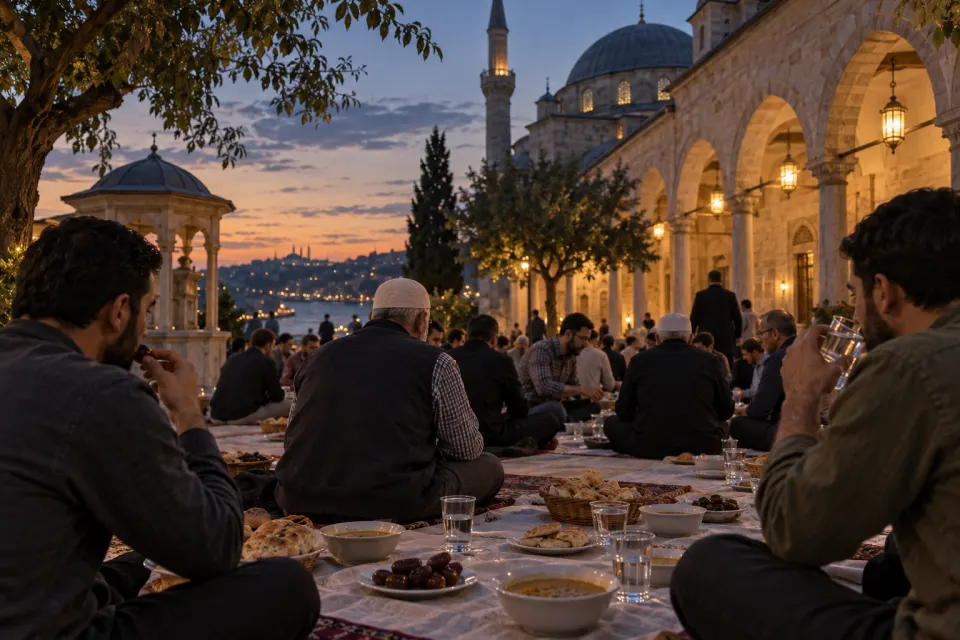

The day begins with suḥūr, a light meal before dawn, and the fast is broken soon after sunset with iftār. Adults who are able must fast; travellers, the sick and the elderly, and women who are pregnant, nursing or menstruating are excused, and missed days are made up later where possible. In the evenings many Muslims fill the mosques for special prayers called tarāwīḥ, which by Sunni tradition ʿUmar arranged behind a single imam. In the last ten nights some withdraw to the mosque for iʿtikāf, a retreat that is especially recommended at this time.[14–19]
Sources
Each statement above was checked against published sources; the verdict says whether it stood as written, was corrected or was hedged.
- VerifiedEncyclopedia.com; Dar al-Ifta al-Misriyyah, The Islamic calendar: a festive tree bearing fruits of mercy.
- VerifiedDar al-Ifta al-Misriyyah, The book of fasting; Encyclopedia.com.
- VerifiedDar al-Ifta al-Misriyyah, The book of fasting; Encyclopedia.com.
- CorrectedDar al-Ifta al-Misriyyah, fatwa 21760; Encyclopedia.com.
- VerifiedDar al-Ifta al-Misriyyah, The book of fasting; Office of Ayatollah al-Sistani, Islamic Laws, ruling 1699.
- VerifiedLibrary of Congress; Dar al-Ifta al-Misriyyah, The book of fasting.
- VerifiedEncyclopedia.com; Dar al-Ifta al-Misriyyah, The book of fasting.
- VerifiedQuran.com, Qur'an 2:183; Dar al-Ifta al-Misriyyah, The book of fasting.
- VerifiedQuran.com, Qur'an 2:183; Dar al-Ifta al-Misriyyah, The book of fasting.
- VerifiedLibrary of Congress; Dar al-Ifta al-Misriyyah, The book of fasting.
- VerifiedEncyclopedia.com; Dar al-Ifta al-Misriyyah, The book of fasting.
- CorrectedDar al-Ifta al-Misriyyah, The book of fasting; IslamWeb, fatwa 229762.
- VerifiedOffice of Ayatollah al-Sistani, Islamic Laws, ruling 1699; hadana.ir.
- VerifiedLibrary of Congress; Encyclopedia.com.
- VerifiedEncyclopedia.com; Dar al-Ifta al-Misriyyah, The book of fasting.
- VerifiedEncyclopedia.com; Dar al-Ifta al-Misriyyah, The book of fasting; Office of Ayatollah al-Sistani, Islamic Laws, rulings 1694–1698; Office of Ayatollah al-Sistani, ruling 459.
- CorrectedLibrary of Congress; Dar al-Ifta al-Misriyyah, The book of fasting.
- VerifiedDar al-Ifta al-Misriyyah, fatwa on tarawih; Islam Q&A, answer 230276.
- CorrectedDar al-Ifta al-Misriyyah, The book of fasting; Office of Ayatollah al-Sistani, Islamic Laws, ruling 1720.