The story behind the day
Mehregan, or Mihragan, is the Zoroastrian autumn festival linked to Mithra, one of the most important divinities of the tradition. It falls on Mihr day of the month of Mihr, the sixteenth, and Zoroastrians keep it as a day of thanksgiving for the harvest. It belongs to the feasts held when the name of the day and the name of the month coincide, and in ancient Iran it stood beside Nowruz as a main celebration. UNESCO notes that Muslim communities in Iran and Tajikistan keep it too, with a table of autumn fruit and grain.[1–8]
Origins
Mehregan is dedicated to Mithra, whom the Zoroastrian tradition counts among its most important divinities, or yazatas, a figure linked with the sun and with covenants. Encyclopaedia Iranica calls the festival apparently dedicated to him, and notes that it is clearly tied to the autumn equinox. The Shāhnāma tells of the blacksmith Kāva and the hero Farēdūn overthrowing the tyrant Zahhāk, and Zoroastrian teaching materials set that victory on Mehregan day, as some medieval Arabic sources also do.[1, 4, 9–10]
What it marks
Mehregan is a day of thanksgiving. Zoroastrian teaching describes it as the day Persians thanked Ahura Mazda for the harvest that would sustain them through winter, and UNESCO ties it to the autumn harvest, when communities express gratitude for their livestock and crops.[5]
How it came to be
Zoroastrians mark a series of feast days on which the name of the day coincides with the name of the month, and Mehregan, on the sixteenth day, Mihr, of the month of Mihr, is the most famous of them. Twelve of the eighteen jashans other than Nowruz are of this kind. In ancient times Mehregan and Nowruz were the two main celebrations, and Sasanian kings marked it with great banquets. Mehregan also reaches beyond the Zoroastrian community, and Borjian identifies the Qalishuyan festival of Ardahal as a survival of it among Muslims.[2–3, 6–7]
How it is kept

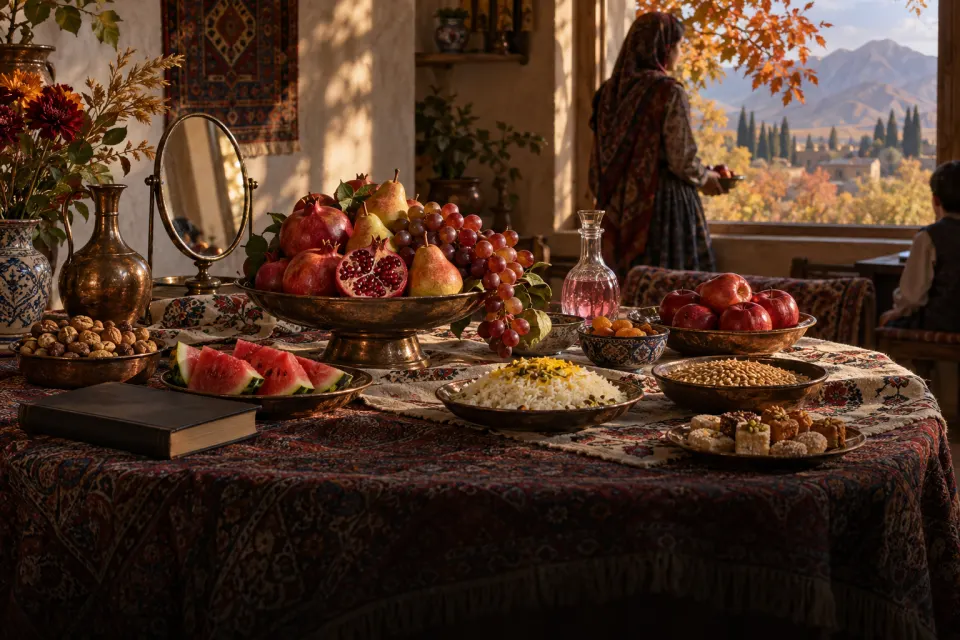
The festival is marked with a decorated table of seasonal goods. UNESCO lists pomegranates, watermelons, pears, grapes, apples, rice and wheat, and Zoroastrian teaching materials add a copy of the Avesta, a mirror, sweets and rosewater.[8]
Across traditions
Zoroastrians follow three calendars. The Fasli calendar, devised in 1906, keeps the New Year at the spring equinox. The Shenshai calendar followed by most Parsis has its New Year in August now, and the Kadmi calendar differs from Shenshai by one month.[11–15]
Sources
Each statement above was checked against published sources; the verdict says whether it stood as written, was corrected or was hedged.
- Verifiedfezana.org, Glossary; Encyclopaedia Iranica, Mehragān; Zoroastrianism, Gale, via Encyclopedia.com.
- VerifiedEncyclopaedia Iranica, Mehragān; Habib Borjian, Shast-Sheshi: the Festival of Khordadgan in the Jarquyeh District of Isfahan, Iranian Studies 58.
- VerifiedHabib Borjian, Shast-Sheshi: the Festival of Khordadgan in the Jarquyeh District of Isfahan, Iranian Studies 58; Zoroastrianism, Gale, via Encyclopedia.com.
- VerifiedZoroastrianism, Gale, via Encyclopedia.com; FEZANA, Age-Appropriate Lesson Plan: Mehregan; UNESCO-Parzor.
- VerifiedFEZANA, Age-Appropriate Lesson Plan: Mehregan; UNESCO Intangible Cultural Heritage, Ceremony of Mehregan.
- VerifiedFEZANA, Age-Appropriate Lesson Plan: Mehregan; Encyclopaedia Iranica, Mehragān.
- VerifiedUNESCO Intangible Cultural Heritage, Ceremony of Mehregan; Habib Borjian, Shast-Sheshi: the Festival of Khordadgan in the Jarquyeh District of Isfahan, Iranian Studies 58.
- VerifiedUNESCO Intangible Cultural Heritage, Ceremony of Mehregan; FEZANA, Age-Appropriate Lesson Plan: Mehregan.
- VerifiedFEZANA, Age-Appropriate Lesson Plan: Mehregan; Encyclopaedia Iranica, Mehragān.
- VerifiedEncyclopaedia Iranica, Mehragān; UNESCO-Parzor.
- VerifiedFEZANA, Age-Appropriate Lesson Plan: Calendar; D. O. Lodrick, Parsis, Worldmark Encyclopedia of Religious Practices.
- VerifiedFEZANA, Age-Appropriate Lesson Plan: Calendar; Zoroastrian Society of British Columbia, Calendars; Jamsheed K. Choksy / D. O. Lodrick, Parsis, Encyclopedia of Religion and Worldmark Encyclopedia of Religious Practices.
- VerifiedZoroastrian Society of British Columbia, Calendars; FEZANA, Navroze & Khordad Saal Mubarak; Zoroastrianism.
- VerifiedD. O. Lodrick, Parsis, Worldmark Encyclopedia of Religious Practices; fezana.org, Glossary.
- VerifiedFEZANA, Age-Appropriate Lesson Plan: Calendar; Zoroastrian Society of British Columbia, Calendars; Zoroastrianism.