
The story behind the day
The Day of ʿArafah falls on the ninth of Dhū al-Ḥijja, the day on which pilgrims on the Hajj stand on the plain of ʿArafāt from noon until sunset. The standing is the essential act of the pilgrimage: Muslims hold that there is no Hajj without it. For Muslims who are not on pilgrimage it is a day of supplication and, for many, of fasting. At sunset the pilgrims move on, and the next morning is Eid al-Adha.[1–5]
Origins
The day belongs to the Hajj, the pilgrimage that Egypt's Dar al-Ifta calls the fifth pillar of Islam and that takes place in Dhū al-Ḥijja. Each year some two million Muslims take part. The standing at ʿArafāt is made on the plain of that name, at the foot of Jabal al-Raḥma, the Mount of Mercy. Tradition holds that the Prophet gave his final sermon there during his own farewell pilgrimage. For those who keep it, ʿArafah is the high point of the pilgrimage and a day of mercy. Dar al-Ifta writes that on this day God pours out mercy on the pilgrims and pardons all their sins, and Islam Q&A quotes a saying in Ṣaḥīḥ Muslim that no day sees more people freed from the Fire.[3, 7–11]
How it came to be
The standing runs from noon until sunset, as the encyclopedias describe it, and Ayatollah al-Sistani's Hajj rules fix its start at the time the sun passes its zenith. After the sun goes down the pilgrims leave for Muzdalifah, and the day after is the Day of Sacrifice. Because the day depends on the lunar calendar, Sunni authorities fix it differently: Dar al-Ifta rules that Muslim countries should follow Saudi Arabia's sighting of the moon in Mecca for ʿArafah and Eid, while Islam Q&A and Singapore's Office of the Mufti hold that each country follows its own sighting.[2, 5, 12]
How it is kept
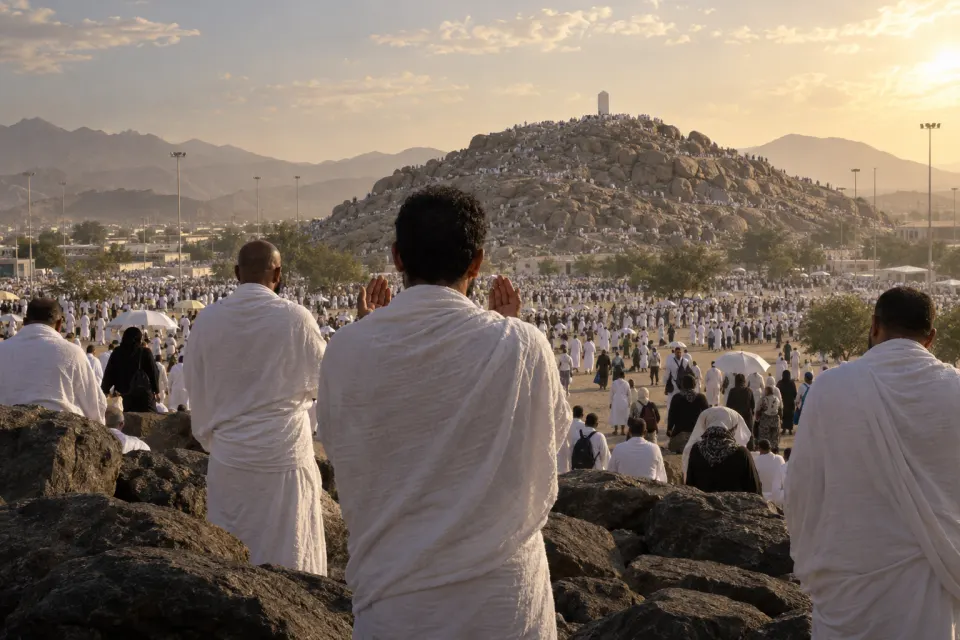
Pilgrims enter the state of iḥrām at the start of the Hajj, which for men means special clothing, and on ʿArafah they stand, pray and call on God through the afternoon. Muslims who are not on pilgrimage are encouraged to fast on ʿArafah. In the Shia rulings of Ayatollahs al-Sistani and Makarem Shirazi the recommended fasts run from the first to the ninth of Dhū al-Ḥijja, but both call the ʿArafah fast disapproved if it would leave one too weak for the day's supplications.[4, 6, 13–14]
Sources
Each statement above was checked against published sources; the verdict says whether it stood as written, was corrected or was hedged.
- VerifiedThe Open University; Encyclopedia.com, Hajj.
- CorrectedEncyclopedia.com, Hajj; The Open University; Office of Ayatollah al-Sistani, Hajj Rituals, Wuquf at Arafat.
- VerifiedLibrary of Congress; Encyclopedia.com, Pilgrimage: Muslim Pilgrimage.
- CorrectedDar al-Ifta al-Misriyyah, The Islamic calendar: a festive tree bearing fruits of mercy; Islam Q&A, Fasting on the Day of Arafah; Office of Ayatollah al-Sistani, Islamic Laws, ruling 1716; Office of Ayatollah Makarem Shirazi, Islamic Laws.
- CorrectedEncyclopedia.com; Encyclopedia.com; Library of Congress.
- CorrectedLibrary of Congress; The Open University.
- VerifiedDar al-Ifta al-Misriyyah, The Islamic calendar: a festive tree bearing fruits of mercy; Congressional Research Service, Muslim Holidays: Fact Sheet.
- VerifiedLibrary of Congress; Congressional Research Service, Muslim Holidays: Fact Sheet.
- VerifiedLibrary of Congress; Encyclopedia.com, Pilgrimage: Muslim Pilgrimage.
- VerifiedLibrary of Congress; Encyclopedia.com, Pilgrimage: Muslim Pilgrimage.
- CorrectedDar al-Ifta al-Misriyyah, The Islamic calendar: a festive tree bearing fruits of mercy; Islam Q&A, Virtues of the Day of Arafah.
- CorrectedDar al-Ifta al-Misriyyah, fatwa 6289; Islam Q&A, Should One Follow Makkah or Their Country for ‘Arafah Day?; muis.gov.sg.
- VerifiedLibrary of Congress; The Open University.
- CorrectedOffice of Ayatollah al-Sistani, Islamic Laws, ruling 1716; Office of Ayatollah Makarem Shirazi, Islamic Laws.