
The story behind the day
Chuseok is Korea's harvest festival, kept at the eighth lunar month's full moon, on its fifteenth day and often called the Korean Thanksgiving. It joins thanks for the year's crops with remembrance of the dead. Families hold a memorial service for their ancestors, called charye, make songpyeon, the half-moon rice cakes of the season, and visit and tend the family graves. These rites are Confucian in form, and Confucian ideas of filial duty give them their weight.[1–7]
Origins
Chuseok comes at the beginning of the harvest season, at the end of the farming year, and is an occasion to give thanks for the crops and to pray for a good harvest the year after. The National Folk Museum of Korea defines the name as the full moon day of the eighth month and calls the holiday Korean Thanksgiving Day. Its date is the eighth month's fifteenth day, the same lunar date on which China keeps the Mid-Autumn Festival.[1–2, 9]
What it marks
Chuseok joins thanksgiving for the crop with thanks to the forebears. For Confucian Koreans, honouring ancestors is a duty of filial piety: Confucius was said to treat venerating ancestors as the fulfilment of filial responsibility rather than a religious act, and ancestral sacrifice is understood as a way to show reverence. The Stanford Encyclopedia of Philosophy counts the ancestral rites, chesa, among the most lasting expressions of Confucian ritual propriety in Korea, and Korea's Cultural Heritage Administration says the holiday's rites help sustain a family culture built on filial piety.[7–8, 10]
How it came to be
Neo-Confucianism became the guiding social and political ideology of the Joseon dynasty, and manuals such as Zhu Xi's Family Rites tied household ritual to the order of the cosmos. Ancestor worship is one of the four household rites that Zhu Xi's Family Rituals sets out, and the historian Martina Deuchler writes that this handbook supplied the Koreans with the rules for the cult.[3]
How it is kept
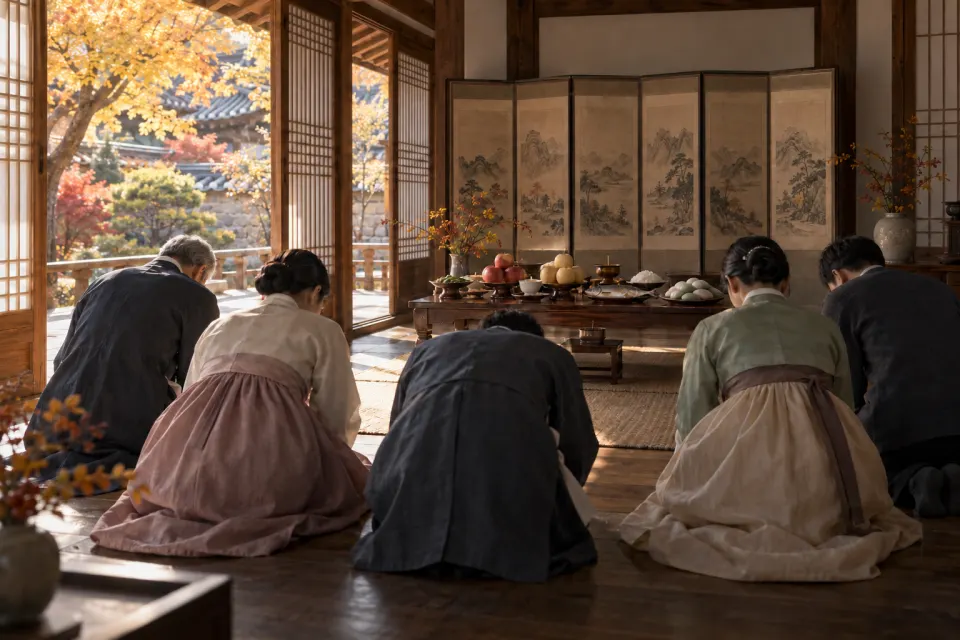
The National Folk Museum of Korea describes charye as a memorial service for one's ancestors, kept today mostly at the great holidays, Seollal and Chuseok, and names songpyeon, half-moon rice cakes, as the seasonal dish for the Chuseok table. The Cultural Heritage Administration calls charye at home and the rite at the graveyard, seongmyo, the two definitive customs of the holiday. Families go to the graves, and the grave and its surroundings are cleaned and tended. Making songpyeon and dancing the ganggangsullae, the circle dance of young women in the south-west beneath the full moon, are among the customs that stand for the full moon.[4–6, 11]
Across traditions
Practice is changing. Industrial society scatters families, the Cultural Heritage Administration observes, yet many Koreans still go back to their hometowns on Chuseok to be with parents, siblings and other relatives. The National Folk Museum adds that charye has moved to later in the day, since many relatives have far to travel.[12]
Sources
Each statement above was checked against published sources; the verdict says whether it stood as written, was corrected or was hedged.
- CorrectedCultural Heritage Administration; National Folk Museum of Korea, Korean Seasonal Customs, Twelve Months of the Lunar Calendar.
- CorrectedCultural Heritage Administration; National Folk Museum of Korea; UNESCO Intangible Cultural Heritage, Ganggangsullae.
- CorrectedStanford Encyclopedia of Philosophy, Korean Confucianism; Martina Deuchler, The Impact of Confucianism on the Korean Kinship System: A Reconsideration, Journal of Confucian Philosophy and Culture 36.
- CorrectedNational Folk Museum of Korea, What is Charye?; Cultural Heritage Administration.
- CorrectedNational Folk Museum of Korea, What is Charye?; Cultural Heritage Administration.
- CorrectedCultural Heritage Administration; National Folk Museum of Korea, Myoje.
- VerifiedPew Research Center, Confucianism, Taoism and Chinese folk religions; Stanford Encyclopedia of Philosophy, Confucius.
- CorrectedCultural Heritage Administration; National Folk Museum of Korea, What is Charye?.
- CorrectedPopular Festivals, World Eras; Smithsonian National Museum of Asian Art, Moon Festival.
- CorrectedStanford Encyclopedia of Philosophy, Korean Confucianism; Cultural Heritage Administration.
- CorrectedUNESCO Intangible Cultural Heritage, Ganggangsullae; Cultural Heritage Administration.
- CorrectedCultural Heritage Administration; National Folk Museum of Korea, What is Charye?.