Beliefs & ideas · 4 min read
Why do Zoroastrians use fire? Prayer, purity and sacred meaning
Understand fire in Zoroastrian worship through community explanations, historical scholarship and the different settings of household and temple practice.
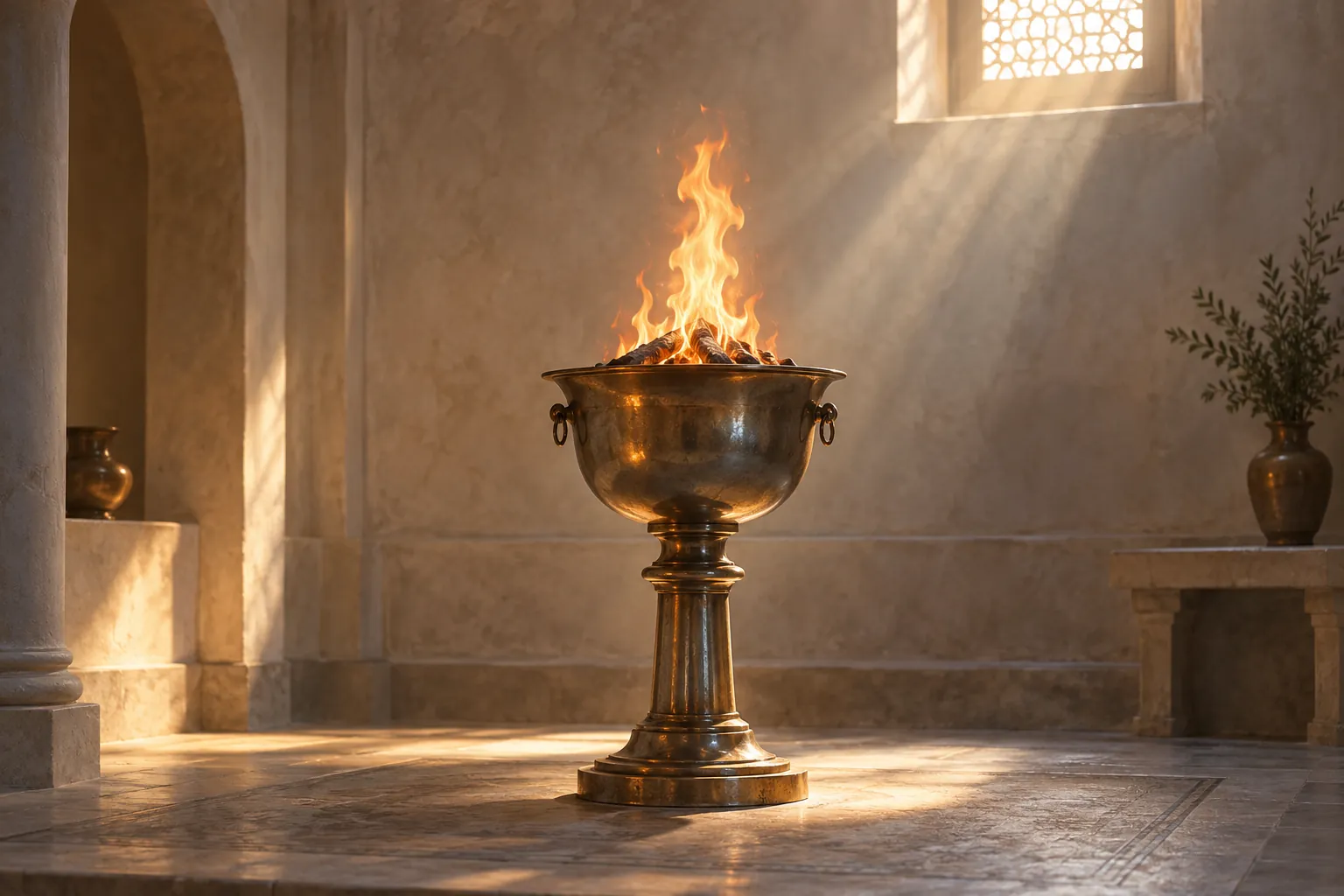
Fire and the direction of prayer
Zoroastrian explanations commonly describe fire or light as a focus for prayer and a sign of divine purity. Harvard’s Pluralism Project explains that worship is directed to Ahura Mazda. Calling a community “fire worshippers” without this context can mistake a visible element of worship for a complete account of whom or what people understand themselves to be addressing. [1]
The Zarathushtrian Assembly describes fire as a symbol connected with enlightenment and the life-giving energy of creation. In its account, a flame or another light can orient prayer. This is the explanation of a particular community organization; it should be identified as such rather than made into a rule that erases every other Zoroastrian interpretation. [2]
More than a decorative light
Mary Boyce’s historical study in Encyclopaedia Iranica traces fire’s religious importance through domestic hearths, ritual care and the personified figure of Atar. This history contains more than a neutral visual aid for concentration. Offerings, consecration and concern for purity distinguish sacred fire from a lamp used only to make a room brighter. [3]
The symbolic explanation and the historical account answer different questions. One explains prayer in the language of a living community; the other examines the development and forms of reverence over time. Read them together without requiring either to stand in for the entire tradition. “Only a symbol” can be as incomplete as a dismissive label when it hides actual religious practice.
Different kinds of sacred fire
Iranica distinguishes categories including Atash Bahram, Adaran and Dadgah. Their preparation and care differ, and a Dadgah fire may be tended by a lay person who meets the required conditions of purity. A general reference to a “fire temple” does not tell a reader which category of fire is present or which rituals maintain it. [3]
Boyce also notes differences between Iranian and Parsi observances. This makes blanket claims unreliable: every temple should not be assumed to follow identical arrangements, and every Zoroastrian household should not be imagined as maintaining the same kind of consecrated fire. A specific claim about an individual temple needs a source for that place and its practices. [3]
Fire, water and ethical responsibility
An Assembly essay by Theo Kapur connects care for fire with asha, religiously understood order, and with responsibility toward creation. It also emphasizes reverence for water. Focusing an introduction on flame should not leave the impression that fire is the only part of the natural world with religious significance in Zoroastrian life. [4]
Kapur links good thoughts, words and deeds to moral responsibility and care for living things. This community interpretation makes the relationship between worship and conduct explicit. It is not enough to identify a striking ritual object and assume that its appearance exhausts the tradition’s teaching about how a person should live. [4]
A community space as well as a prayer room
The Pluralism Project describes a Chicago-area dar-e-mehr with a prayer room, a fire vase on a raised platform, lamps and sandalwood offerings. Its account also places worship within a community setting that includes learning and social activity. This is a documented example, not a template to impose on every Zoroastrian center in another city or country. [1]
The same essay notes household prayer and smaller gatherings. A beginner should therefore avoid defining religious participation only through attendance at a large temple. Its descriptions are useful for understanding forms of community life; older membership figures or historical building details should not automatically be treated as a current directory for planning a visit. [1]
How to ask better questions about a fire temple
Before visiting, ask whether the intended site admits visitors and what local instructions apply. A description of a welcoming learning center does not establish access to every temple. For study, useful questions include how the community explains the fire, who tends it and what role the space plays in everyday religious life.
When evaluating an image, distinguish a documentary photograph from an illustration and avoid assigning a ritual grade to an unidentified flame. When evaluating an explanation, note whether it comes from a community, a historian or a travel writer. Those simple distinctions lead to a fuller account of Zoroastrian fire than either an exotic label or a single sentence stripped of its source.
Sources & further reading
The numbered links connect claims to the sources below. Sources checked October 14, 2026 by a separate AI fact-checking agent. This is not human or specialist review. Read our editorial approach.
- A Visit to a Dar-e-Mehr ↗The Pluralism Project, Harvard University · Accessed October 14, 2026
- FAQs: Do Zoroastrians worship fire? ↗Zarathushtrian Assembly · Accessed October 14, 2026
- ĀTAŠ ↗Encyclopaedia Iranica · Accessed October 14, 2026
- Zoroastrianism, an Environmental Religion ↗Zarathushtrian Assembly · Accessed October 14, 2026
Found a problem? Send a correction with the passage and a supporting source.
Continue your reading
All articles ↗
History · 3 min read
What is the oldest religion? What the evidence can tell us
Separate prehistoric ritual evidence, ancient written religions and continuing traditions to understand why there is no single agreed “oldest religion.”

People & places · 3 min read
Which countries are most religiously diverse? How to read the index
Learn what Pew’s religious diversity index measures, why Singapore ranks first in its 2020 data, and what national rankings leave out.

Beliefs & ideas · 3 min read
What does dharma mean? Context across traditions
Explore dharma as duty, teaching and order, including Hindu, Buddhist and Jain uses, without forcing one English translation onto every passage.