Beliefs & ideas · 3 min read
What Is Puja? Hindu Worship, Offerings, and Home Practice
Understand Hindu puja, the meaning of offerings and darshan, and how home and temple practices differ across traditions.
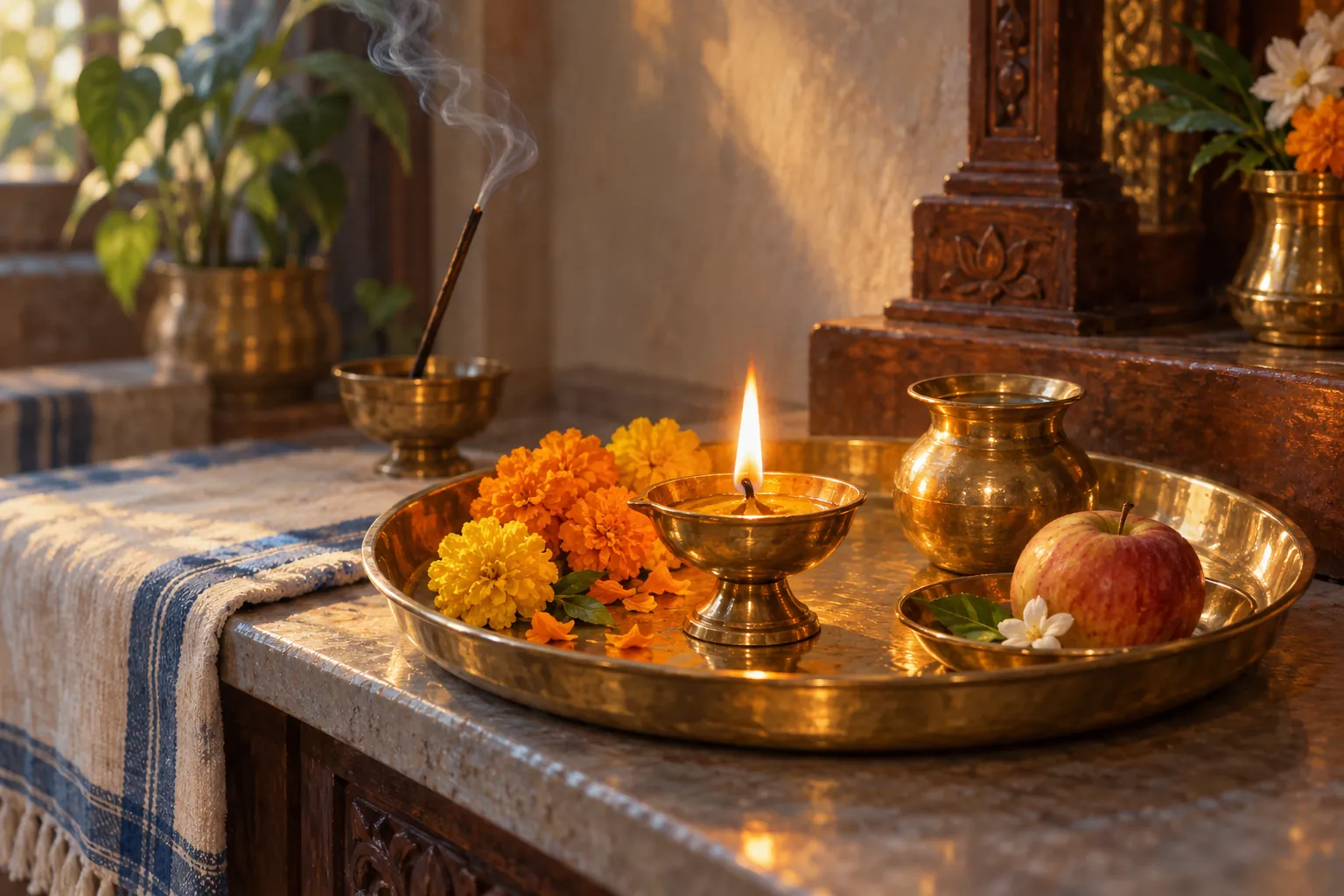
The meaning and scope of puja
Puja broadly means worship in religious traditions of India. This guide focuses on Hindu puja, often explained through hospitality offered to the divine. The word also appears in other traditions, whose understanding of an offering may differ. Harvard's Pluralism Project, for example, distinguishes Hindu offerings to a deity from Jain puja before an image of a Jina, who is not understood to receive them. [1]
Why there is no single universal sequence
A home puja can involve flowers, fragrance, a lamp, water, or food. The Hindu American Foundation's guide presents several formats, from a brief observance to a sixteen-offering sequence. The range is itself instructive: puja is not the name of one fixed script that every Hindu household must perform identically. The guide allows a home shrine to center on a murti, picture, or sacred symbol. [2]
In that guide, an upachara is an offering or act of service, while naivedya refers to food presented as an offering. The items are part of a relationship of devotion, rather than a checklist whose length determines a worshipper's worth. Its different formats also allow a reader to distinguish a general explanation of puja from the instructions of a particular household or community. [2]
A named example: BAPS morning puja
BAPS Swaminarayan Sanstha describes morning puja through meditation, introspection, mantra repetition, prayer, and scripture reading. Its account of a home mandir also includes family worship, arti, and food offerings. This is a specific Swaminarayan example, not a claim that all Hindus follow BAPS's theology or daily schedule. It makes clear, however, that puja can involve attention, remembrance, and study alongside the handling of ritual objects. [3]
A photograph of a tray or a shrine therefore shows only part of the activity described in that tradition. Quiet prayer and personal reflection may be central even though they are less visible. The BAPS account presents an ideal of devotional practice; it does not establish that every individual devotee carries it out in exactly the same way each day. [3]
Murti and darshan
A murti is a sacred image. In the temple practice discussed by Harvard's Pluralism Project, the image focuses divine presence; this understanding does not confine divinity to the material of the sculpture. Permanent temple images may undergo consecration and receive daily care. Some other observances invite divine presence temporarily. The source describes these rites as ways of welcoming and attending to the deity. [4]
Darshan involves seeing the deity and being seen. That reciprocal understanding helps explain why viewing an image can itself be a devotional encounter, rather than merely looking at an artwork. It also explains why museum-style descriptions of material and date cannot, on their own, capture what a worshipper understands to be happening. Hindu traditions differ, and an image-centered temple practice should not be treated as a requirement for every Hindu. [4]
Sources & further reading
The numbered links connect claims to the sources below. Sources checked October 14, 2026 by a separate AI fact-checking agent. This is not human or specialist review. Read our editorial approach.
- Puja ↗Harvard University Pluralism Project · Accessed October 14, 2026
- Pūjā at Home — A Practical Guide for Hindu Americans ↗Hindu American Foundation · Accessed October 14, 2026
- Spirituality & Satsang: Morning Puja ↗BAPS Swaminarayan Sanstha, North America · Accessed October 14, 2026
- Abodes of God: Temple and Image ↗Harvard University Pluralism Project · Accessed October 14, 2026
- Lamp Offerings: Hindu Worship ↗Harvard University Pluralism Project · Accessed October 14, 2026
Found a problem? Send a correction with the passage and a supporting source.
Continue your reading
All articles ↗
Sacred texts · 3 min read
What Does Om Mean? Aum, the Upanishads, and Sacred Sound
Explore Om and Aum, the Mandukya Upanishad’s interpretation, and distinct Hindu and Buddhist uses of the sacred syllable.

Sacred texts · 3 min read
How to read the Bhagavad Gita: a beginner’s route
Start the Bhagavad Gita with its dramatic setting, follow action, knowledge and devotion, and keep translation and commentary distinct.