Sacred texts · 3 min read
The Dead Sea Scrolls Explained: Languages, Contents, and Discovery
What are the Dead Sea Scrolls? Learn about the Qumran manuscripts, their languages, biblical and other writings, and why they matter.
What the name covers
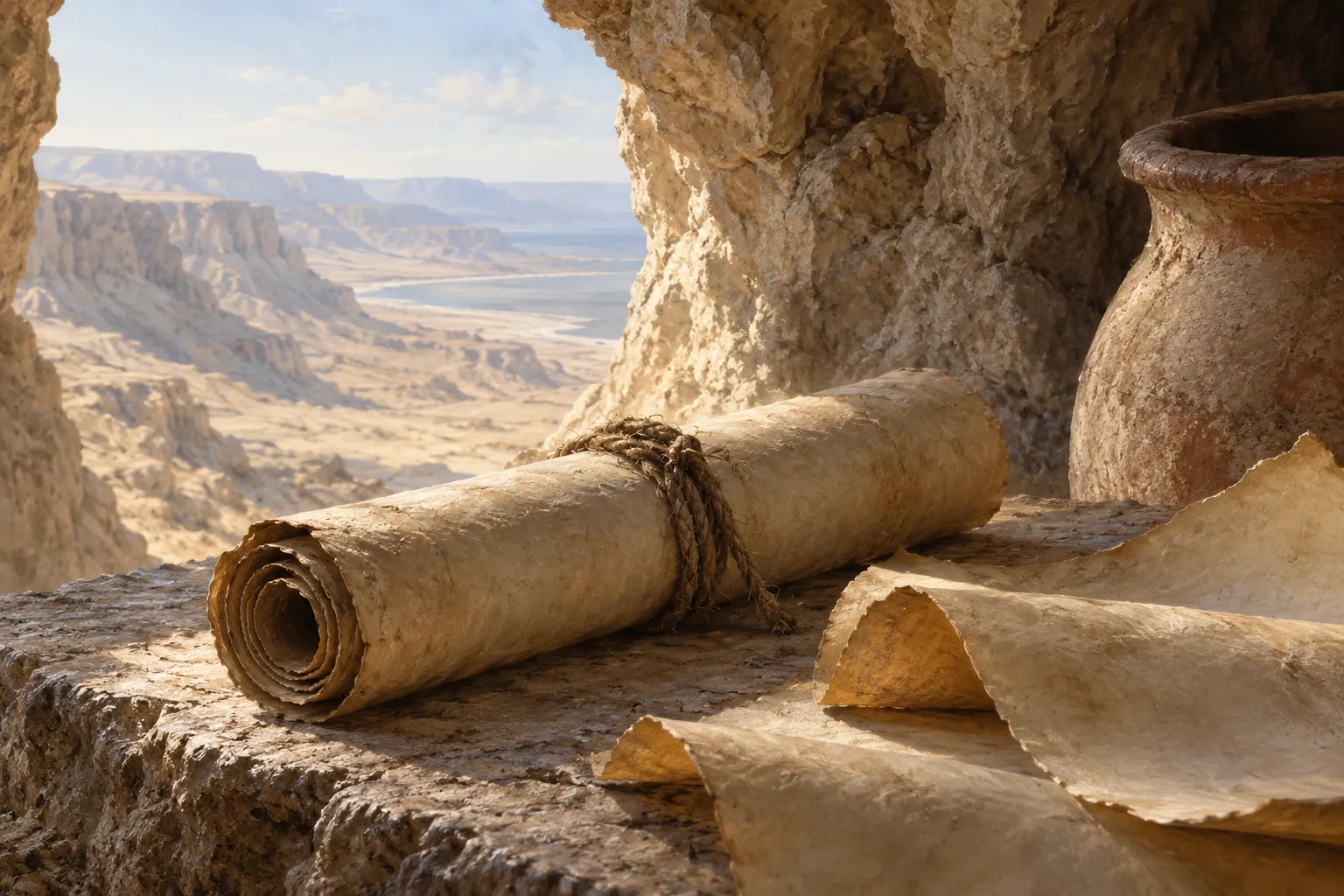
The Dead Sea Scrolls include ancient manuscripts found in the Judean Desert. The famous Qumran cave writings date from the third century BCE to the first century CE; many survive only as fragments. The Israel Antiquities Authority distinguishes these from documents discovered at other desert sites, which span different periods. Parchment is the main material at Qumran, with papyrus and the exceptional Copper Scroll also represented. The collection includes writings now in the Hebrew Bible and other Jewish religious literature. [1]
Discovery began in 1947
The first discoveries in 1947 brought seven scrolls to attention. Finds in ten further nearby caves followed over the next nine years. The Israel Antiquities Authority describes more than nine hundred manuscripts from the Qumran discoveries, but that does not mean nine hundred complete books lying intact on shelves. Cave 4 alone yielded thousands of pieces from hundreds of manuscripts, making identification and reconstruction a substantial part of the work. [2]
The initial scrolls included Isaiah, the Community Rule, a commentary on Habakkuk, the War Scroll, thanksgiving hymns, and the Genesis Apocryphon. Even that short list shows why calling the discovery simply an ancient Bible is inadequate. The material includes scriptural books, interpretation, and writings concerned with a religious community's life and expectations. [2]
Hebrew, Aramaic, and Greek
Hebrew is the principal language of the Qumran corpus; Aramaic and Greek are also represented. Language and script are different questions. The Israel Antiquities Authority describes both square Hebrew writing and older Hebrew letter forms, including cases where older forms are used for the divine name. A manuscript's visual appearance therefore involves choices of script as well as the language of its words. [3]
The authority's discussion of Greek fragments explicitly says attempts to identify New Testament texts among them have been unsuccessful. Greek writing does not itself make a manuscript Christian. Nor should languages found in the wider, later Judean Desert holdings automatically be assigned to the Qumran religious corpus. Keeping the site and date range clear prevents several common misunderstandings. [3]
Three examples beyond a single Bible volume
The Library of Congress exhibition includes portions of Enoch in Aramaic, a commentary on Hosea, and Songs of the Sabbath Sacrifice. These represent different kinds of writing. The Hosea commentary is a pesher, interpreting prophetic verses; the Sabbath Songs contain thirteen liturgical sections. Enoch adds another example of Jewish religious literature preserved alongside texts that became part of the familiar Hebrew Bible. [4]
The exhibition also notes debate about how to classify the writings and identify their communities. An inkwell may help make local scribal activity plausible, but it cannot prove that every manuscript was copied at Qumran. Surviving objects and literary similarities are evidence to interpret, not a label establishing one author or one origin for the entire collection. [4]
Why conservation matters to reading
Dry cave conditions helped preserve the manuscripts, but their discovery also exposed them to changes in environment and handling. The Israel Antiquities Authority records damage from early adhesive tape and glass storage. Later conservation has emphasized controlled conditions, careful documentation, and treatments designed to be reversible. A readable digital image is therefore partly the result of work on the physical fragment, not simply a photograph of a perfectly preserved page. [5]
Conservators record and photograph individual pieces, and digital imaging helps researchers study them with less repeated handling. For a reader browsing the digital library, this is an important distinction: the image offers access to surviving evidence. It cannot supply words from material that no longer survives or remove the interpretive work needed to join fragments and understand damaged passages. [5]
Sources & further reading
The numbered links connect claims to the sources below. Sources checked October 14, 2026 by a separate AI fact-checking agent. This is not human or specialist review. Read our editorial approach.
- Introduction — The Dead Sea Scrolls ↗Israel Antiquities Authority, Leon Levy Dead Sea Scrolls Digital Library · Accessed October 14, 2026
- Discovery and Publication ↗Israel Antiquities Authority, Leon Levy Dead Sea Scrolls Digital Library · Accessed October 14, 2026
- Languages and Scripts ↗Israel Antiquities Authority, Leon Levy Dead Sea Scrolls Digital Library · Accessed October 14, 2026
- The Qumran Library — Scrolls from the Dead Sea ↗Library of Congress; 1993 exhibition with Israel Antiquities Authority loans · Accessed October 14, 2026
- Conservation — The Dead Sea Scrolls ↗Israel Antiquities Authority, Leon Levy Dead Sea Scrolls Digital Library · Accessed October 14, 2026
Found a problem? Send a correction with the passage and a supporting source.
Continue your reading
All articles ↗
Sacred texts · 3 min read
Septuagint vs Hebrew Bible: Language, Books, and Textual Differences
Understand the Septuagint’s Jewish origins, its varied Greek texts, and differences of wording, contents, and order from the Hebrew Bible.
Comparisons · 3 min read
Torah vs Tanakh vs Talmud: a guide to the terms
Understand how Torah, Tanakh, Mishnah, Gemara and Talmud relate, and why Torah can mean more than the first five biblical books.
Sacred texts · 3 min read
The Nag Hammadi Library: Coptic Books, Thomas, and the 1945 Find
Explore the Nag Hammadi manuscripts, their Coptic texts and publication history, and which details of their discovery remain uncertain.