
Overview
Yorùbá religion, which many practitioners now call Ìṣẹ̀ṣe or òrìṣà religion, is the indigenous religion of the Yorùbá people of south-western Nigeria and neighbouring Benin and Togo. It speaks of a supreme God, Olódùmarè, and of many òrìṣà, approached through offerings, divination, music and festivals. Yorùbá teaching holds that each person's orí, or inner head, carries a destiny received before birth, and families honour their dead as ancestors. The religion has no founder and no written scripture; its knowledge lives in priesthoods and in the chanted verses of Ifá divination, which UNESCO lists as heritage of humanity. Most Yorùbá today are Christians or Muslims, yet òrìṣà devotion continues in West Africa and, carried by enslaved Africans, across the Americas.[1–4, 9, 12–16]
History

Ifẹ̀ and sacred kingship c. 500–1500 CE
Ifẹ̀ began as a cluster of hamlets around the 6th century CE, and by the 9th to 11th centuries it was a thriving city and royal capital. Between about 1200 and 1500 its artists made the naturalistic copper-alloy and terracotta heads for which it is famous. Yorùbá tradition places the start of creation here: sent by Olódùmarè, Odùduwà became the first king while Ọbàtálá shaped human bodies from clay. Yorùbá kings still trace their lines to Odùduwà, and the Ọọ̀ni of Ifẹ̀ is regarded as the spiritual head of the Yorùbá. The archaeologist Akinwumi Ogundiran argues that the religion has changed alongside Yorùbá society for some two thousand years.[17–21]
The Ọ̀yọ́ empire c. 1600–1837
Ọ̀yọ́, the northernmost Yorùbá kingdom, used its cavalry to become an empire that dominated the lands between the Volta and the Niger at its height, about 1650–1750. Its rulers, the Aláàfin, drew spiritual authority from a sword given by the Ọọ̀ni of Ifẹ̀. Ṣàngó, remembered as an early king of Ọ̀yọ́ who became an òrìṣà, had a cult that became part of royal installation and spread with the empire. Ọ̀yọ́'s foreign trade depended on selling captives to European ships on the coast. From 1817 a revolt at Ìlọrin, backed by Fulani Muslims, broke the empire apart, and the old capital was destroyed in the 1830s.[22–26]
Across the Atlantic 1700s–1860s
In the 18th and 19th centuries thousands of Yorùbá were enslaved and shipped to the Americas, and the wars of Ọ̀yọ́'s collapse sent many of them, through ports such as Lagos and Ouidah, mainly to Brazil and Cuba. Where they could, they rebuilt òrìṣà worship, often pairing òrìṣà with Catholic saints. Known as Lucumí in Cuba and Nagô in Brazil, they shaped Lucumí (Santería) and Candomblé. Free Yorùbá who reached Trinidad as indentured workers in the mid-19th century founded the religion long called Shango, now Orisha.[10, 27–29]
Islam, Christianity and colonial rule 1800s–1960
Islam's major inroads among the Yorùbá followed the early 19th-century jihad, which made Ìlọrin an emirate of the Sokoto caliphate. Anglican missionaries and Christian Yorùbá returning from Sierra Leone settled at Abẹ́òkúta in the 1840s, and Yorùbá agents did much of the mission's work. Under colonial rule and religious pressure, traditional belief and practice faced discrimination. In a 2012–13 survey of Yorùbá states, about two-thirds of respondents were Christian and almost one-third Muslim. Many Nigerians who name Christianity or Islam as their religion still blend it with traditional beliefs.[11, 30–33]
Revival at home and abroad 1959–today
Cuban exiles after 1959 carried Lucumí to Miami, New York and beyond. In 1960 Walter King, an African American initiated in Cuba, opened the Yoruba Temple in Harlem, and around 1970 he founded Ọ̀yọ́túnjí African Village in South Carolina. In Nigeria, artists led by the Austrian-born Susanne Wenger restored the Ọ̀ṣun grove at Òṣogbo from the 1960s; UNESCO inscribed it in 2005, the year it proclaimed Ifá a masterpiece of intangible heritage. Osun State made 20 August Ìṣẹ̀ṣe Day in 2013, and Lagos, Ogun and Oyo have since followed.[14, 34–37]
Key moments
- c. 1750 CEAfrican religions cross the Atlantic · West and Central Africa to the Americas
Beliefs
Olódùmarè · Olódùmarè
the supreme God
Yorùbá tradition names Olódùmarè, also called Ọlọ́run, as the high God and source of all things, who sent the òrìṣà to make the world. Olódùmarè is not honoured with an annual festival as many òrìṣà are; for help in daily life people turn mainly to the òrìṣà. In some creation stories it is Olódùmarè who breathes life into the human figures Ọbàtálá moulds.[4, 19, 38]
Òrìṣà · òrìṣà
divinities
Tradition speaks of 401 òrìṣà, and which of them are worshipped differs from town to town. The Nigerian scholar J. Omosade Awolalu sorted them into primordial beings that came from God, deified ancestors such as kings and city founders, and forces of nature like rivers, hills and the earth, categories that often overlap.[5, 39]
Àṣẹ · àṣẹ
power to make things happen
Àṣẹ is the divine, generative power that runs through gods, ancestors, people and things, the warrant for all creative action against chaos. Ritual objects, words and offerings are understood to carry and direct it, and Èṣù is called the keeper of àṣẹ. The scholar John Pemberton describes it as a power with no particular meaning of its own that nonetheless fills every thing and person.[40–41]
Orí · orí
head; one's inner self and destiny
Besides the physical head, each person has an orí inú, an inner head that comes from God before birth and shapes character and fate. Tradition says the soul chooses this destiny kneeling before Olódùmarè and forgets it at birth; a poor destiny can be eased through patient effort and the help of the òrìṣà. Many keep a small cowrie-covered shrine for the head, the ilé orí.[12, 42–43]
Ancestors
forebears
Yorùbá lineages include the living, the dead and those not yet born. The ancestors who founded a family house are believed to keep standing surety for it, and they return in visible form in egúngún masquerades, through which the living renew their bond with them. Most Yorùbá groups trace descent through the father's line.[13, 44–45]
Practice

Ifá divination · Ifá
When an important personal or communal decision is due, people consult a babaláwo, a priest of Ifá. He manipulates sixteen sacred palm nuts (ìkin) or casts a divining chain (ọ̀pẹ̀lẹ̀) to find one of 256 odù, then chants its verses and interprets them for the client. Ifá relies on a system of signs read by a trained diviner rather than on spirit possession, and a consultation usually ends by prescribing an offering.[6, 9, 46–47]
Offerings and shrines · ẹbọ
Each òrìṣà is honoured at shrines holding sacred objects, such as stones set in water, where it is addressed in prayer and fed with offerings (ẹbọ): every rite involves some sacrifice, from a prayer or kola nut to an animal. Èṣù is the bearer of sacrifices to their destination. Worship also takes place at sites in nature, such as a river where an òrìṣà dwells.[47–50]
Priesthood and initiation
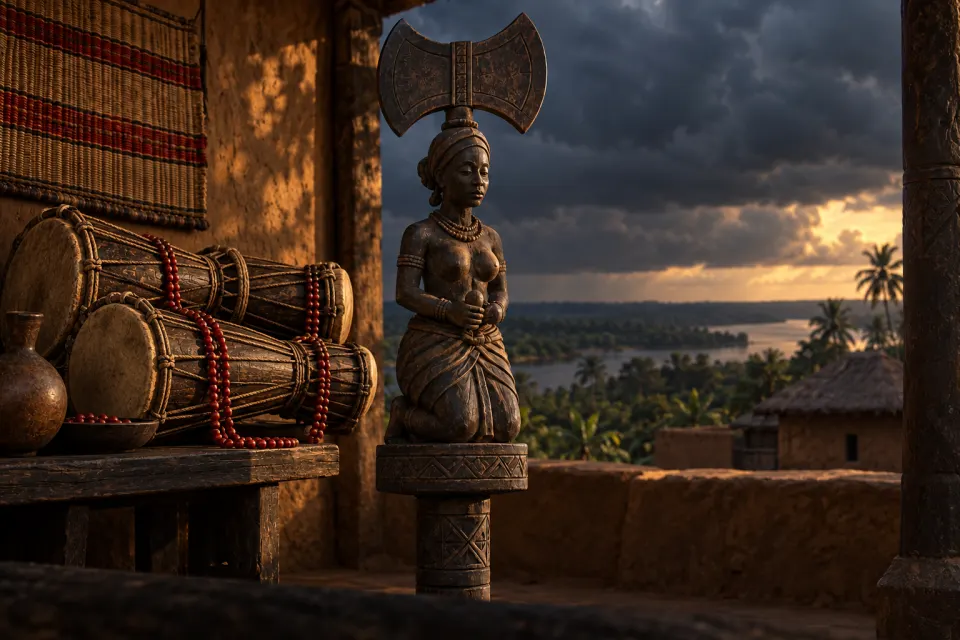
Each òrìṣà has its own cult group and priesthood, and both priests and priestesses serve. Ṣàngó's priests dance with his double-headed axe, and the bàtá drums are his. In the shrines of Ọ̀ṣun's grove at Òṣogbo, designated priests and priestesses tend nine worship points along the river. At Òṣogbo the king, the Àtáọ̀jà, and his council also carry out rites for the goddess.[8, 51–52]
Egúngún masquerade · Egúngún
In egúngún festivals, masqueraders in costumes of many layered cloths embody returning ancestors, visiting families and blessing the town. Some are solemn; others satirise human failings. The masquerade travelled with Yorùbá people to Benin, Sierra Leone and the Americas. A single ensemble from Ògbómọ̀ṣọ́, now in the Brooklyn Museum, joins over 300 cloths sourced from three continents.[44, 53–54]
Holy days
The year ahead
| Date | Holy day | Reckoned |
|---|---|---|
| 20 August 2027 | Ìṣẹ̀ṣe Day Ọjọ́ Ìṣẹ̀ṣe | 20 August |
Ọ̀ṣun-Òṣogbo Festival
Yearly, about two weeks spanning late July and August
A twelve-day processional festival renews the bond between Ọ̀ṣun, the ruler and the people of Òṣogbo. Devotees go to the river to make offerings and to pray for children, health and wealth.[55]
Egúngún festival · Ọdún Egúngún
Yearly, on dates set by each town
Ancestral masqueraders come out over the festival, visiting families, dignitaries and sacred sites, while the community honours its dead. Pemberton ranks it first among Yorùbá festivals in both reach and importance.[56]
Ìṣẹ̀ṣe Day · Ọjọ́ Ìṣẹ̀ṣe
20 August
A day celebrating Yorùbá tradition and religion with rites, dances, lectures and parades. Osun State made it a public holiday in 2013, and Lagos, Ogun and Oyo states followed from 2023.[37]
People

Ọbàtálá · Ọbàtálá
deity
In many tellings Olódùmarè gave Ọbàtálá the task of creating the land, and he is the òrìṣà who shapes the human body from clay. In some versions Odùduwà took over the creation of the earth from him.[19]

Odùduwà · Odùduwà
ruler
By tradition the first king of Ifẹ̀ and ancestor of Yorùbá royal lines. In one well-known telling he climbed down a chain from the sky and spread earth on the primeval water, making the first dry land at Ifẹ̀.[19–20]

Ọ̀rúnmìlà · Ọ̀rúnmìlà
deity
The òrìṣà of wisdom and of Ifá divination, also called Ifá. Through the odù verses that babaláwo recite, Ọ̀rúnmìlà is understood to reveal what a person's destiny requires. Babaláwo serve as his priests.[57]


Ògún · Ògún
deity
Òrìṣà of iron and war, patron of blacksmiths, hunters and warriors, and among the most widely worshipped. The scholar John Pemberton counts seven Ògún. Scholars read him as a figure in whom creation and destruction meet, since iron both builds and kills.[60]

Ọ̀ṣun · Ọ̀ṣun
deity
Òrìṣà of the Ọ̀ṣun River, of sweet and healing water, fertility and women's power. In one myth she alone could bring life to the earth after the male òrìṣà failed. Tradition says she allowed the founders of Òṣogbo to settle by her river.[61]

Yemọja · Yemọja
deity
Mother òrìṣà of waters and fertility, linked with the Ògùn River, whose main Nigerian shrine is at Abẹ́òkúta. Her name is usually explained as "mother whose children are fish". In the Americas she became the sea goddess Yemayá and Iemanjá.[62]
Scripture
Odù Ifá · Odù Ifá
Oral; age unknown
The corpus of Ifá is divided into 256 odù, each holding many verses (ẹsẹ), perhaps around 800 per odù, and new ones are still added. Babaláwo memorise and chant them in poetic language. They carry history, beliefs and ethics, and Yorùbá scholars, notably Wande Abimbola, treat them as the foundation of Yorùbá knowledge.[6, 63]
Praise poetry and lineage chants · oríkì
Oral
Yorùbá has a rich oral literature of poetry, myths and proverbs. Sacred and family knowledge travels in performance, such as the praise poems and lineage histories that women's choruses chant when egúngún come out, and the stories (ìtàn) told about each òrìṣà.[64]
Places

Ilé-Ifẹ̀
NGA
Probably the oldest Yorùbá town, regarded as holy and as the place where humankind began. The palace of the Ọọ̀ni, seat of Yorùbá sacred kingship, stands at its centre. Yorùbá kings have long looked to Ifẹ̀ to confirm their right to wear beaded crowns.[7, 20, 65]
Osun-Osogbo Sacred Grove
NGA · UNESCO World Heritage, 2005
A 75-hectare forest on the edge of Òṣogbo, regarded as Ọ̀ṣun's home, with about forty shrines and sculptures along her river. Probably the last of the sacred groves that once stood outside every Yorùbá town, it was inscribed as a World Heritage Site in 2005.[66]
Ọ̀yọ́
NGA
Today's Ọ̀yọ́, founded in the 1830s after the old imperial capital to the north was abandoned, is the seat of the Aláàfin. Since at least the 19th century, part of a new Aláàfin's installation has taken place at Kòso, Ṣàngó's chief shrine.[67]
Where it spread
| Region | From | How |
|---|---|---|
| Nigeria | 1000 CE | Ile-Ife, sacred city of the orisha; flourished c. 1000–1400, origins older |
| Benin | 1500 CE | Nagô and Ketu Yoruba kingdoms in the southeast; approximate date |
| Cuba | 1820 CE | NGA. Santería (Lucumí), formed by enslaved Yoruba in the early 19th century |
| Brazil | 1830 CE | NGA. Candomblé Ketu (Nagô); the Casa Branca terreiro in Salvador dates from the 1830s |
| Trinidad and Tobago | 1850 CE | NGA. Orisha (Shango), brought by liberated Yoruba indentured workers |
| Uruguay | 1958 CE | BRA. Batuque, an orisha tradition from southern Brazil |
| Puerto Rico | 1960 CE | CUB. Santería brought by Cuban exiles |
| United States | 1960 CE | CUB. Santería via Cuban exiles; Yoruba Temple in Harlem, 1960 |
| Venezuela | 1965 CE | CUB. Santería brought by Cuban exiles; grew from the 1980s |
| Argentina | 1966 CE | BRA. Batuque, an orisha tradition from Brazil and Uruguay |
| Mexico | 1990 CE | CUB. Santería of Cuban lineage, rare before the 1990s |
Art & objects
Public-domain objects from museum collections. Select one to see it at the museum.
 Veranda Post (Òpó Ògògá)Ikere, 1910-14
 Esu Dance Staff (Ogo Elegbara)Nigeria, Mid–late 19th century
 Tapper (Iroke Ifa)Nigeria, 17th or 18th century
 Pair of Staffs (Edan)Nigeria, 19th century or before
 Royal Cap (Orikogbofo)Nigeria, Early/mid–20th century
 Headdress (Ago Egungun)Nigeria, Mid–late 19th century
 Shrine Figure for SàngóAfrica, West Africa, Nigeria, Yorùbá-style maker, c. 1910
 Egúngún Masquerade Dance CostumeAfrica, West Africa, Nigeria, Yorùbá-style maker, 1900s
 Diviner's Bag (Apo Ifa)Africa, West Africa, Nigeria, Yorùbá-style maker, 1900s
 Divination Tray (ọpọ́n Ifá)Africa, West Africa, Nigeria, Yorùbá-style maker, 1900s
 Twin Figure (Ère Ìbejì)Africa, West Africa, Nigeria, Yorùbá-style maker, late 1800s–early 1900s
 Àgéré Ifá (Ifá divination vessel) with kneeling womanYoruba peoples, Owo group, 17th–19th century
 Aṣọ òkèYoruba peoples, late 19th century
Numbers
- Traditionalists in a south-west Nigeria survey
- 1.3% of 2,819 respondents (2012–13)[11]
The Knowing Each Other survey; 67.1% were Christian and 31.6% Muslim. Many Christians and Muslims also take part in some traditional rites.
- Nigerians outside Christianity and Islam
- 0.6–2% (Pew estimates for 2015 and 2020)[68]
Includes followers of traditional religions and people with no religion; many Christians and Muslims also take part in traditional rites.
- Parts (odù) of the Ifá corpus
- 256[6]
How we know
Counting followers
No census or survey counts Ìṣẹ̀ṣe worldwide. Pew puts all Nigerians outside Christianity and Islam at 0.6–2% of the population, and a large 2012–13 survey in Yorùbá states found 1.3% who called themselves traditionalists. Self-description understates practice, since many Nigerians blend Christianity or Islam with traditional beliefs, and in Cuba Santería's overlap with Catholicism makes it hard to measure. Atlas therefore gives no follower total.[11, 33, 68–69]
How the history is known
Much of the evidence is oral: Ifá verses, lineage chants and town traditions, which preserve history but vary from place to place. Archaeology at Ifẹ̀ supplies dates and art. Nineteenth-century mission records, including the letters and diaries of missionaries and of the first literate Yorùbá converts, were studied closely by the historian J. D. Y. Peel to trace the encounter between Christianity and òrìṣà worship from both sides. Ogundiran argues that scholars have overlooked the religion's deep, changing history, which he traces over two thousand years.[6, 18, 21, 70]
Common misconceptions
Myth Èṣù is the Yorùbá devil.
Fact In Yorùbá tradition Èṣù is the messenger who carries offerings to the òrìṣà and the keeper of àṣẹ. He can be a disruptive trickster, but he is not a power of evil opposed to God. The equation with Satan comes from the 19th-century Yorùbá Bible, which used his name for the devil. Practitioners reject it, and some scholars argue it has cut Èṣù off from his own cosmology, though some Christian theologians defend it.[49, 58–59]
Myth Santería, Candomblé and Vodou are simply Yorùbá religion in the Americas.
Fact Lucumí (Santería) and Candomblé grew from Yorùbá òrìṣà worship but took shape in Cuba and Brazil, absorbing Catholic and other African elements. Haitian Vodou combines Fon, Kongo, Yorùbá and other African traditions with Catholic beliefs, so it is not a Yorùbá religion as such.[10, 28, 71]
Myth Ifá is fortune-telling by someone with psychic powers.
Fact UNESCO stresses that Ifá does not depend on a diviner's personal oracular powers. A trained babaláwo reads a system of signs and recites verses learned over many years, and the consultation leads to advice and a prescribed offering for a decision at hand.[46–47]
Glossary
- Òrìṣà · òrìṣà
- A Yorùbá divinity: a primordial being, deified ancestor or force of nature, honoured through its own priesthood. Spelled orisha in English and orixá in Brazil.[39, 72]
- Àṣẹ · àṣẹ
- The divine power to make things happen, present in gods, ancestors, people and things, and the warrant for all creative action.[40]
- Orí · orí
- The head; above all the inner head (orí inú) that carries a person's character and destiny.[12]
- Babaláwo · babaláwo
- A priest of Ifá divination. The title is glossed as "father of the mystery" or "father of ancient wisdom".[73]
- Odù · odù
- One of the 256 divisions of the Ifá corpus, each with its own sign and many verses (ẹsẹ).[6]
- Ẹbọ · ẹbọ
- An offering or sacrifice to an òrìṣà or ancestor, often prescribed by divination.[47]
- Egúngún · egúngún
- A masquerade embodying the ancestors, and the society that performs it.[44]
- Ọọ̀ni · Ọọ̀ni
- The king of Ilé-Ifẹ̀, regarded as the spiritual head of the Yorùbá and a descendant of Odùduwà.[20]
- Ìṣẹ̀ṣe · Ìṣẹ̀ṣe
- The name many Yorùbá now use for their indigenous religion, alongside òrìṣà religion.[1]
- Lucumí · Lucumí
- The name for Yorùbá people in Cuba, and for the Cuban òrìṣà religion often called Santería.[74]
Sources
Each statement above was checked against published sources; the verdict says whether it stood as written, was corrected or was hedged.
- VerifiedAkinwumi Ogundiran, Yorùbá Indigenous Religion, Oxford Research Encyclopedia of African History; Oluwaseun Olanrewaju, Yoruba indigenous religion; The Guardian (supporting).
- VerifiedBritannica, Yoruba; World Religions and Spirituality Project; Oluwaseun Olanrewaju, Yoruba indigenous religion.
- VerifiedOluwaseun Olanrewaju, Yoruba indigenous religion; UNESCO Intangible Cultural Heritage, Ifa divination system; Akinwumi Ogundiran, Yorùbá Indigenous Religion, Oxford Research Encyclopedia of African History.
- VerifiedEncyclopedia of Religion, John Pemberton III, Yoruba Religion; The Metropolitan Museum of Art, Heilbrunn Timeline, Ife; Britannica, Oshun.
- VerifiedEncyclopedia of Religion, John Pemberton III, Yoruba Religion; Britannica, Yoruba.
- VerifiedUNESCO Intangible Cultural Heritage, Ifa divination system; Encyclopedia of Religion, John Pemberton III, Yoruba Religion; Oluwaseun Olanrewaju, Yoruba indigenous religion.
- VerifiedBritannica, Ile-Ife; The Metropolitan Museum of Art, Heilbrunn Timeline, Ife.
- VerifiedBritannica, orisha; UNESCO World Heritage Centre, Osun-Osogbo Sacred Grove.
- VerifiedUNESCO Intangible Cultural Heritage, Ifa divination system; Encyclopedia of Religion, John Pemberton III, Yoruba Religion; Oluwaseun Olanrewaju, Yoruba indigenous religion.
- VerifiedBritannica, Santeria; Encyclopedia of Religion, Rachel E. Harding, Afro-Brazilian Religions; Ryan J. Bazinet, The Sonic Structure of Shango Feasts, Ethnomusicology Review; Encyclopedia of Religion, George Eaton Simpson, Caribbean Religions: Afro-Caribbean Religions.
- VerifiedInsa Nolte, Rebecca Jones, Khadijeh Taiyari and Giovanni Occhiali, Research note: Exploring survey data for historical and anthropological r; Oluwaseun Olanrewaju, Yoruba indigenous religion.
- VerifiedBritannica, orisha; Encyclopedia of Religion, John Pemberton III, Yoruba Religion.
- VerifiedHenry John Drewal, Egúngún, RISD Museum Manual; Encyclopedia of Religion, John Pemberton III, Yoruba Religion.
- VerifiedUNESCO Intangible Cultural Heritage, Ifa divination system; Nigeria, Federal Ministry of Art, Culture and the Creative Economy, Intangible Cultural Heritage; Oluwaseun Olanrewaju, Yoruba indigenous religion.
- VerifiedBritannica, Yoruba; Insa Nolte, Rebecca Jones, Khadijeh Taiyari and Giovanni Occhiali, Research note: Exploring survey data for historical and anthropological r.
- VerifiedBritannica, orisha; The Metropolitan Museum of Art, Heilbrunn Timeline, Ife.
- HedgedThe Metropolitan Museum of Art, Heilbrunn Timeline, Ife; Encyclopedia of Religion, John Pemberton III, Yoruba Religion; Britannica, Ile-Ife.
- VerifiedThe Metropolitan Museum of Art, Heilbrunn Timeline, Ife; Britannica, Ile-Ife.
- VerifiedThe Metropolitan Museum of Art, Heilbrunn Timeline, Ife; Encyclopedia of Religion, John Pemberton III, Yoruba Religion; Henry B. Lovejoy, Old Oyo Influences on the Transformation of Lucumí Identity in Colonial Cuba; U·X·L Encyclopedia of World Mythology, Olorun.
- VerifiedThe Metropolitan Museum of Art, Heilbrunn Timeline, Ife; Britannica, Ile-Ife; Henry B. Lovejoy, Old Oyo Influences on the Transformation of Lucumí Identity in Colonial Cuba.
- VerifiedAkinwumi Ogundiran, Yorùbá Indigenous Religion, Oxford Research Encyclopedia of African History; Akinwumi Ogundiran, The Yorùbá: A New History.
- VerifiedBritannica, Oyo empire; Henry B. Lovejoy, Old Oyo Influences on the Transformation of Lucumí Identity in Colonial Cuba.
- VerifiedBritannica, Ile-Ife; Henry B. Lovejoy, Old Oyo Influences on the Transformation of Lucumí Identity in Colonial Cuba.
- VerifiedBritannica, Shango; Encyclopedia of Religion, John Pemberton III, Yoruba Religion; Henry B. Lovejoy, Old Oyo Influences on the Transformation of Lucumí Identity in Colonial Cuba.
- VerifiedBritannica, Western Africa: the southward expansion of Oyo; Henry B. Lovejoy, Old Oyo Influences on the Transformation of Lucumí Identity in Colonial Cuba.
- VerifiedBritannica, Ilorin; Henry B. Lovejoy, Old Oyo Influences on the Transformation of Lucumí Identity in Colonial Cuba.
- VerifiedBritannica, orisha; Henry B. Lovejoy, Old Oyo Influences on the Transformation of Lucumí Identity in Colonial Cuba; Wiens, Lovejoy, Mullen and Vance, A Modelling Strategy to Estimate Conditional Probabilities of African Origins: The Collapse of the Oyo Emp.
- VerifiedBritannica, orisha; USCIRF, Factsheet: The Santería Tradition in Cuba; Encyclopedia of Religion, George Eaton Simpson, Caribbean Religions: Afro-Caribbean Religions.
- VerifiedRyan J. Bazinet, The Sonic Structure of Shango Feasts, Ethnomusicology Review; Encyclopedia of Religion, George Eaton Simpson, Caribbean Religions: Afro-Caribbean Religions.
- VerifiedEncyclopedia of Religion, Nehemia Levtzion and Abdin Chande, Islam: Islam in Sub-Saharan Africa; Britannica, Ilorin.
- VerifiedBritannica, Abeokuta; Review of J. D. Y. Peel, Religious Encounter and the Making of the Yoruba.
- VerifiedUNESCO Intangible Cultural Heritage, Ifa divination system; Oluwaseun Olanrewaju, Yoruba indigenous religion.
- VerifiedUS Department of State, 2023 Report on International Religious Freedom: Nigeria; Pew Research Center, 5 facts about religion in Nigeria.
- VerifiedBritannica, Santeria; Encyclopedia of Latin American History and Culture and Dictionary of American History, Joseph M. Murphy, Santería.
- HedgedSouth Carolina Encyclopedia; The Pluralism Project.
- VerifiedUNESCO World Heritage Centre, Osun-Osogbo Sacred Grove; Nigeria, National Commission for Museums and Monuments, Osun Osogbo Sacred Grove; Britannica, Osogbo.
- VerifiedOluwaseun Olanrewaju, Yoruba indigenous religion; The Guardian.
- HedgedU·X·L Encyclopedia of World Mythology, Olorun; Britannica, orisha.
- VerifiedBritannica, orisha; Encyclopedia of Religion, John Pemberton III, Yoruba Religion.
- VerifiedEncyclopedia of Religion, John Pemberton III, Yoruba Religion; Henry John Drewal, Egúngún, RISD Museum Manual; Ọlásopé O. Oyèláràn, Èṣù and ethics in the Yorùbá world view, Africa 90/2.
- VerifiedEncyclopedia of Religion, John Pemberton III, Yoruba Religion; Ọlásopé O. Oyèláràn, Èṣù and ethics in the Yorùbá world view, Africa 90/2.
- VerifiedEncyclopedia of Religion, John Pemberton III, Yoruba Religion; Britannica, orisha.
- VerifiedBritannica, orisha; The Metropolitan Museum of Art, Ilé-orí.
- VerifiedHenry John Drewal, Egúngún, RISD Museum Manual; Brooklyn Museum, One: Egúngún; North Carolina Museum of Art, Egúngún Masquerade Ensemble; Encyclopedia of Religion, John Pemberton III, Yoruba Religion.
- VerifiedBritannica, Yoruba; Encyclopedia of Religion, John Pemberton III, Yoruba Religion; Henry John Drewal, Egúngún, RISD Museum Manual.
- VerifiedUNESCO Intangible Cultural Heritage, Ifa divination system; Britannica, Santeria.
- VerifiedEncyclopedia of Religion, John Pemberton III, Yoruba Religion; Britannica, Santeria.
- VerifiedBritannica, orisha; Encyclopedia of Religion, John Pemberton III, Yoruba Religion; Britannica, Yemonja.
- VerifiedBritannica, Eshu; Encyclopedia of Religion, John Pemberton III, Yoruba Religion.
- VerifiedBritannica, orisha; UNESCO World Heritage Centre, Osun-Osogbo Sacred Grove.
- VerifiedBritannica, Shango; Henry B. Lovejoy, Old Oyo Influences on the Transformation of Lucumí Identity in Colonial Cuba.
- VerifiedUNESCO World Heritage Centre, Osun-Osogbo Sacred Grove; Britannica, Osogbo.
- VerifiedNorth Carolina Museum of Art, Egúngún Masquerade Ensemble; Brooklyn Museum, One: Egúngún.
- VerifiedBrooklyn Museum, One: Egúngún; North Carolina Museum of Art, Egúngún Masquerade Ensemble.
- VerifiedUNESCO World Heritage Centre, Osun-Osogbo Sacred Grove; Nigeria, National Commission for Museums and Monuments, Osun Osogbo Sacred Grove; Britannica, Oshun.
- VerifiedEncyclopedia of Religion, John Pemberton III, Yoruba Religion; North Carolina Museum of Art, Egúngún Masquerade Ensemble; Oluwaseun Olanrewaju, Yoruba indigenous religion.
- VerifiedUNESCO Intangible Cultural Heritage, Ifa divination system; Encyclopedia of Religion, John Pemberton III, Yoruba Religion.
- VerifiedBritannica, Eshu; Encyclopedia.com, Eshu.
- VerifiedAnthony Oladayo Fawole, Èṣù is; Mohammed Akinola Akomolafe, On Esu and Aje: An Exercise in Conceptual Decolonization, Makurdi Owl Journal of Philosophy 2/1; Ọlásopé O. Oyèláràn, Èṣù and ethics in the Yorùbá world view, Africa 90/2 (supporting); Britannica, Eshu.
- HedgedEncyclopedia of Religion, John Pemberton III, Yoruba Religion; World Eras; V.O. Fayemi, The Dual Nature of Ogun in Yoruba Mythology; Sandra T. Barnes (supporting).
- VerifiedBritannica, Oshun; Encyclopedia of Religion, John Pemberton III, Yoruba Religion; UNESCO World Heritage Centre, Osun-Osogbo Sacred Grove.
- VerifiedBritannica, Yemonja; Solimar Otero and Toyin Falola.
- VerifiedOluwaseun Olanrewaju, Yoruba indigenous religion; UNESCO Intangible Cultural Heritage, Ifa divination system.
- VerifiedBritannica, Yoruba; Henry John Drewal, Egúngún, RISD Museum Manual; Britannica, Yemonja.
- VerifiedBritannica, Ile-Ife; The Metropolitan Museum of Art, Heilbrunn Timeline, Ife.
- VerifiedUNESCO World Heritage Centre, Osun-Osogbo Sacred Grove; Britannica, Osogbo; Nigeria, National Commission for Museums and Monuments, Osun Osogbo Sacred Grove.
- VerifiedBritannica, Oyo; Henry B. Lovejoy, Old Oyo Influences on the Transformation of Lucumí Identity in Colonial Cuba.
- VerifiedPew Research Center, 5 facts about religion in Nigeria; US Department of State, 2023 Report on International Religious Freedom: Nigeria.
- VerifiedUSCIRF, Factsheet: The Santería Tradition in Cuba; Britannica, Santeria.
- VerifiedInsa Nolte, Beyond Christian perspectives: new studies of Yoruba Islam and religious coexistence, Africa 92/3; Britannica, Abeokuta.
- VerifiedEncyclopedia of Religion, George Eaton Simpson, Caribbean Religions: Afro-Caribbean Religions; Britannica, Vodou.
- VerifiedBritannica, orisha; Encyclopedia of Religion, Rachel E. Harding, Afro-Brazilian Religions.
- VerifiedBritannica, Santeria; Encyclopedia of Religion, John Pemberton III, Yoruba Religion.
- VerifiedBritannica, Santeria; Encyclopedia of Religion, George Eaton Simpson, Caribbean Religions: Afro-Caribbean Religions; World Religions and Spirituality Project.
Last fact-checked 3 October 2026.