
Overview
Vedic religion was the sacrificial religion of Indo-European-speaking peoples who entered northwest India from around 1500 BCE, bringing hymns, rites and a pantheon related to those of their Iranian cousins. It takes its name from the Vedas, texts its priests, the Brahmans, memorized and transmitted by voice for centuries before they were written down. Vedic worship centred on fire sacrifice: offerings of grain, ghee, soma and animals were given to the fire-god Agni, believed to carry them to the gods, chief among them the warlike Indra. It had no temples or images, only a fresh altar for each rite. As ritual grew more elaborate, a reaction set in: late thinkers turned toward speculation on brahman, a single underlying reality, and new ideas of karma and rebirth, carrying Vedic religion into classical Hinduism, covered in a separate profile.[1–4, 6]
History
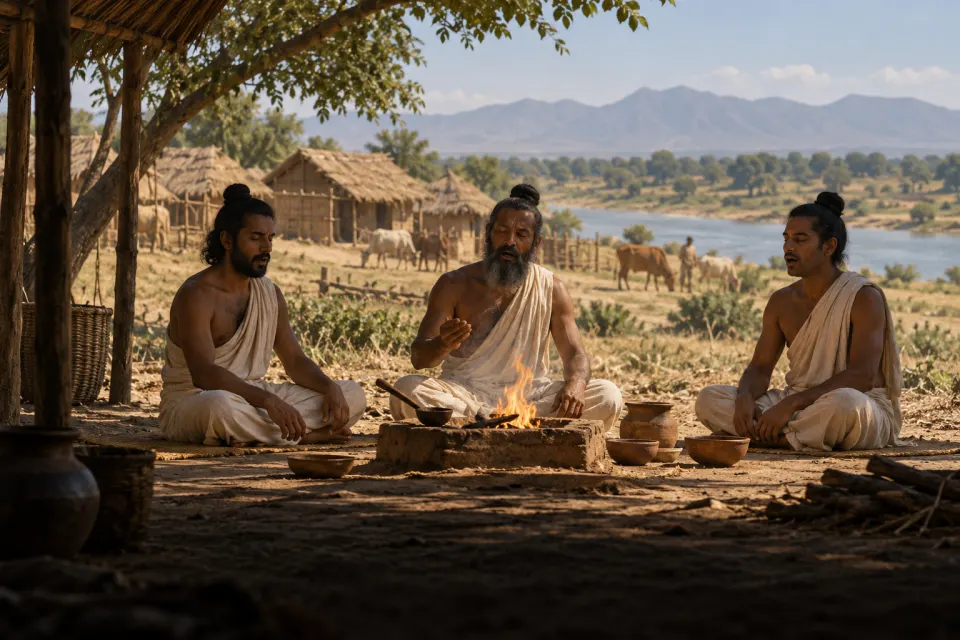
Arrival and the Rigveda c. 1500–1200 BCE
Indo-European-speaking peoples entered the Indus region from the area of present-day Iran around 1500 BCE, carrying religious vocabulary and practice shared with the early Iranians, including the sacred drink soma (Iranian haoma) and a priest title, hotr, matched by the Iranian zaotar. Their earliest and most important collection of hymns, the Rigveda, took shape over the following centuries as this society moved from the upper Indus toward the watershed with the Ganges basin, addressed chiefly to Agni and Indra by priestly families who were its custodians.[1, 7–8]
The developing Vedic corpus c. 1200–600 BCE
To the Rigveda were added the Yajurveda, prose formulas for ritual acts, the Samaveda, Rigvedic verses set to chant melodies, and the later Atharvaveda, a collection of incantations and spells associated less with formal public sacrifice than with a household priest's everyday concerns. Each was linked to one of four priestly roles in the great soma sacrifice. Prose Brahmanas (c. 800–600 BCE) then explained the ceremonies and the hymns' ritual use, extending a tradition whose antiquity scholars have traced, through shared vocabulary and ritual parallels, to a common Indo-Iranian period possibly as early as the 12th century BCE.[2, 7, 9]
Elaboration and reaction c. 800–500 BCE
As Vedic society settled the Ganges plain, public sacrifice grew so complex that only highly trained Brahmans could perform it correctly, and incorrectly performed rites were held to risk disaster. Partly in reaction to this ritualism and to growing Brahman power, the Aranyakas reinterpreted ritual symbolically, while the Upanishads (c. 700–500 BCE) went further, questioning sacrifice itself and developing the idea of brahman, a single underlying reality, and its identity with atman, the individual self.[10–11]
Transition to classical Hinduism 6th–2nd centuries BCE
A falloff in new Vedic literary activity from the 5th century BCE onward marks a gradual shift toward a more recognizably Hindu religious culture, as the spread of ideas of karma, rebirth (samsara) and release (moksha) sought through meditation and knowledge, rather than sacrifice, displaced sacrifice as the central concern of Indian religious life. The Vedic hymns themselves, though increasingly set aside in favour of later devotional and philosophical texts, were never abandoned: they became Hinduism's most sacred and authoritative, if now less-read, scripture.[6, 12]
Key moments
- c. 1500 BCEHymns of the Rigveda · Punjab, northwestern South Asia
- c. 700 BCEThe Upanishads · Northern India
Beliefs
rta
cosmic and ritual order
The Vedic gods, especially Varuna, were believed to uphold a cosmic and moral order knit together with correct ritual performance; maintaining this order, rather than personal salvation, was the chief concern of Vedic religious life, pursued through sacrifice offered on behalf of a patron who bore its cost.[4, 13]
brahman
the ultimate reality
In the late Vedic Upanishads, speculation about correspondences between ritual, cosmos and self crystallized into the idea of brahman, an all-embracing ultimate reality, and the claim that atman, a person's unchanging core, is identical with it — an equation that became foundational to later Hindu metaphysics.[11]
soma
sacred ritual drink
Soma was both a plant and the mind-altering drink pressed from it, offered to the gods and drunk by priests in the central public sacrifice; its name and ritual role closely parallel the Iranian haoma, pointing to a shared origin in the common Indo-Iranian religious past.[3, 7]
Vedic corpus layers
Samhita, Brahmana, Aranyaka/Upanishad
The Vedic textual corpus is organized in ritual layers: Samhitas, the hymn and formula collections headed by the Rigveda; Brahmanas, prose explaining the ceremonies; and the Aranyakas and Upanishads, later appendices that move from ritual symbolism toward philosophical speculation.[2, 9, 11]
Practice
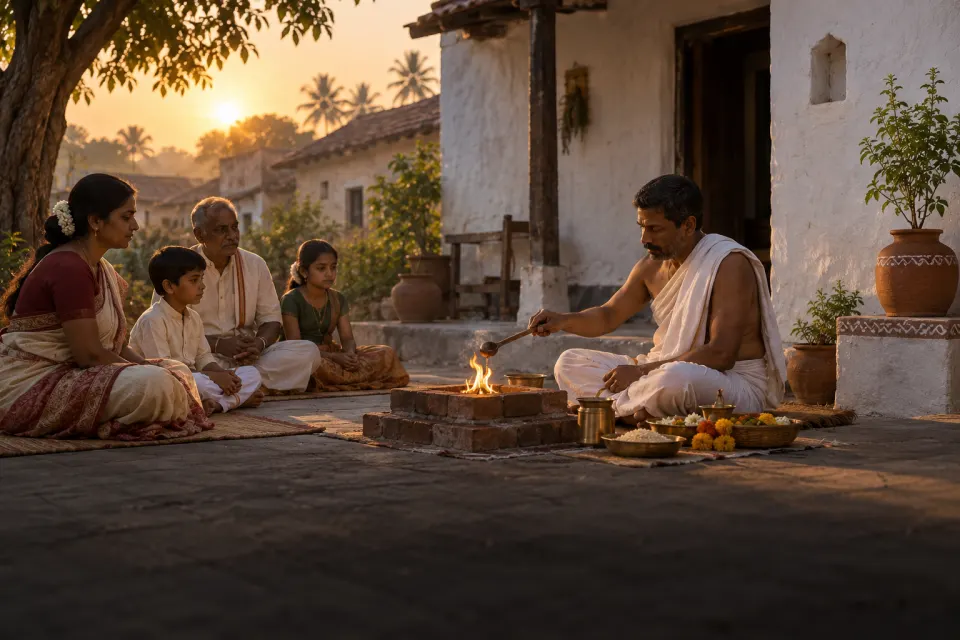
Domestic and public sacrifice
Vedic sacrifice took two main forms: simple domestic rites performed by a householder or a single priest at the home hearth, including life-stage sacraments called samskaras, and grand public rites lasting days or months, affordable only to wealthy patrons or kings, requiring many priests and as many as three fire-altars.[3, 14]
The soma sacrifice
The soma sacrifice, most characteristic of public Vedic ritual, consecrated a lay patron before soma juice was pressed three times, part offered to the sacred fire and part drunk by the priests, each stage framed by recitation and chant; animal sacrifice, usually of a goat or ram, often accompanied it.[3, 7]
The horse sacrifice
The ashvamedha, or horse sacrifice, was an especially elaborate variant of the soma rite; a human sacrifice is described in Vedic texts as a onetime, probably symbolic, former practice modelled on the myth of the cosmic giant Purusha, from whose body the four social classes were said to have arisen.[15–16]
People
Indra
deity
The highest-ranking Vedic god, a warlike figure who defeats countless human and demon enemies and famously releases the sun and the waters after they are stolen or withheld; later Hindu tradition keeps him as a king of the gods in myth and ritual recitation, though he is no longer an object of active worship.[4, 17]
Agni
deity
The deified sacrificial fire, Agni carried offerings from the human to the divine world and was himself identified with the sun, with lightning and with the flame of burning wood, making him present at every Vedic rite regardless of which other god it addressed.[3]
Varuna
deity
Varuna upheld rta, the cosmic and moral order binding gods, humans and ritual together, and was invoked particularly where oaths, truth-telling and the consequences of wrongdoing were at stake.[13]
Scripture
Rigveda
c. 1200–1000 BCE
The oldest and most important Veda, the Rigveda is a collection of roughly a thousand hymns organized into ten books (mandalas), composed to serve the priestly families who guarded them; it contains the Vedic corpus's oldest surviving material and is the chief modern source for Vedic mythology, though it gives little direct information about its own ritual context.[2, 8, 18]
Upanishads
c. 700–500 BCE
A body of speculative texts attached to the end of the Vedic corpus, the Upanishads turn from ritual to philosophical questioning, developing the ideas of brahman and atman that would underlie later Hindu thought; alone among the Vedic scriptures, they remain widely read and quoted in modern Hinduism.[11]
Atharvaveda
later compilation
The latest of the four Vedas, the Atharvaveda is a compilation of incantations and magic spells for such everyday concerns as promoting well-being, averting or undoing evil, curing illness, and even harming an enemy, placing it closer to a household priest's practice than to grand public sacrifice.[19]
Art & objects
Public-domain objects from museum collections. Select one to see it at the museum.
 Male Figure, Possibly IndraPakistan, Gandhara, possibly Swat, 300s–400s CE
 Standing IndraIndia (Uttar Pradesh, Mathura or Ahicchatra), ca. 2nd century
 Seated Ascetic, Deified King, Agni (The God of Fire)India (Kaushambi, Uttar Pradesh), ca. 3rd century
 The Sun God Surya(?) in His Chariot with Wives and AttendantsIndia (West Bengal),, Shunga period, 2nd–1st century BCE
Common misconceptions
Myth The Vedas describe the Hindu gods still worshipped today, such as Vishnu and Shiva.
Fact Vishnu and Shiva appear only briefly and marginally in Vedic mythology, where the dominant figures are Indra, Agni, Varuna and Soma; most of today's major Hindu deities rose to prominence only after the Vedic period, even though Hindus regard the Vedas as their most sacred and authoritative scripture.[17, 20]
Myth Vedic religion and Hinduism are simply two names for the same unchanging tradition.
Fact Vedic religion was a sacrificial cult without temples, images or belief in rebirth as a central concern, centred on fire altars built fresh for each occasion; classical Hinduism developed gradually out of it from around the 6th century BCE onward, adding temple worship, personal devotion to gods such as Vishnu and Shiva, and the ideas of karma and rebirth that define Hindu thought today.[6, 12]
Glossary
- Veda
- The four collections of hymns and ritual texts — Rigveda, Yajurveda, Samaveda, Atharvaveda — composed and transmitted orally over roughly a thousand years and regarded as divinely revealed.[2]
- yajna
- Vedic fire sacrifice, in which offerings were given to a sacred fire on behalf of a patron who bore its cost, in hope of material blessings such as cattle, health and progeny.[3]
- soma
- A sacred, mind-altering drink pressed from a plant and offered to the gods in the central public sacrifice; also the name of its presiding deity.[7]
- rta
- The moral and cosmic order the Vedic gods, especially Varuna, were believed to uphold, maintained in part through correct ritual.[13]
- brahman
- In the Upanishads, the single underlying reality behind the universe, later identified with atman, the self.[11]
- Brahman (priestly class)
- The hereditary priestly social class that performed Vedic sacrifice and transmitted the Vedas by memorization; distinct in spelling convention from the philosophical term brahman.[5]
- ashvamedha
- An elaborate variant of the Vedic soma sacrifice.[15]
- moksha
- Liberation from the cycle of rebirth (samsara), an idea that spread as Vedic religion gave way to classical Hinduism.[12]
Sources
Each statement above was checked against published sources; the verdict says whether it stood as written, was corrected or was hedged.
- VerifiedBritannica, Vedic religion; Encyclopedia of Religion.
- VerifiedBritannica, Vedic religion; Encyclopedia of Religion.
- VerifiedBritannica, Vedic religion; Encyclopedia of Religion.
- VerifiedBritannica, Vedic religion; Encyclopedia of Religion.
- VerifiedBritannica, Vedic religion; Encyclopedia of Religion.
- VerifiedBritannica, Vedic religion; Encyclopedia of Religion.
- VerifiedEncyclopedia of Religion; Britannica, Vedic religion.
- VerifiedBritannica, Vedic religion; Encyclopedia of Religion.
- VerifiedBritannica, Vedic religion; Encyclopedia of Religion.
- VerifiedBritannica, Vedic religion; Encyclopedia of Religion.
- VerifiedBritannica, Vedic religion; Encyclopedia of Religion.
- VerifiedBritannica, Vedic religion; Encyclopedia of Religion.
- VerifiedBritannica, Vedic religion; Encyclopedia of Religion.
- VerifiedBritannica, Vedic religion; Encyclopedia of Religion.
- CorrectedBritannica, Vedic religion; Encyclopedia of Religion.
- VerifiedBritannica, Vedic religion; Encyclopedia of Religion.
- VerifiedBritannica, Vedic religion; Encyclopedia of Religion.
- VerifiedBritannica, Rigveda; Encyclopedia of Religion.
- VerifiedBritannica, Vedic religion; Encyclopedia of Religion.
- VerifiedBritannica, Vedic religion; Encyclopedia of Religion.
Last fact-checked 4 October 2026.