
Overview
Śaktism is, with Vaiṣṇavism and Śaivism, one of Hinduism's three principal streams, worshipping the Hindu goddess Śakti, "Power", either as the supreme reality in her own right or as the consort of a male god, usually Śiva. Hindus know her by countless names: gentle as Pārvatī, Lakṣmī or Sarasvatī, fierce as Durgā or Kālī, and regard all goddesses as her manifestations. Śaktism is bound up with Tantra, a ritual and meditative system aimed at awakening the Goddess's power, imagined as a coiled serpent (kuṇḍalinī) within the body, to reach liberation. The stream is especially strong in Bengal and Assam, where Durgā Pūjā and Kālī worship are the great annual festivals.[1–2, 6, 8]
History
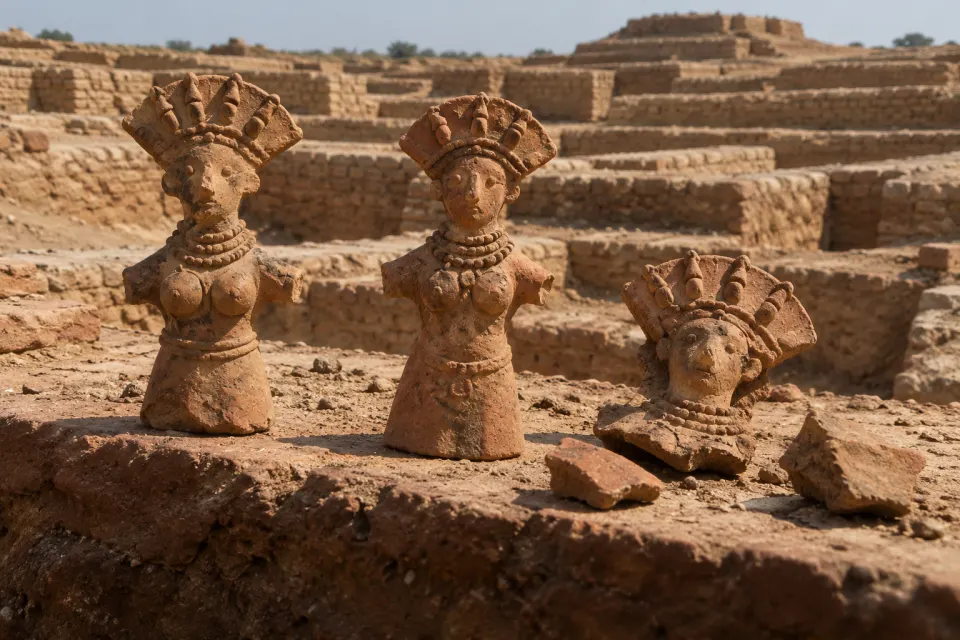
Goddesses before Śaktism c. 2600 BCE – 4th century CE
Terracotta figurines from the Indus civilization are often read as goddess images, and scholars broadly agree its people likely revered goddesses, though Vedic religion gave them only minor roles. Lakṣmī, goddess of fortune, was worshipped before the Common Era, and further goddesses are attested under the Guptas.[9–10]
The Devī Māhātmya and the Great Goddess 5th–6th century CE
Śaktism's foundational scripture, the Devī Māhātmya, part of the Mārkaṇḍeya Purāṇa, cast the Goddess as Mahādevī, the Great Goddess behind every lesser goddess, who defeats the buffalo-demon Mahiṣāsura when the male gods fail. From this point, local and tribal goddesses across India were increasingly identified as her regional forms, a process scholars call the Sanskritization of goddess worship.[4, 11]
Tantra and the Śākta pīṭhas c. 7th–12th century
A pan-Indian Tantric movement, flourishing from the 5th–6th century, placed the Goddess at its centre as the sole power capable of granting both worldly enjoyment and final liberation. Devotion crystallised around śākta pīṭhas, shrines said to mark where pieces of the goddess Satī's dismembered body fell to earth; the Kāmākhyā temple in Assam, said to hold her yoni, became Tantric Śaktism's most important centre, and animal sacrifice was practised there until substituted by an animal-shaped offering in 1832.[12–14]
Bengali devotion and a global festival 18th century – today
In 18th-century Bengal, the poet Rāmprasād Sen gave Śākta devotion a popular voice in Bengali song, addressing Kālī with the mixed love and complaint of a child to a mother. Durgā Pūjā grew into Bengal's great public festival, and in 2021 UNESCO inscribed its Kolkata form on the Representative List of the Intangible Cultural Heritage of Humanity.[15–16]
Beliefs
Mahādevī · महादेवी
the Great Goddess
Śāktas hold that every goddess, however local or however different in temperament, is a face of one supreme Devī. The Devī Māhātmya already praises one goddess in the terms of another and tells of goddesses emerging from each other, a theology that let countless regional goddess cults be drawn into a single pan-Indian Goddess.[11, 17]
Benign and fierce Devī
Scholars group Hindu goddesses on a spectrum from "breast", gentle, nurturing and bound to a male consort, such as Lakṣmī or Sarasvatī, to "tooth", ambivalent and potentially dangerous, such as Durgā and Kālī. Śāktas approach fierce goddesses directly, trusting that their compassionate side will temper their dangerous one.[18]
Kuṇḍalinī · कुण्डलिनी
coiled one
Tantric yogis picture Śakti as a serpent power lying dormant at the base of the body, which must be awakened and raised through the body's centres (cakras) to the crown of the head to achieve liberation; the Goddess herself is this dynamic, manifesting energy, as against the male god's static, unmanifest aspect.[19]
Mahāvidyā · महाविद्या
great wisdom
Ten Mahāvidyās, headed by Kālī and Tārā, embody unsettling truths meant to push the worshipper past comfortable, conventional ideas of the divine; several, such as the self-decapitating Chinnamastā, deliberately violate ordinary expectations of a goddess's appearance or conduct.[20]
Practice

Tantric ritual · तन्त्र
Śākta Tantra uses mantras, yantras (geometric diagrams) and a guru-guided initiation to invoke the Goddess within the practitioner's own body, aiming at both worldly power (bhukti) and liberation (mukti). Techniques are often kept secret and transmitted only from teacher to initiated disciple.[5, 21]
Durgā Pūjā and Navarātri
Durgā Pūjā, centred on West Bengal, re-enacts the Goddess's defeat of Mahiṣāsura over ten days: clay images are sculpted anew each year, worshipped from Ṣaṣṭhī, the sixth day, and finally immersed in a river on Vijayadaśamī. It shares its opening day with Navarātri, kept more widely across northern and western India. The river immersion is read as the Goddess's departure home to her husband, Śiva, in the Himalayas.[16, 22–23]
Offerings at Śakti shrines
Worship at Śākta pīṭhas historically included animal sacrifice to the Goddess; at Kāmākhyā this was replaced by a substitute offering in 1832, and practice today ranges from simple flowers and vegetarian food to continuing goat sacrifice at some Kālī and Durgā temples in eastern India.[14, 24]
Holy days
The year ahead
| Date | Holy day | Reckoned |
|---|---|---|
| 16 October 2026 – 20 October 2026 | Durgā Pūjā দুর্গাপূজা | Āśvina śukla 6th, the tithi at sunrise |
| 8 November 2026 | Kālī Pūjā কালীপূজা | Āśvina kṛṣṇa amāvāsyā, the tithi at midnight |
| 5 October 2027 – 9 October 2027 | Durgā Pūjā দুর্গাপূজা | Āśvina śukla 6th, the tithi at sunrise |
Durgā Pūjā · দুর্গাপূজা
ten days of bright Āśvina (September–October)
Bengal's great public festival of the Goddess, with elaborately sculpted clay images displayed in temporary pavilions and immersed in the river on the tenth day; UNESCO inscribed its Kolkata form as intangible cultural heritage in 2021.[16, 22]
Kālī Pūjā · কালীপূজা
new moon of Kārttika (October–November), the same night as Diwali
Kept chiefly in West Bengal and Assam, with midnight worship of Kālī using red flowers, sweets and sometimes animal sacrifice, on the same new-moon night that most other Hindus keep as Diwali.[25]
People

Durgā · दुर्गा
deity
"The Inaccessible", a warrior form of the Goddess created when the male gods, unable to defeat the buffalo-demon Mahiṣāsura themselves, surrendered their collective power to her; she beheads him after days of shape-shifting combat, and her autumn festival is Śaktism's most public celebration.[26]

Kālī · काली
deity
"The Black One", goddess of time, death and dissolution, shown dark-skinned with a lolling tongue, a garland of skulls and a skirt of severed arms; devotees, especially in Bengal, approach her fearsome form as that of a true, if unpredictable, mother. Her figure draws on older Vedic dark goddesses such as Rātrī ("Night") and Nirṛti, and only in the Purāṇas (c. 400–1500 CE) does she shift from a marginal, death-linked spirit into a powerful goddess able to grant favours to her devotees.[27–29]

Rāmprasād Sen
saint · 1718–1785
A Bengali poet whose devotional songs to Kālī, full of a child's tender complaint to its mother as much as reverence, remain among the best-loved expressions of Śākta bhakti and are still widely sung in Bengal today.[15]
Scripture
Devī Māhātmya · देवीमाहात्म्य
5th–6th century CE
"The Glorification of the Goddess", part of the Mārkaṇḍeya Purāṇa, is Śaktism's founding scripture: it tells of Durgā's defeat of Mahiṣāsura and first sets out the doctrine that every goddess is a face of one Mahādevī.[4, 30]
Devī Bhāgavata Purāṇa · देवीभागवतपुराण
variously dated 6th–14th century CE
A later Purāṇa, probably composed in Bengal, that makes the Goddess the active force behind all other deities and the agent of creation itself, and gives instructions for her worship, holy days and sacred places.[31]
Places
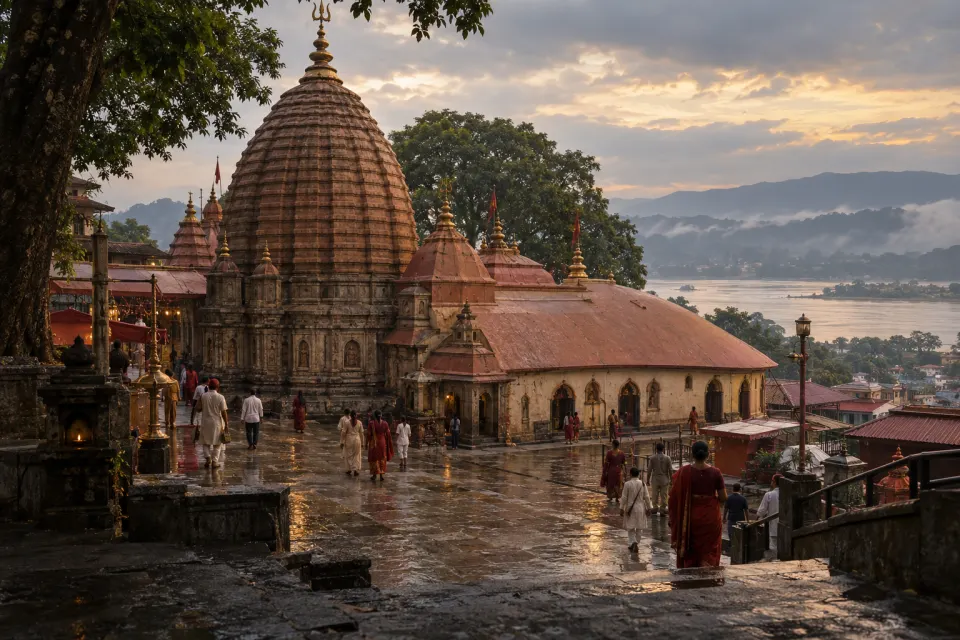
Kāmākhyā Temple
IND
On Nīlācala hill above Guwahati, Assam, the most important Tantric śākta pīṭha, said to hold the yoni of the goddess Satī; animal sacrifice there was replaced with a substitute offering in 1832.[13–14]
Art & objects
Public-domain objects from museum collections. Select one to see it at the museum.
 Bust of a Female Deity (Devi)Cambodia, Angkor period, 11th century
 KaliSouth India, Tamil Nadu, Chola period (900-13th century), 900s–1000s
 (Parvati) DeviSouth India, Chola period (900–1200s), 1000s
 Comb with Devi and AttendantsCeylon, 1600s–1700s
 DeviNepal, 600s–700s
 Leaf from a Kalighat album: The Goddess Kali (recto); Kali Standing on Shiva (verso)Eastern India, Bengal, Kolkata, Kalighat, c. 1890
 The Goddess Durga Slaying the Buffalo Demon (Mahishasura Mardini)India (Bihar), Pala period, ca. 11th century
 Durga as Slayer of the Buffalo Demon MahishasuraNepal, 14th–15th century
 Sword Handle with Scenes of the Goddess Durga Slaying the Buffalo Demon MahishasuraNepal, Kathmandu Valley, early Malla period, 13th–14th century
 Book Cover with Four DurgasNepal (Kathmandu Valley), 18th century
 Durga, Kali, and Five Matrikas Battle the Daitya Army of the Demon Shumbha: Scene from the Devi MahatmyaIndia (Himachal Pradesh, Guler), ca. 1780
 Jagadhatri, a benign form of Durga-KaliIndia, Kolkata, West Bengal, 1878–83
 Devi vanquishes the demon Nisumbha and his armies; folio from a Devi Mahatmya series.India, Guler, Himachal Pradesh, 18th century
How we know
Where does Goddess worship in India begin?
Whether Hindu goddess worship descends from the Indus civilization, from later Vedic religion, or from older tribal cults is debated. The scholarly consensus leans toward the Indus peoples being goddess-revering, from parallels between their seals and later Dravidian sacrificial goddess cults, and goddess worship remains prominent in many tribal societies today; but Vedic texts, composed and preserved by a male Brahmin elite, give goddesses only a minor place, so their silence may reflect who wrote them rather than what was actually practised.[32–33]
Common misconceptions
Myth Śaktism is mainly about Kālī, blood sacrifice and fear of the Goddess.
Fact Most Śākta worship is directed at gentler forms of the Goddess, such as Lakṣmī and Sarasvatī, and uses ordinary offerings of flowers, food and lamps; Kālī and animal sacrifice are real but regional and far from the whole picture, and even at historic sacrificial centres such as Kāmākhyā the practice has been substituted or restricted.[14, 18]
Myth Tantra is essentially a transgressive sex ritual.
Fact Tantra is first of all a system of mantra, visualisation, yantra and initiation aimed at liberation and worldly power; a minority of esoteric Tantric lineages did use ritual transgression of social norms, but this is not what most Śākta Tantric practice, ancient or modern, actually involves.[5, 21]
Glossary
- Devī · देवी
- "Goddess": the generic term for any female deity, and a common short name for the supreme Goddess herself.[2]
- Śakti Pīṭha · शक्तिपीठ
- A shrine to the Goddess, traditionally one of the sites where a piece of Satī's dismembered body is said to have fallen to earth.[12]
- Mahāvidyā · महाविद्या
- One of ten "great wisdom" goddesses, headed by Kālī, each revealing a different, often unsettling, truth to the worshipper.[20]
- Kuṇḍalinī · कुण्डलिनी
- The Goddess's power imagined as a coiled serpent at the base of the body, awakened in Tantric yoga and raised to the crown to reach liberation.[19]
- Yantra · यन्त्र
- A geometric diagram used in Tantric ritual to represent and invoke a deity, especially a form of the Goddess.[21]
- Mahiṣāsura · महिषासुर
- The shape-shifting buffalo-demon defeated by Durgā in the Devī Māhātmya, the central myth of Durgā Pūjā.[26]
Sources
Each statement above was checked against published sources; the verdict says whether it stood as written, was corrected or was hedged.
- VerifiedBritannica, Shaktism; Encyclopedia of Religion, Ecumenism, via Encyclopedia.com.
- VerifiedBritannica, Shaktism; Encyclopedia of Religion, Hindu Tantric Deities, via Encyclopedia.com.
- VerifiedBritannica, Shaktism; Encyclopedia of Religion, Hindu Tantric Deities, via Encyclopedia.com.
- VerifiedBritannica, Durga Puja; Encyclopedia of Religion, Hindu Tantric Deities, via Encyclopedia.com; Britannica, Kali.
- VerifiedBritannica, Shaktism; Encyclopedia of Religion, Hindu Tantric Deities, via Encyclopedia.com.
- VerifiedBritannica, Shaktism; Encyclopedia of Religion, Poetry: Indian Religious Poetry, via Encyclopedia.com.
- VerifiedOxford Reference, A Dictionary of Hinduism, Kāmarūpa, read on Oxford Reference's search-results page; Encyclopedia of Religion, Hindu Tantric Deities, via Encyclopedia.com.
- VerifiedBritannica, Shaktism; Encyclopedia of Religion, Ecumenism, via Encyclopedia.com.
- VerifiedEncyclopedia of Religion, Goddess Worship: The Hindu Goddess, via Encyclopedia.com; Britannica, Hinduism: Early Hinduism.
- VerifiedBritannica, Hinduism: Early Hinduism; Encyclopedia of Religion, Goddess Worship: The Hindu Goddess, via Encyclopedia.com.
- VerifiedBritannica, Durga Puja; Encyclopedia of Religion, Goddess Worship: The Hindu Goddess, via Encyclopedia.com.
- VerifiedEncyclopedia of Religion, Hindu Tantric Deities, via Encyclopedia.com; Encyclopedia of Religion, Goddess Worship: The Hindu Goddess, via Encyclopedia.com; Oxford Reference, A Dictionary of Hinduism, Kāmākhyā, read on Oxford Reference's search-results page.
- VerifiedOxford Reference, A Dictionary of Hinduism, Kāmarūpa, read on Oxford Reference's search-results page; Encyclopedia of Religion, Hindu Tantric Deities, via Encyclopedia.com.
- VerifiedOxford Reference, A Dictionary of Hinduism, Kāmākhyā, read on Oxford Reference's search-results page; Britannica, Shaktism.
- VerifiedEncyclopedia of Religion, Poetry: Indian Religious Poetry, via Encyclopedia.com; Britannica, Kali.
- VerifiedBritannica, Durga Puja; UNESCO, Durga Puja in Kolkata.
- VerifiedEncyclopedia of Religion, Goddess Worship: The Hindu Goddess, via Encyclopedia.com; Encyclopedia of Religion, Hindu Tantric Deities, via Encyclopedia.com; Britannica, Shaktism.
- VerifiedEncyclopedia of Religion, Goddess Worship: The Hindu Goddess, via Encyclopedia.com; Britannica, Shaktism.
- VerifiedBritannica, Shaktism; Encyclopedia of Religion, Hindu Tantric Deities, via Encyclopedia.com.
- VerifiedEncyclopedia of Religion, Hindu Tantric Deities, via Encyclopedia.com; Britannica, Shaktism.
- VerifiedEncyclopedia of Religion, Hindu Tantric Deities, via Encyclopedia.com; Britannica, Shaktism.
- VerifiedBritannica, Durga Puja; UNESCO, Durga Puja in Kolkata.
- VerifiedBritannica, Durga Puja; Encyclopedia of Religion, Goddess Worship: The Hindu Goddess, via Encyclopedia.com; Britannica, Shaktism.
- VerifiedBritannica, Shaktism; Oxford Reference, A Dictionary of Hinduism, Kāmākhyā, read on Oxford Reference's search-results page.
- VerifiedBritannica, Kali; Encyclopedia of Religion, Poetry: Indian Religious Poetry, via Encyclopedia.com; Britannica, Shaktism.
- VerifiedBritannica, Durga Puja; Encyclopedia of Religion, Hindu Tantric Deities, via Encyclopedia.com; Britannica, Shaktism.
- VerifiedBritannica, Kali; Encyclopedia of Religion, Hindu Tantric Deities, via Encyclopedia.com.
- VerifiedBritannica, Kali; Encyclopedia of Religion, Goddess Worship: The Hindu Goddess, via Encyclopedia.com.
- VerifiedBritannica, Kali; Encyclopedia of Religion, Hindu Tantric Deities, via Encyclopedia.com.
- VerifiedBritannica, Kali; Encyclopedia of Religion, Hindu Tantric Deities, via Encyclopedia.com.
- VerifiedBritannica, Devī Bhāgavata Purāṇa; Encyclopedia of Religion, Hindu Tantric Deities, via Encyclopedia.com.
- VerifiedEncyclopedia of Religion, Goddess Worship: The Hindu Goddess, via Encyclopedia.com; Britannica, Hinduism: Early Hinduism.
- VerifiedEncyclopedia of Religion, Goddess Worship: The Hindu Goddess, via Encyclopedia.com; Britannica, Hinduism: Early Hinduism.
Last fact-checked 3 October 2026.