
Overview
The Olmec were the first major civilization of ancient Mesoamerica, flourishing from about 1200 to 400 BCE along the Gulf Coast lowlands of what is now Veracruz and Tabasco, Mexico. They left no deciphered writing and no religious texts, so everything known about Olmec religion comes from archaeology: monumental stone sculpture, jade and greenstone carvings, and the remains of ceremonial centers such as San Lorenzo and La Venta. Olmec art shows a world of composite supernatural beings blending human, jaguar, eagle, serpent and crocodilian traits, rather than a settled pantheon of named gods, alongside the famous colossal stone heads now generally read as portraits of rulers. Olmec religious imagery and ideas fed into later Mesoamerican traditions, including those of the Maya and the Aztec.[1, 3–6]
History
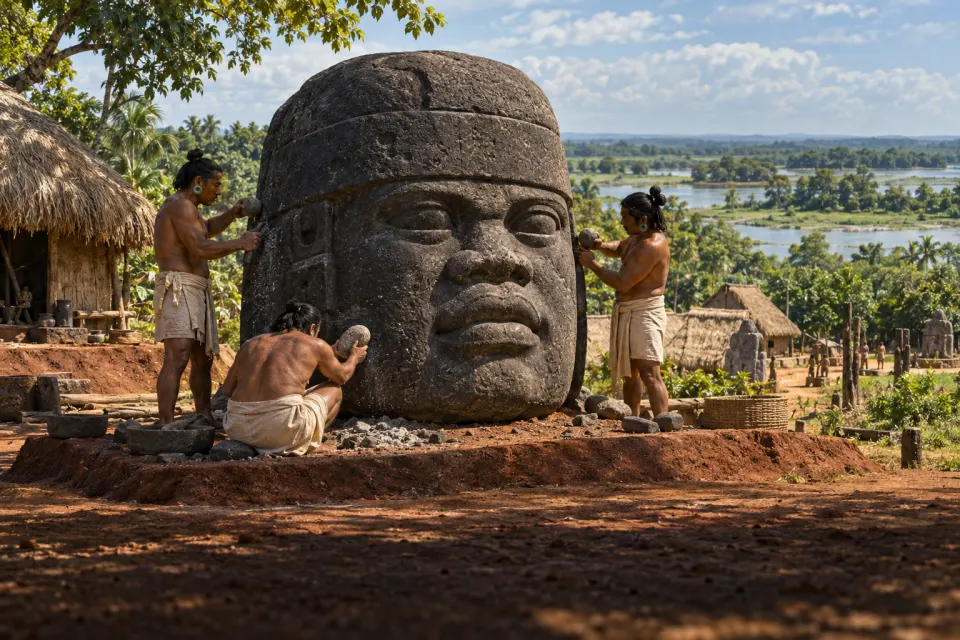
Rise at San Lorenzo c. 1200–900 BCE
San Lorenzo, in the Veracruz lowlands, was the oldest known Olmec center, rising to prominence around 1200 BCE. It is famous for seventeen known colossal basalt heads, up to about three meters tall, generally read today as portraits of individual Olmec rulers rather than, as once proposed, ballplayers. Olmec art from this period also includes "were-jaguar" figures blending human and feline features, which some scholars connect to a belief that religious specialists took on a jaguar alter ego in ritual. The Olmec likely played a ritual ball game, evidenced by rubber balls recovered nearby at El Manatí and by clay figurines dressed as ballplayers.[4, 7–9]
La Venta and decline c. 900–400 BCE
After about 900 BCE, religious and political life shifted east to La Venta, in Tabasco, where elites carved jade and greenstone, imported from as far as Guatemala's Motagua valley, into supernatural beings and buried "Massive Offerings": huge pits filled with hundreds of polished stone blocks. Large stone sculptures there show rulers in mythological scenes, including emerging from caves, reflecting a belief, shared across later Mesoamerica, that caves were doorways to the supernatural world. Olmec stylistic influence declined after about 400 BCE, when La Venta was largely abandoned as a major center, though later peoples continued to revere Olmec objects: archaeologists found a roughly 2,000-year-old Olmec jade mask buried as an offering at the Aztec Templo Mayor in Tenochtitlan.[6, 10–12]
Key moments
- c. 1200 BCEOlmec colossal heads · San Lorenzo, Veracruz, Mexico
Places

San Lorenzo
MEX
The oldest known Olmec center, rising to prominence around 1200 BCE and famous for its colossal basalt heads.[7]
La Venta
MEX
The leading Olmec center after about 900 BCE, where elites buried "Massive Offerings" of polished stone blocks and carved jade supernatural figures.[10]
Art & objects
Public-domain objects from museum collections. Select one to see it at the museum.
 Cup with Profile Head of the Maize GodValley of Mexico, 800–400 BCE
 Standing Figurine with Missing LegGuerrero state, 800–400 BCE
 MaskGulf of Mexico, 200 BCE–300 CE
 Standing FigurineMexico, 800–400 BCE
 Seated FigureMesoamerica, Mexico, Olmec, 1200–300 BCE
 MaskMesoamerica, Mexico, Olmec, 1200–300 BCE
 Celt with DeityMesoamerica, Mexico, Olmec, 1000–300 BCE
 MaskOlmec, 1000–400 BCE
 Yuguito (ritual object)Olmec, 1300–400 BCE
 Figure seated on a benchOlmec, 1000–400 BCE
 Ritual objectOlmec, 900–400 BCE
 Funerary Mask (?)Olmec, 8th–4th century BCE
 Vessel with mythical bird of preyOlmec Tradition artist, Central Highlands, Mexico, 1200–800 BCE
 Celt (votive axe)Olmec, 10th–4th century BCE
How we know
Reconstructing a religion with no texts
The Olmec left no deciphered writing and no religious texts; what is known of their religion comes entirely from archaeology — stone monuments, temple platforms, and small jade and greenstone objects from sites such as San Lorenzo and La Venta, read mainly as portraits of rulers and as a world of composite supernatural beings rather than as evidence for a fixed pantheon of named gods.[3–5]
Common misconceptions
Myth The Olmec colossal heads show ballplayers in giant helmets.
Fact Early researchers proposed that the colossal heads depicted players in Mesoamerica's ritual ball game, but the current scholarly consensus, based on their individualized facial features and headgear, reads them instead as portraits of specific Olmec rulers.[4]
Glossary
- colossal heads
- The seventeen known basalt sculptures of human heads, up to about three meters tall, carved at Olmec centers such as San Lorenzo; usually read as portraits of individual rulers.[4]
- were-jaguar
- A recurring Olmec image blending human, often infant, features with jaguar traits such as a snarling mouth; its meaning is debated, with some scholars linking it to shamanic transformation.[8]
- Massive Offering
- A La Venta ritual deposit: a huge pit filled with hundreds of polished stone blocks, sometimes arranged in symbolic patterns.[10]
Sources
Each statement above was checked against published sources; the verdict says whether it stood as written, was corrected or was hedged.
- VerifiedBritannica, Olmec; Met, Olmec Art.
- VerifiedBritannica, Olmec; Diehl, Olmec Religion, Encyclopedia of Religion, via Encyclopedia.com.
- CorrectedDiehl, Olmec Religion; Met, Olmec Art.
- VerifiedBritannica, Olmec; Diehl, Olmec Religion.
- VerifiedMet, Olmec Art; Diehl, Olmec Religion.
- VerifiedMet, Olmec Art; Britannica, Olmec.
- VerifiedBritannica, Olmec; Met, Olmec Art.
- VerifiedBritannica, Olmec; Diehl, Olmec Religion.
- VerifiedMet, Olmec Art; Diehl, Olmec Religion.
- VerifiedMet, Olmec Art; Diehl, Olmec Religion.
- VerifiedMet, Olmec Art; Diehl, Olmec Religion.
- VerifiedBritannica, Olmec; Met, Olmec Art.
Last fact-checked 6 October 2026.