Overview
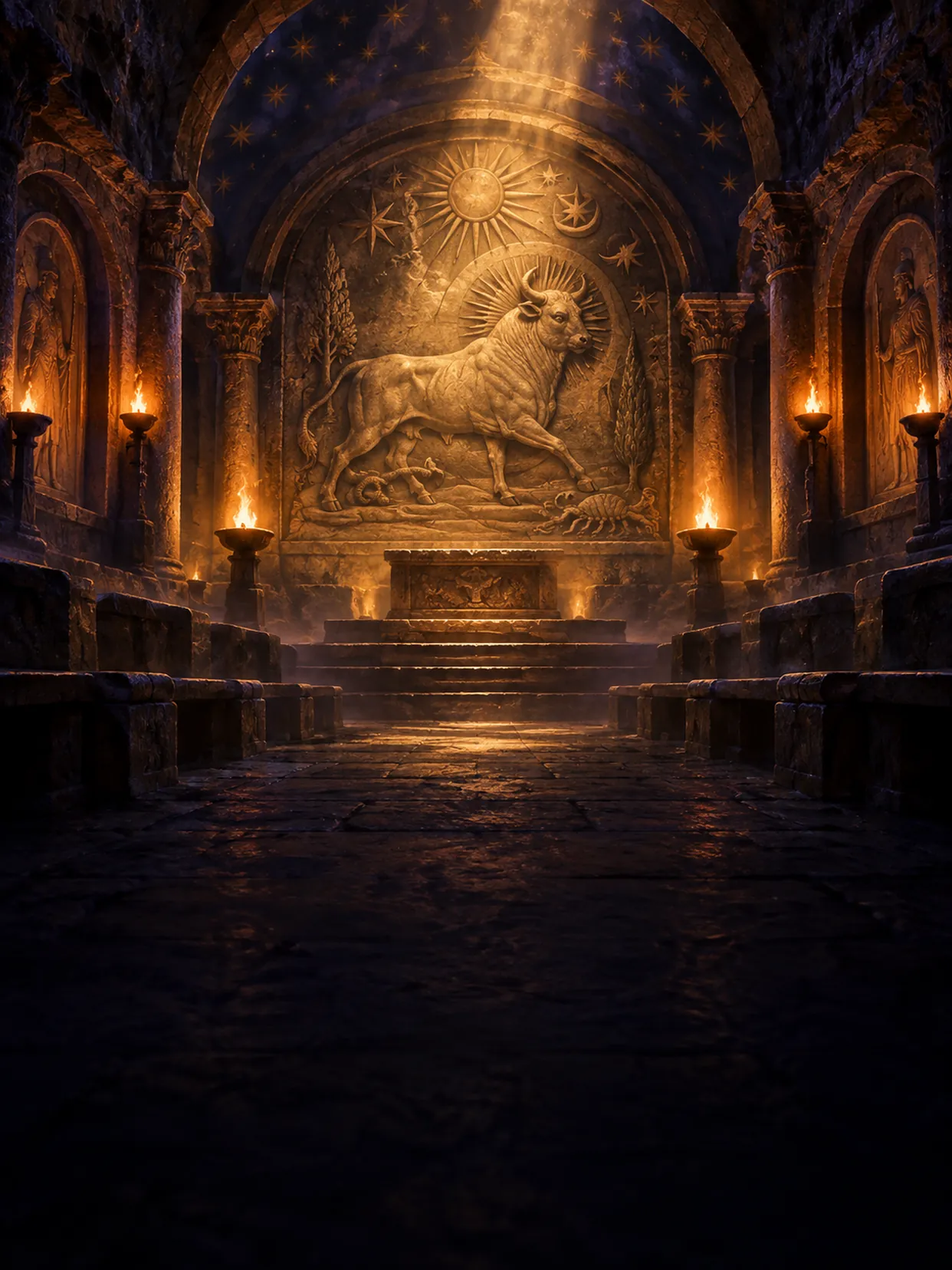
Roman Mithraism, called in antiquity the mysteries of Mithras, was a cult that people joined only through initiation. Its members, all men, met in small groups in dim, cave-like rooms to share a sacred meal beneath an image of their god killing a bull. The cult surfaces in the late 1st century CE and spread across the Roman Empire, flourishing above all in Rome, its port of Ostia, and the army bases of the Rhine and Danube. No scripture of theirs survives, so nearly everything we know comes from excavated temples, sculpture and inscriptions, plus scraps from outside writers, many of them hostile Christians. Mithras bore the name of an ancient Iranian god, and how much of the Roman cult really came from Iran has been argued over for more than a century. The cult dwindled during the 4th century and had vanished by the early 5th.[9–14]
History

An Iranian name Before c. 80 CE
Mitra in India and Mithra in Iran are one ancient god whose name grew out of a word for contract or covenant. In the Avesta's hymn to him, he upholds those who keep faith and punishes those who break it. Rulers on Rome's eastern fringe honoured him too: Antiochus I of Commagene gave a sun-like Mithras a place in his royal cult in the mid-1st century BCE, and the Armenian king Tiridates, crowned by Nero in Rome, hailed the emperor as Mithras. Plutarch says pirates defeated by Pompey in the 60s BCE kept secret rites of Mithras, but whether these fed into the Roman cult is doubtful.[15–18]
A new cult appears c. 80–150 CE
The Roman cult turns up abruptly. Its earliest datable traces, from the decades around 100 CE, appear almost at once in far-flung places: army bases at Carnuntum on the Danube and Heddernheim near Frankfurt, customs posts, a harbour town in Judaea, and Rome, where a rich slave of the praetorian prefect dedicated a statue of the bull-killing. In the same years the poet Statius already pictures Mithras wrestling a bull by the horns in a Persian cave. Through the 2nd century, shrines and dedications multiply.[19–21]
Across the empire c. 150–300 CE
By the 3rd century, mithraea stood from Hadrian's Wall to Dura-Europos on the Euphrates, though the cult was far more common in the western, Latin-speaking provinces than in the Greek East. Inscriptions show members drawn largely from soldiers, junior imperial officials, imperial slaves and freedmen, and in towns like Ostia from comfortable craftsmen and traders. Commodus and the Severan emperors seem to have favoured it; the Historia Augusta, a later collection of imperial lives, even claims Commodus defiled its rites with a real killing. In 308 the empire's rulers, meeting at Carnuntum, restored a shrine there to Mithras as patron of their reign.[6, 22–24]
Decline and disappearance c. 312–c. 420 CE
After Constantine turned to Christianity, imperial favour ebbed, and the building and repair of mithraea tailed off through the 4th century. In Rome, pagan senators still made dedications to Mithras in the 370s and 380s, among many other gods. Jerome praises a city prefect, Gracchus, who around 377 smashed a mithraeum and its images before his baptism. Theodosius I banned sacrifice in 391 and all pagan worship in 392. Some mithraea were damaged on purpose, yet others, at Ostia for example, stayed in use into the early 5th century, and the scholar David Walsh argues that the cult mostly withered from within rather than being stamped out.[25–29]
Rediscovery 16th century–today
Renaissance antiquarians were already identifying bull-slaying reliefs as Mithras, and Franz Cumont's collection of texts and monuments (1896–99) founded modern study of the cult. In 1954, excavations on a bombed site in the City of London uncovered a temple of Mithras, and huge crowds queued to see it. Moved a short distance away in the 1960s, it was reconstructed in 2017 at Roman ground level, near its first site. In Rome, mithraea survive beneath the churches of Santa Prisca and San Clemente.[30–33]
Beliefs
Deus Sol Invictus Mithras
God, the Unconquered Sun, Mithras
Mithras's cult title made him a god, the Sun and unconquerable at once. Yet the monuments also show him beside the sun god Sol, feasting with him and riding in his chariot, so that he both is and is not the Sun. He was always pictured as a Persian, in trousers and a soft pointed cap, and his followers thought of themselves as Persians in a ritual sense.[34–35]
Tauroctony
Bull-slaying (a modern term)
The main image, placed at the head of the temple, shows Mithras at a cave mouth pinning a bull and stabbing it. A dog and a snake reach for the blood, a scorpion grips the bull's genitals, a raven perches nearby, and two torchbearers flank the scene while Sun and Moon look on. It seems to show a deed that brought life and cosmic order, but its exact meaning is disputed.[36–37]
The cave as universe
Members called their temples caves. The 3rd-century philosopher Porphyry says a mithraeum was an image of the cosmos, built so that initiates could be led through the soul's descent into a body and its return. Roger Beck accepts this as real Mithraic teaching; Robert Turcan argued that Platonist philosophers bent the cult to their own ideas.[38]
The stars
Astronomy and astrology ran through the cult. Each of the seven grades was placed under one of the seven planets, zodiac signs ring many reliefs, and several figures in the bull-slaying match nearby constellations, such as the raven and Corvus. Whether this formed a deep doctrine or was largely decoration is still argued.[39]
Practice
Initiation
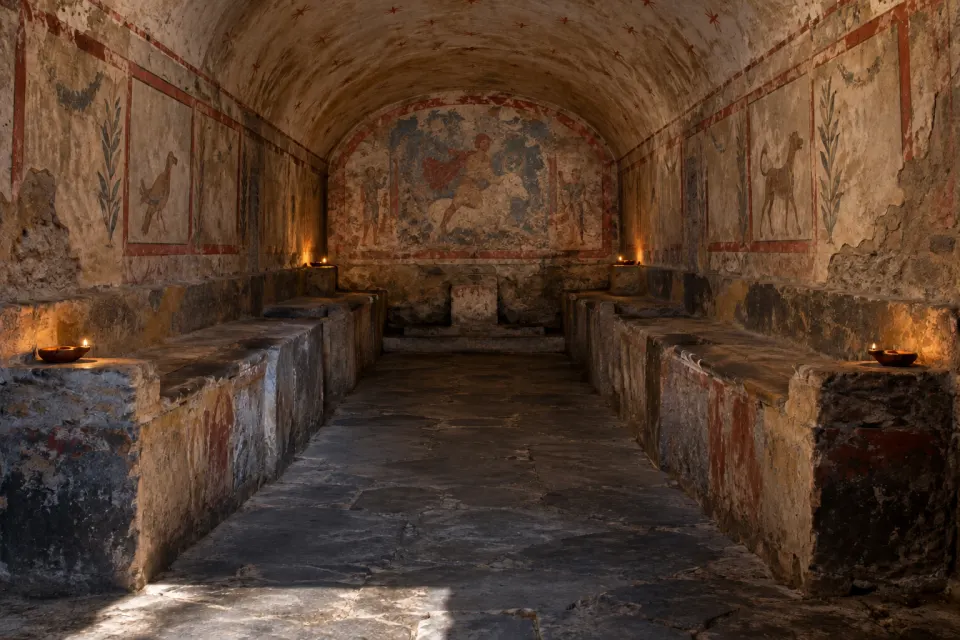
Initiation alone made someone a member, and every member had to be initiated. Paintings at Santa Maria Capua Vetere show small, naked candidates kneeling or blindfolded between two initiators. Tertullian reports that a candidate for the Soldier grade was offered a crown and had to refuse it, saying Mithras alone was his crown.[40–41]
The seven grades
The grades ran Raven (Corax), Bridegroom (Nymphus), Soldier (Miles), Lion (Leo), Persian (Perses), Sun-runner (Heliodromus) and Father (Pater). The floor of the Felicissimus mithraeum at Ostia shows their emblems in order. Grade titles appear mostly in Rome, Ostia and Dura-Europos, and scholars disagree over whether every member climbed them or the upper grades formed a kind of priesthood; a Father led virtually every group.[42–44]
The sacred meal
The chief rite was a shared meal. Members reclined on the raised benches along both walls, facing each other, to eat and drink as Mithras and Sol had feasted on the hide of the slain bull. Some large reliefs could be turned on a pivot to show the bull-slaying on one face and this banquet on the other.[45]
Vows and gifts
Worshippers thanked Mithras by fulfilling vows with altars and sculptures. At Carrawburgh three commanders of the fort each gave an altar, and in London a veteran of the Second Augustan Legion, Ulpius Silvanus, recorded on a marble relief that he had been initiated at Orange in Gaul.[46–47]
People
Mithras
deity
The god of the mysteries, a Roman reworking of the Indo-Iranian Mithra. His monuments show his birth from a rock as a young man, his capture and killing of a bull, his feast with Sol and his ride in the Sun's chariot. No written myth of his survives.[48]
Cautes and Cautopates
deity
Twin torchbearers dressed like Mithras who flank the bull-slaying and appear in almost every mithraeum, one torch held up and the other down. Roger Beck reads them as paired opposites, such as rising and setting sun, that also govern the soul's passage into and out of mortal life.[49]
Commodus
ruler · 161–192 CE; emperor 180–192
Emperor under whom Mithraism seems to have enjoyed imperial goodwill, as it did under the Severans after him. The Historia Augusta accuses him of profaning the rites with an actual killing where only a show of danger was customary.[23]
Franz Cumont
scholar · 1868–1947
Belgian scholar whose collection of Mithraic texts and monuments (1896–99) founded the modern field. He held that the cult was Iranian religion carried west and reshaped on the way; that view dominated until the 1970s and has since been largely given up.[50]
Scripture
Santa Prisca wall inscriptions
c. 210–230 CE
Painted and scratched lines on the walls of the mithraeum beneath Santa Prisca in Rome, among the very few words to survive from Mithraists themselves. They include verses on the god bearing the gods' commands and saving his followers, and greetings to the grades used in the London reconstruction's soundscape.[51]
On the Cave of the Nymphs
3rd century CE
An essay by the Neoplatonist Porphyry, citing an earlier writer, Euboulus. It says Zoroaster dedicated the first cave to Mithras as creator and father of all, and explains the mithraeum as a model of the universe. How faithfully it reports real Mithraic belief is debated.[52]
Places

Mithraeum of Santa Prisca, Rome
ITA · UNESCO World Heritage, 1980
A mithraeum under the church of Santa Prisca on the Aventine, within the Historic Centre of Rome World Heritage property. Two layers of wall paintings show initiates in procession. It was filled with rubble around 400 CE, after which a church was built above it.[53]
Mithraeum of San Clemente, Rome
ITA · UNESCO World Heritage, 1980
Three levels deep, within the Historic Centre of Rome: a 12th-century basilica stands on an older church, and below that lies a mithraeum with an altar carved with the bull-slaying. The lower church dates from the late 4th or early 5th century; when the mithraeum was abandoned is unknown.[54]
Mithraeum of Felicissimus, Ostia
ITA
One of many mithraea in Rome's port city, dating from around the middle of the 3rd century. Its black-and-white floor mosaic shows, in sequence along the aisle, the emblems of the seven grades and of the planetary gods linked with them.[55]
Temple of Mithras, Carrawburgh
GBR
A small temple of about 200 CE outside the Hadrian's Wall fort of Brocolitia, where replicas of three altars given by the fort's commanders stand in place. It was rebuilt or refurbished four times and had fallen out of use by about 350, after some deliberate damage.[56]
London Mithraeum, Walbrook
GBR
Built around 240 to 250 CE on the bank of the Walbrook stream and used as a mithraeum into the 4th century. Found in 1954, it is now shown seven metres below the modern street, at the Roman ground level.[57]
Where it spread
| Region | From | How |
|---|---|---|
| Italy | 80 CE – 400 CE | Rome and Ostia; mithraea survive under Santa Prisca and San Clemente |
| Austria | 100 CE – 400 CE | Carnuntum, where the emperors dedicated an altar to Mithras in 308 |
| Germany | 100 CE – 400 CE | Rhine frontier garrisons and towns |
| Hungary | 150 CE – 400 CE | The Pannonian Danube frontier |
| Syria | 170 CE – 256 CE | The garrison mithraeum at Dura-Europos |
| United Kingdom | 200 CE – 400 CE | Carrawburgh on Hadrian's Wall and the London mithraeum |
Art & objects
Public-domain objects from museum collections. Select one to see it at the museum.
 Bronze plaque of Mithras slaying the bullRoman, Mid-Imperial, Antonine or Severan, mid-2nd–early 3rd century CE
 Statue of Mithras, from "Speculum Romanae Magnificentiae"1564
 Relief with Mithras kneeling upon a bull and driving a sword into its shoulder, at left two smaller standing figures, one holding a sheathed sword and one holding a sword, a frieze with chariots and serpents coiled around figures above1564
How we know
Stones, not scriptures
No Mithraic scripture, creed or service book survives, and members themselves are almost silent. The evidence is overwhelmingly archaeological: temples, reliefs, altars, small finds and inscriptions, catalogued by Cumont and later by Maarten Vermaseren. Outsiders add a little, but much comes from Christian writers such as Justin Martyr, Tertullian and Jerome, who wrote to attack the cult; Justin called its bread-and-water rite a demonic copy of the Eucharist. Many scholars therefore treat Christian claims with caution.[58–59]
Iran or Rome?
Cumont argued that the cult was Iranian religion, Romanised on its way west. Since the 1970s that picture has been dismantled: no Iranian text has Mithra killing a bull, and plainly Iranian elements shrink to the god's name, a few words such as nama, and a figure called Areimanius. Merkelbach and Clauss see a new creation of the Roman world, Clauss placing it in Rome; Beck traces its founders to the court of Commagene; Gordon derives it from the remnants of older Iranian cult in Anatolia. There is no consensus, but opinion has moved towards reinvention.[60–63]
A map of the sky?
Because the bull-slaying's animals line up with constellations, some scholars read it as a star map. David Ulansey argued that it encoded the precession of the equinoxes; critics, Gordon among them, find that thesis strongly contested and built on misreadings of Hipparchus. Beck holds that the monuments speak an astronomical language without concealing a single secret doctrine.[64]
Common misconceptions
Myth Christmas on 25 December was borrowed from the birthday of Mithras.
Fact The only pagan feast recorded on 25 December, the birthday of the Unconquered Sun, first appears in a Roman calendar of 354 CE and is usually read as a festival of the Sun god, distinct from Mithras even though Mithras shared the title Sol Invictus. Whether Mithraists themselves marked Mithras's own birth on that day is debated: some specialists find little evidence for it, others think they did. Nothing shows the pagan feast predates Christmas, and historians still debate which came first.[65]
Myth Roman Mithraism was simply Persian Zoroastrianism transplanted to Rome.
Fact The Roman cult had no Iranian priests or fire cult and made Mithras a bull-killer, which Iranian Mithra never is: in Zoroastrian myth the primal bull is slain by the evil spirit Ahriman. Specialists find little in it that is distinctively Iranian beyond the god's name and a few words. Its Persian dress and words, and its claim that Zoroaster founded it, were part of its self-image rather than proof of descent.[66]
Myth Mithraism was Christianity's great rival and nearly became the empire's religion.
Fact This picture grew out of older scholarship that cast the mystery cults as Christianity's competitors. Mithraism was in fact a private cult of small, men-only groups with no central organisation, whose members went on honouring the public gods. Modern scholars treat the rivalry story as misleading.[67]
Glossary
- Mithraeum
- Modern name for a Mithraic temple: a small, often partly sunken room built to recall a cave, with a central aisle between raised benches and the bull-slaying image at the far end.[68]
- Mysteries · mystēria
- Cults entered by initiation; the Greek word means rites into which one is initiated, not anything mystical. Mithraism went by the name mysteries of Mithras, or of the Persians.[69]
- Pater
- Father, the highest grade and the leader of a Mithraic group.[70]
- Sol Invictus
- The Unconquered Sun: part of Mithras's cult title, but also the name of a Roman sun god honoured by emperors, which has caused confusion between the two.[71]
- Nama
- A Persian word meaning hail, one of the few genuinely Iranian words used in the cult.[72]
- Phrygian cap
- The soft cap worn by Mithras in Roman art, part of the eastern, Persian costume that marked him as a foreign god.[73]
Sources
Each statement above was checked against published sources; the verdict says whether it stood as written, was corrected or was hedged.
- VerifiedR. Gordon, Mithraism, Encyclopedia of Religion, 2nd ed.; Bryn Mawr Classical Review 2001.09.25, review of M. Clauss, The Roman Cult of Mithras; University of Kent repository, abstract of D. Walsh, The Cult of Mithras in Late Antiquity.
- VerifiedEncyclopaedia Iranica, R. Beck, Mithraism; R. Gordon, Mithraism, Encyclopedia of Religion, 2nd ed.; Bryn Mawr Classical Review 2001.09.25, review of M. Clauss, The Roman Cult of Mithras.
- VerifiedEncyclopaedia Iranica, R. Beck, Mithraism; R. Gordon, Mithraism, Encyclopedia of Religion, 2nd ed..
- VerifiedEncyclopaedia Iranica, R. Beck, Mithraism; R. Gordon, Mithraism, Encyclopedia of Religion, 2nd ed.; London Museum, Roman London's Temple of Mithras.
- VerifiedEncyclopaedia Iranica, R. Beck, Mithraism; Britannica, Mithraism: Mythology and theology; English Heritage, History of Carrawburgh Roman Fort and Temple of Mithras (supporting).
- VerifiedBritannica, R. Merkelbach, Mithraism; Encyclopaedia Iranica, R. Beck, Mithraism; R. Gordon, Mithraism, Encyclopedia of Religion, 2nd ed.; Bryn Mawr Classical Review 2001.09.25, review of M. Clauss, The Roman Cult of Mithras; London Museum, Roman London's Temple of Mithras; MOLA, Mithras and Mithraism: Top 10 things you need to know (supporting).
- VerifiedEncyclopaedia Iranica, R. Beck, Mithraism; Britannica, Mithraism: Mythology and theology; London Museum, Roman London's Temple of Mithras.
- VerifiedEncyclopaedia Iranica, R. Beck, Mithraism; London Museum, Roman London's Temple of Mithras; MOLA, Mithras and Mithraism: Top 10 things you need to know (supporting).
- VerifiedUniversity of Kent repository, abstract of D. Walsh, The Cult of Mithras in Late Antiquity; Bryn Mawr Classical Review 2019.08.23, review of D. Walsh, The Cult of Mithras in Late Antiquity.
- VerifiedEncyclopaedia Iranica, R. Beck, Mithraism; R. Gordon, Mithraism, Encyclopedia of Religion, 2nd ed..
- VerifiedEncyclopaedia Iranica, R. Beck, Mithraism; Britannica, Mithraism: Mythology and theology; R. Gordon, Mithraism, Encyclopedia of Religion, 2nd ed..
- VerifiedEncyclopaedia Iranica, R. Beck, Mithraism; Britannica, R. Merkelbach, Mithraism; R. Gordon, Mithraism, Encyclopedia of Religion, 2nd ed..
- VerifiedEncyclopaedia Iranica, R. Beck, Mithraism; R. Gordon, Mithraism, Encyclopedia of Religion, 2nd ed.; D. Walsh, Development, Decline and Demise: The Cult of Mithras c. AD 270–430, PhD thesis, University of Kent; Current Archaeology 334, S. Jackson (supporting).
- VerifiedEncyclopaedia Iranica, R. Beck, Mithraism; R. Gordon, Mithraism, Encyclopedia of Religion, 2nd ed.; Bryn Mawr Classical Review 2006.12.08, review of R. Beck, The Religion of the Mithras Cult in the Roman Empire.
- VerifiedEncyclopaedia Iranica, Mithra i. Mitra in Old Indian and Mithra in Old Iranian; Britannica, R. Merkelbach, Mithraism.
- VerifiedEncyclopaedia Iranica, Mithra i. Mitra in Old Indian and Mithra in Old Iranian; Britannica, R. Merkelbach, Mithraism.
- VerifiedEncyclopaedia Iranica, R. Beck, Mithraism; Britannica, R. Merkelbach, Mithraism.
- HedgedEncyclopaedia Iranica, R. Beck, Mithraism; R. Gordon, Mithraism, Encyclopedia of Religion, 2nd ed.; Britannica, R. Merkelbach, Mithraism.
- VerifiedR. Gordon, Mithraism, Encyclopedia of Religion, 2nd ed.; Bryn Mawr Classical Review 2001.09.25, review of M. Clauss, The Roman Cult of Mithras.
- VerifiedR. Gordon, Mithraism, Encyclopedia of Religion, 2nd ed.; Bryn Mawr Classical Review 2001.09.25, review of M. Clauss, The Roman Cult of Mithras.
- VerifiedBritannica, R. Merkelbach, Mithraism; Bryn Mawr Classical Review 2001.09.25, review of M. Clauss, The Roman Cult of Mithras; R. Gordon, Mithraism, Encyclopedia of Religion, 2nd ed..
- VerifiedThe Met, Bronze plaque of Mithras slaying the bull; Encyclopaedia Iranica, R. Beck, Mithraism; Yale University Art Gallery, Dura-Europos: Excavating Antiquity — Mithraeum (supporting).
- HedgedBritannica, R. Merkelbach, Mithraism; Bryn Mawr Classical Review 2001.09.25, review of M. Clauss, The Roman Cult of Mithras; Historia Augusta, Commodus 9.6.
- VerifiedBritannica, R. Merkelbach, Mithraism; I. Vilogorac Brčić, Mithras and the Imperial Cult, in Religion and Myth as Factors of Integration and Disintegration, FF Press, University o; Römerstadt Carnuntum (supporting).
- VerifiedBritannica, R. Merkelbach, Mithraism; Bryn Mawr Classical Review 2019.08.23, review of D. Walsh, The Cult of Mithras in Late Antiquity; D. Walsh, Development, Decline and Demise: The Cult of Mithras c. AD 270–430, PhD thesis, University of Kent.
- VerifiedBritannica, R. Merkelbach, Mithraism; D. Walsh, Development, Decline and Demise: The Cult of Mithras c. AD 270–430, PhD thesis, University of Kent; Bryn Mawr Classical Review 2019.08.23, review of D. Walsh, The Cult of Mithras in Late Antiquity.
- VerifiedJerome, Letter 107.2; D. Walsh, Development, Decline and Demise: The Cult of Mithras c. AD 270–430, PhD thesis, University of Kent; L. Grig, Deconstructing the Symbolic City: Jerome as Guide to Late Antique Rome, Papers of the British School at Rome 80.
- VerifiedBritannica, Theodosius I: The middle years; New Catholic Encyclopedia.
- VerifiedEnglish Heritage, History of Carrawburgh Roman Fort and Temple of Mithras (supporting); Bryn Mawr Classical Review 2019.08.23, review of D. Walsh, The Cult of Mithras in Late Antiquity; University of Kent repository, abstract of D. Walsh, The Cult of Mithras in Late Antiquity.
- VerifiedR. Gordon, Mithraism, Encyclopedia of Religion, 2nd ed.; Encyclopaedia Iranica, R. Beck, Mithraism; E. Hussein, Roman Religion in the Classroom: Spotlight on the Mysteries of Mithras, Journal of Classics Teaching 19.38.
- VerifiedHistoric England, National Heritage List for England, Temple of Mithras, Non Civil Parish, list entry 1391846; London Museum, Roman London's Temple of Mithras; MOLA, Temple of Mithras: remembering London's greatest archaeological discovery (supporting); Current Archaeology 334, S. Jackson (supporting).
- CorrectedHistoric England, National Heritage List for England, Temple of Mithras, Non Civil Parish, list entry 1391846; MOLA, Archaeological consultancy for the Temple of Mithras reconstruction; MOLA, London Mithraeum Bloomberg SPACE brings Roman Temple of Mithras to life (supporting); London Museum, Roman London's Temple of Mithras.
- VerifiedD. Walsh, Development, Decline and Demise: The Cult of Mithras c. AD 270–430, PhD thesis, University of Kent; Catholic Encyclopedia (supporting); Britannica, Santa Prisca.
- VerifiedEncyclopaedia Iranica, R. Beck, Mithraism; R. Gordon, Mithraism, Encyclopedia of Religion, 2nd ed.; Britannica, Mithraism: Mythology and theology.
- VerifiedEncyclopaedia Iranica, R. Beck, Mithraism; MOLA, Mithras and Mithraism: Top 10 things you need to know (supporting); R. Gordon, Mithraism, Encyclopedia of Religion, 2nd ed..
- VerifiedEncyclopaedia Iranica, R. Beck, Mithraism; The Met, Bronze plaque of Mithras slaying the bull; D. Walsh, Development, Decline and Demise: The Cult of Mithras c. AD 270–430, PhD thesis, University of Kent; Britannica, Mithraism: Mythology and theology.
- HedgedMOLA, Mithras and Mithraism: Top 10 things you need to know (supporting); London Museum, Roman London's Temple of Mithras; Encyclopaedia Iranica, R. Beck, Mithraism; Britannica, Mithraism: Mythology and theology.
- VerifiedEncyclopaedia Iranica, R. Beck, Mithraism; R. Gordon, Mithraism, Encyclopedia of Religion, 2nd ed..
- VerifiedEncyclopaedia Iranica, R. Beck, Mithraism; Britannica, Mithraism: Mythology and theology; R. Gordon, Mithraism, Encyclopedia of Religion, 2nd ed..
- VerifiedEncyclopaedia Iranica, R. Beck, Mithraism; R. Gordon, Mithraism, Encyclopedia of Religion, 2nd ed..
- VerifiedEncyclopaedia Iranica, R. Beck, Mithraism; Britannica, Mithraism: Mythology and theology; R. Gordon, Mithraism, Encyclopedia of Religion, 2nd ed..
- VerifiedBritannica, Mithraism: Mythology and theology; E. Hussein, Roman Religion in the Classroom: Spotlight on the Mysteries of Mithras, Journal of Classics Teaching 19.38; Jerome, Letter 107.2; Bryn Mawr Classical Review 2001.09.25, review of M. Clauss, The Roman Cult of Mithras.
- VerifiedE. Hussein, Roman Religion in the Classroom: Spotlight on the Mysteries of Mithras, Journal of Classics Teaching 19.38; Bryn Mawr Classical Review 2001.09.25, review of M. Clauss, The Roman Cult of Mithras; A. Griffith, Mitreo di Felicissimo (supporting).
- VerifiedBryn Mawr Classical Review 2019.08.23, review of D. Walsh, The Cult of Mithras in Late Antiquity; Encyclopaedia Iranica, R. Beck, Mithraism; Bryn Mawr Classical Review 2001.09.25, review of M. Clauss, The Roman Cult of Mithras.
- VerifiedEncyclopaedia Iranica, R. Beck, Mithraism; Britannica, Mithraism: Mythology and theology; R. Gordon, Mithraism, Encyclopedia of Religion, 2nd ed..
- VerifiedR. Gordon, Mithraism, Encyclopedia of Religion, 2nd ed.; Roman Inscriptions of Britain, RIB 1544, altar to Mithras, Carrawburgh; London Museum, Roman London's Temple of Mithras.
- VerifiedEnglish Heritage, History of Carrawburgh Roman Fort and Temple of Mithras (supporting); Roman Inscriptions of Britain, RIB 1544, altar to Mithras, Carrawburgh; London Museum, Roman London's Temple of Mithras; MOLA, Mithras and Mithraism: Top 10 things you need to know (supporting).
- VerifiedEncyclopaedia Iranica, R. Beck, Mithraism; Britannica, Mithraism: Mythology and theology; R. Gordon, Mithraism, Encyclopedia of Religion, 2nd ed..
- VerifiedEncyclopaedia Iranica, R. Beck, Mithraism; S. Blakely, Starry Twins and Mystery Rites: From Samothrace to Mithras, Acta Antiqua Academiae Scientiarum Hungaricae 58; Bryn Mawr Classical Review 2001.09.25, review of M. Clauss, The Roman Cult of Mithras; D. Walsh, Development, Decline and Demise: The Cult of Mithras c. AD 270–430, PhD thesis, University of Kent; E. Hussein, Roman Religion in the Classroom: Spotlight on the Mysteries of Mithras, Journal of Classics Teaching 19.38.
- VerifiedR. Gordon, Mithraism, Encyclopedia of Religion, 2nd ed.; Encyclopaedia Iranica, R. Beck, Mithraism; E. Hussein, Roman Religion in the Classroom: Spotlight on the Mysteries of Mithras, Journal of Classics Teaching 19.38.
- VerifiedR. Gordon, Mithraism, Encyclopedia of Religion, 2nd ed.; MOLA, Mithras and Mithraism: Top 10 things you need to know (supporting); Britannica, Mithraism: Mythology and theology; Current Archaeology 334, S. Jackson (supporting).
- VerifiedEncyclopaedia Iranica, R. Beck, Mithraism; R. Gordon, Mithraism, Encyclopedia of Religion, 2nd ed..
- VerifiedBritannica, Santa Prisca; D. Walsh, Development, Decline and Demise: The Cult of Mithras c. AD 270–430, PhD thesis, University of Kent; UNESCO World Heritage Centre, Historic Centre of Rome....
- VerifiedCatholic Encyclopedia (supporting); D. Walsh, Development, Decline and Demise: The Cult of Mithras c. AD 270–430, PhD thesis, University of Kent; UNESCO World Heritage Centre, Historic Centre of Rome....
- VerifiedE. Hussein, Roman Religion in the Classroom: Spotlight on the Mysteries of Mithras, Journal of Classics Teaching 19.38; Bryn Mawr Classical Review 2001.09.25, review of M. Clauss, The Roman Cult of Mithras; Britannica, R. Merkelbach, Mithraism; A. Griffith, Mitreo di Felicissimo (supporting).
- VerifiedHistoric England, National Heritage List for England, Carrawburgh Roman Fort and Hadrian's Wall and Vallum..., list entry 1015914; D. Walsh, Development, Decline and Demise: The Cult of Mithras c. AD 270–430, PhD thesis, University of Kent; Roman Inscriptions of Britain, RIB 1544, altar to Mithras, Carrawburgh; English Heritage, History of Carrawburgh Roman Fort and Temple of Mithras (supporting).
- VerifiedHistoric England, National Heritage List for England, Temple of Mithras, Non Civil Parish, list entry 1391846; London Museum, Roman London's Temple of Mithras; MOLA, Mithras and Mithraism: Top 10 things you need to know (supporting).
- VerifiedEncyclopaedia Iranica, R. Beck, Mithraism; R. Gordon, Mithraism, Encyclopedia of Religion, 2nd ed.; E. Hussein, Roman Religion in the Classroom: Spotlight on the Mysteries of Mithras, Journal of Classics Teaching 19.38; MOLA, Mithras and Mithraism: Top 10 things you need to know (supporting).
- VerifiedJustin Martyr, First Apology 66; D. Walsh, Development, Decline and Demise: The Cult of Mithras c. AD 270–430, PhD thesis, University of Kent; R. Gordon, Mithraism, Encyclopedia of Religion, 2nd ed..
- VerifiedEncyclopaedia Iranica, R. Beck, Mithraism; R. Gordon, Mithraism, Encyclopedia of Religion, 2nd ed.; E. Hussein, Roman Religion in the Classroom: Spotlight on the Mysteries of Mithras, Journal of Classics Teaching 19.38.
- VerifiedEncyclopaedia Iranica, R. Beck, Mithraism; R. Gordon, Mithraism, Encyclopedia of Religion, 2nd ed.; Britannica, R. Merkelbach, Mithraism.
- HedgedEncyclopaedia Iranica, R. Beck, Mithraism; R. Gordon, Mithraism, Encyclopedia of Religion, 2nd ed.; Bryn Mawr Classical Review 2001.09.25, review of M. Clauss, The Roman Cult of Mithras; Britannica, R. Merkelbach, Mithraism.
- HedgedEncyclopaedia Iranica, R. Beck, Mithraism; Bryn Mawr Classical Review 2006.12.08, review of R. Beck, The Religion of the Mithras Cult in the Roman Empire.
- VerifiedR. Gordon, Mithraism, Encyclopedia of Religion, 2nd ed.; Encyclopaedia Iranica, R. Beck, Mithraism; Bryn Mawr Classical Review 2006.12.08, review of R. Beck, The Religion of the Mithras Cult in the Roman Empire.
- HedgedC. P. E. Nothaft, The Origins of the Christmas Date: Some Recent Trends in Historical Research, Church History 81.4; Britannica, Christmas; Encyclopaedia Iranica, R. Beck, Mithraism; Live Science, Roman Temple of Mithras May Align with Sun on 'Jesus' Birthday' (supporting).
- VerifiedR. Gordon, Mithraism, Encyclopedia of Religion, 2nd ed.; Encyclopaedia Iranica, R. Beck, Mithraism; MOLA, Mithras and Mithraism: Top 10 things you need to know (supporting); Britannica, R. Merkelbach, Mithraism.
- VerifiedE. Hussein, Roman Religion in the Classroom: Spotlight on the Mysteries of Mithras, Journal of Classics Teaching 19.38; Encyclopaedia Iranica, R. Beck, Mithraism; R. Gordon, Mithraism, Encyclopedia of Religion, 2nd ed..
- VerifiedEncyclopaedia Iranica, R. Beck, Mithraism; Britannica, Mithraism: Mythology and theology; English Heritage, Mithras and Eastern Religion on Hadrian's Wall (supporting); MOLA, Mithras and Mithraism: Top 10 things you need to know (supporting).
- VerifiedEncyclopaedia Iranica, R. Beck, Mithraism; R. Gordon, Mithraism, Encyclopedia of Religion, 2nd ed..
- VerifiedBritannica, Mithraism: Mythology and theology; Encyclopaedia Iranica, R. Beck, Mithraism; London Museum, Roman London's Temple of Mithras.
- VerifiedEncyclopaedia Iranica, R. Beck, Mithraism; Bryn Mawr Classical Review 2001.09.25, review of M. Clauss, The Roman Cult of Mithras; S. E. Hijmans, Sol: The Sun in the Art and Religions of Rome, PhD thesis, University of Groningen; C. P. E. Nothaft, The Origins of the Christmas Date: Some Recent Trends in Historical Research, Church History 81.4.
- VerifiedEncyclopaedia Iranica, R. Beck, Mithraism; R. Gordon, Mithraism, Encyclopedia of Religion, 2nd ed..
- VerifiedMOLA, Mithras and Mithraism: Top 10 things you need to know (supporting); E. Hussein, Roman Religion in the Classroom: Spotlight on the Mysteries of Mithras, Journal of Classics Teaching 19.38; Encyclopaedia Iranica, R. Beck, Mithraism.
Last fact-checked 3 October 2026.