
Overview
Minoan religion was the belief system of Bronze Age Crete, flourishing from about 3000 to 1100 BCE. It left no decipherable religious texts: its main script, Linear A, has never been read, so Minoan belief is pieced together from palace architecture, frescoes, seals and clay figurines. Worship centred on grand palace-complexes such as Knossos, combining political, economic and religious functions, as well as on caves, springs and open-air peak sanctuaries. Imagery in frescoes and figurines points to a goddess, or a few related goddesses, at the centre of Minoan cult, alongside a recurring reverence for the bull. Around 1450 BCE Crete's palaces were destroyed, Mycenaean Greeks took political control, and Minoan religious symbolism passed, transformed, into Mycenaean and later Greek tradition, including the legend of the Minotaur.[1, 3–7]
History
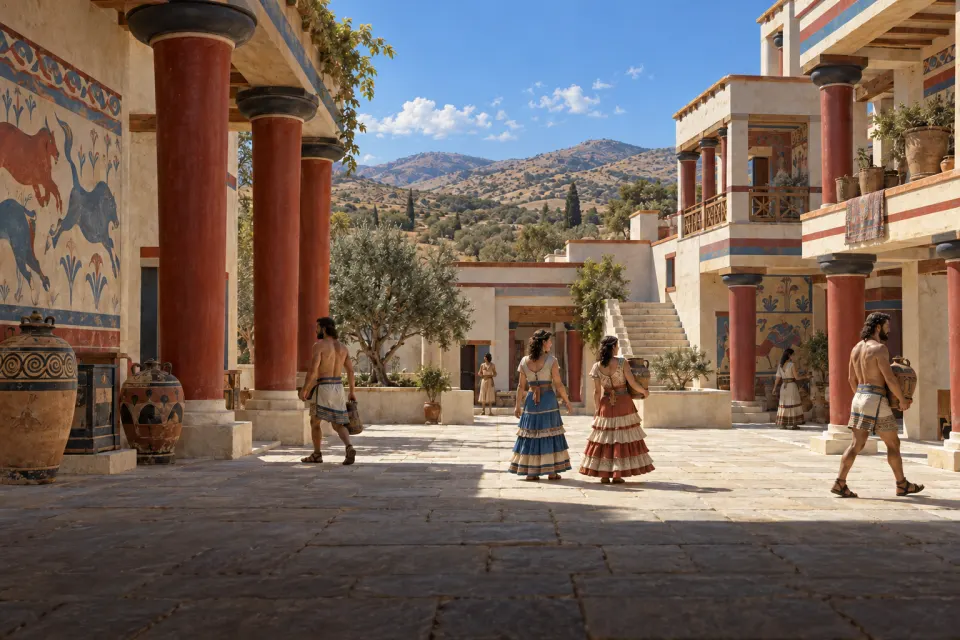
Palaces rise on Crete c. 1900–1600 BCE
Minoan civilization, named after the legendary King Minos of Knossos by the British archaeologist Arthur Evans, who began excavating Knossos in 1900, reached its first peak in the Middle Minoan or "palatial" period. Grand palace-complexes went up at Knossos, Phaistos, Malia and Zakros, combining political, economic and religious roles. Crete's position between Greece, Anatolia and Egypt made it a Bronze Age trading hub: Minoan pottery and goods travelled across the Eastern Mediterranean, and the Minoans imported metals, ivory and fine stone in return.[1–2, 8]
Goddesses, bulls and peak sanctuaries c. 1700–1450 BCE
At its height, Minoan religion combined palace cult with worship at caves, springs and hilltop peak sanctuaries across the countryside. Vivid frescoes on palace walls, showing processions, nature and female figures in elaborate dress, are read by many scholars as evidence that one or more goddesses stood at the centre of Minoan belief. The bull was a recurring sacred motif: paintings and vase scenes show the ritual of bull-leaping, and bull imagery later fed into the Greek legend of the Minotaur, said to live in a labyrinth beneath the Knossos palace.[5–6, 9]
Destruction and Mycenaean takeover c. 1450–1100 BCE
By the mid-15th century BCE, Crete's palace culture collapsed amid some combination of natural disaster, internal upheaval and growing pressure from Mycenaean Greece; Knossos alone was rebuilt under new, Mycenaean-influenced rule before its final destruction. Minoan religious symbolism and some cult practices passed to the Mycenaeans, and the Linear B script that the Mycenaeans used to write early Greek was itself adapted from the Minoans' undeciphered Linear A.[7, 10]
Places

Knossos
GRC · UNESCO World Heritage, 2025
The largest Bronze Age palace-centre on Crete, excavated from 1900 by Arthur Evans, Knossos combined royal, administrative and religious functions and later gave rise to the Greek legend of the Minotaur's labyrinth. It is now part of the UNESCO-listed Minoan Palatial Centres.[2, 11]
Art & objects
Public-domain objects from museum collections. Select one to see it at the museum.
 Silver NecklaceAegean, Minoan(?), Bronze Age, c. 1500 BCE
 Minoan Petal BowlCrete, 1600–1500 BCE
 Female WorshiperCrete, Minoan, middle Minoan III–late Minoan I, c. 1600–1500 BCE
 Carnelian AmygdaloidMinoan, Middle Minoan III–Late Minoan I, ca. 1650–1500 BCE
 Amethyst lentoidMinoan, Late Minoan I, ca. 1600–1500 BCE
 Haematite amygdaloid sealMinoan, Late Minoan I–II, ca. 1600–1400 BCE
 Bronze double-ax headMinoan, Middle Minoan III–Late Minoan I, ca. 1700–1450 BCE
 Bronze double axeMinoan, Late Minoan III, ca. 1400–1050 BCE
How we know
Reading a religion with no legible texts
Minoan religion has to be reconstructed almost entirely from archaeology. Its main script, Linear A, has never been deciphered, so modern understanding of Minoan belief comes from excavated palaces, frescoes, seals, clay figurines and the layout of shrines rather than from any readable prayer, myth or religious law. Even the names scholars use, such as "Minoan" itself, are modern labels: Arthur Evans coined it after the legendary King Minos when he began excavating Knossos in 1900, not a name the people of Bronze Age Crete are known to have used for themselves.[2–3]
Common misconceptions
Myth Knossos's maze-like palace was literally the labyrinth that housed a monstrous Minotaur.
Fact The palace's complex, maze-like floor plan likely helped inspire the Greek legend of the Minotaur's labyrinth, but no archaeological find shows the Minoans themselves told this story or kept such a creature; the tale survives only in later Greek myth, centuries after the palace was built.[6]
Myth Scholars can read what Minoans actually believed from their own religious writings.
Fact No Minoan religious text can be read today: the main Minoan script, Linear A, remains undeciphered. Nearly everything said about Minoan goddess-imagery, peak sanctuaries or bull ritual is inferred from frescoes, figurines and shrine architecture, not from translated words.[3]
Glossary
- Linear A
- The main script of Minoan Crete, found on administrative tablets and ritual objects; it has never been deciphered, which is why Minoan religious belief must be reconstructed from archaeology.[3]
- Peak sanctuary
- An open-air shrine on a hilltop or mountaintop in Crete, used for offerings and ritual outside the palaces.[4]
- Bull-leaping
- A ritual, shown on Minoan frescoes and painted vases, of vaulting over a bull; its exact religious meaning is debated.[6]
- Minotaur
- In later Greek legend, a bull-headed monster kept in a labyrinth under the palace of King Minos at Knossos; the story draws on Minoan bull imagery and the palace's maze-like plan.[6]
- Knossos
- The largest Minoan palace-centre, on Crete, excavated by Arthur Evans from 1900 and now part of a UNESCO World Heritage property.[2, 11]
Sources
Each statement above was checked against published sources; the verdict says whether it stood as written, was corrected or was hedged.
- VerifiedBritannica, Minoan civilization; UNESCO, Minoan Palatial Centres.
- VerifiedBritannica, Minoan civilization; Met, Minoan Crete.
- VerifiedBritannica, Minoan civilization; Met, Minoan Crete.
- VerifiedUNESCO, Minoan Palatial Centres; Met, Minoan Crete.
- VerifiedBritannica, Minoan civilization; Oxford Classical Dictionary.
- VerifiedBritannica, Minoan civilization; UNESCO, Minoan Palatial Centres.
- VerifiedBritannica, Minoan civilization; Oxford Classical Dictionary.
- VerifiedBritannica, Minoan civilization; Met, Minoan Crete.
- VerifiedBritannica, Minoan civilization; Met, Minoan Crete.
- VerifiedBritannica, Minoan civilization; Met, Minoan Crete.
- VerifiedBritannica, Aegean civilizations; UNESCO, Minoan Palatial Centres.
Last fact-checked 6 October 2026.