
Overview
"Megalithic Europe" is not a single religion but a scholars' label for the huge-stone monuments that Neolithic and early Bronze Age communities raised across Atlantic and western Europe over some three thousand years; their builders left no writing, so archaeologists generally link monuments such as Stonehenge, Newgrange and Carnac to a cult of the dead, while cautioning against describing them as one unified "megalithic religion," since their forms and evident purposes vary widely from site to site.[1–2]
History

Standing stones across Atlantic Europe c. 5000–2300 BCE
From Portugal to Scandinavia, Neolithic communities built huge stone monuments—dolmens, passage graves, gallery graves and standing stones or menhirs, sometimes arranged into circles or long rows—including, at Carnac in Brittany, thousands of menhirs raised in long alignments over more than two thousand years, from roughly 5000 to 2300 BCE, probably for ritual, perhaps processional, purposes.[1, 5–6]
Stonehenge and Avebury c. 3000–1500 BCE
Stonehenge, on Salisbury Plain, was built in several stages from about 3000 BCE into the early Bronze Age; its first phase was an earthwork enclosure with 56 pits, the Aubrey Holes, holding cremation burials and forming one of the largest known Neolithic cemeteries in Britain. Around 2500 BCE, locally quarried sarsen stones were raised into a circle and five trilithons, with smaller bluestones hauled from the Preseli Hills in Wales, over 200 km away, and the monument was aligned on the midsummer sunrise and midwinter sunset. Antiquarians John Aubrey and William Stukeley studied Stonehenge from the 17th and 18th centuries on, taking it for a Druid temple; present-day druid and pagan groups still gather there, and at nearby Avebury—itself a henge with hundreds of standing stones—to mark the solstices.[3, 7–12]
Newgrange and the Boyne tombs c. 3200 BCE
In Ireland's Boyne Valley, Neolithic farmers built the passage tomb of Newgrange around 3200 BCE, one of three great mounds alongside Knowth and Dowth surrounded by dozens of satellite tombs, often regarded as the finest passage grave of its kind in Europe.[4]
Key moments
- c. 4500 BCEThe stones of Carnac · Brittany, France
- c. 3200 BCENewgrange aligns with the sun · Boyne Valley, Ireland
- c. 3000 BCEStonehenge · Salisbury Plain, England
Places
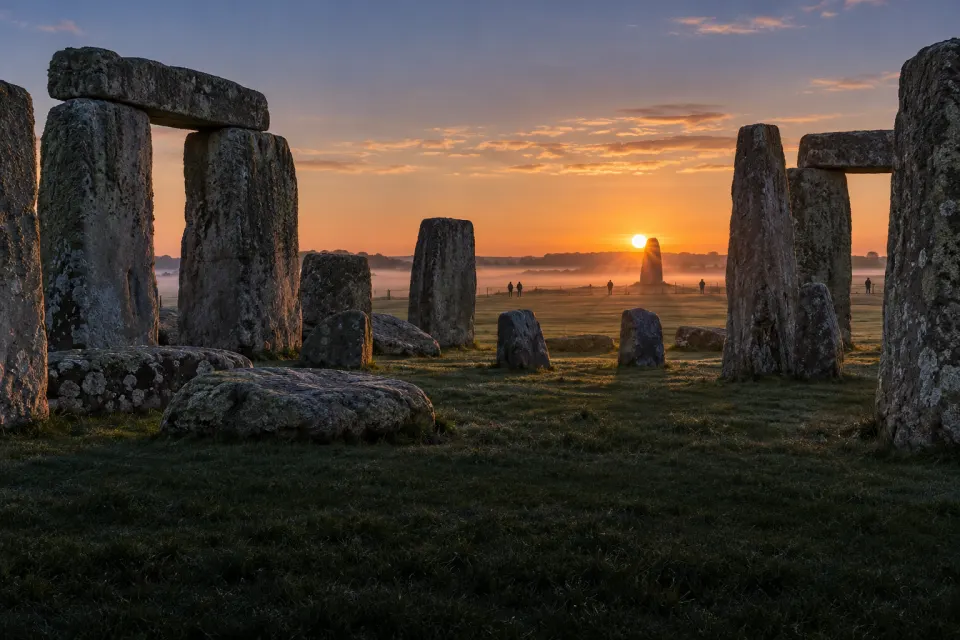
Stonehenge
GBR · UNESCO World Heritage, 1986
Built in stages from about 3000 BCE, Stonehenge began as an earthwork cemetery and later gained its famous sarsen and bluestone circle, aligned on the solstices.[3, 7–9]
Brú na Bóinne (Newgrange)
IRL · UNESCO World Heritage, 1993
Ireland's great Neolithic passage-tomb landscape, built around 3200 BCE, holding the mounds of Newgrange, Knowth and Dowth with dozens of satellite tombs.[4]
Megaliths of Carnac
FRA · UNESCO World Heritage, 2025
A dense concentration of Neolithic standing stones, passage tombs and stone circles in Brittany, including long alignments of thousands of menhirs.[5–6]
Art & objects
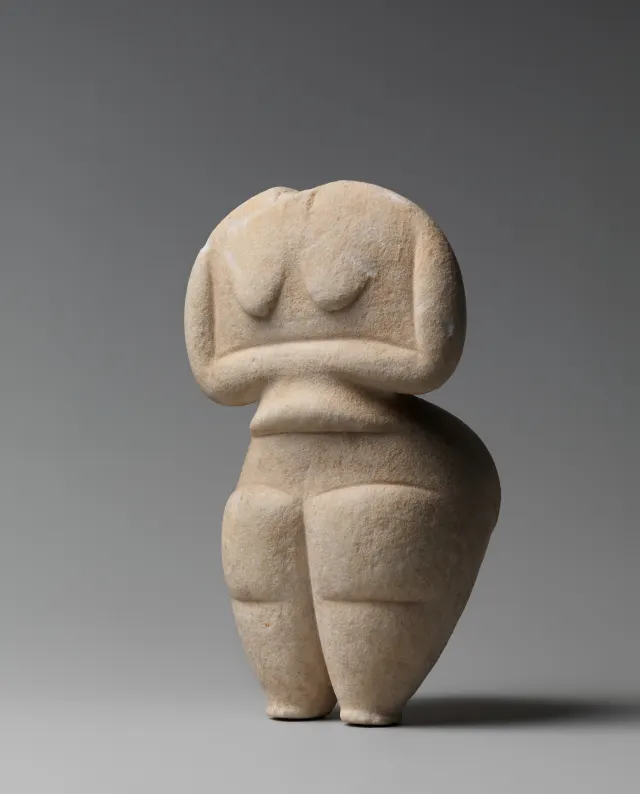
Public-domain objects from museum collections. Select one to see it at the museum.


How we know
No written testimony, only stones and bones
Megalith builders left no texts, so archaeologists link their tombs generally to a cult of the dead while resisting one shared "megalithic religion," since forms and purposes vary so widely from site to site; Stonehenge's clear solstice alignment is treated as strong evidence of deliberate intent, while the Carnac alignments show a less obvious logic that archaeologists admit they cannot yet explain with certainty.[2, 6–7, 9]
Common misconceptions
Myth Stonehenge was built by the druids.
Fact 17th- and 18th-century antiquarians proposed that druids built Stonehenge, and modern druid and pagan groups still gather there for the solstices, but this is a modern association, not evidence about the original builders.[10–11]
Myth All of Europe's megalithic monuments belong to one shared "megalithic religion."
Fact Archaeologists generally connect megalithic tombs with a cult of the dead, but caution that forms and purposes vary so widely by region that one unified megalithic religion is a mistake.[2]
Glossary
- Megalith
- A huge, often roughly dressed stone used in various Neolithic and early Bronze Age monuments; the word covers tombs, standing stones and the circles and rows built from them.[1]
- Alignment
- A row, or several parallel rows, of standing stones, as at Carnac; probably used for ritual, possibly processional, purposes.[5–6]
Sources
Each statement above was checked against published sources; the verdict says whether it stood as written, was corrected or was hedged.
- VerifiedBritannica, megalith; UNESCO World Heritage Centre, Stonehenge, Avebury and Associated Sites.
- VerifiedBritannica, Prehistoric religion; UNESCO World Heritage Centre, Megaliths of Carnac and of the shores of Morbihan.
- VerifiedBritannica, Stonehenge; English Heritage, History of Stonehenge; UNESCO World Heritage Centre, Stonehenge, Avebury and Associated Sites.
- VerifiedBritannica, Newgrange; UNESCO World Heritage Centre, Brú na Bóinne.
- VerifiedUNESCO World Heritage Centre, Megaliths of Carnac and of the shores of Morbihan; Britannica, megalith.
- VerifiedBritannica, megalith; UNESCO World Heritage Centre, Megaliths of Carnac and of the shores of Morbihan.
- VerifiedEnglish Heritage, History of Stonehenge; Britannica, Stonehenge; UNESCO World Heritage Centre, Stonehenge, Avebury and Associated Sites.
- VerifiedEnglish Heritage, History of Stonehenge; UNESCO World Heritage Centre, Stonehenge, Avebury and Associated Sites; Britannica, Stonehenge.
- VerifiedUNESCO World Heritage Centre, Stonehenge, Avebury and Associated Sites; Britannica, Stonehenge.
- VerifiedBritannica, Stonehenge; UNESCO World Heritage Centre, Stonehenge, Avebury and Associated Sites.
- VerifiedBritannica, Stonehenge; UNESCO World Heritage Centre, Stonehenge, Avebury and Associated Sites.
- VerifiedUNESCO World Heritage Centre, Stonehenge, Avebury and Associated Sites; Britannica, megalith.
Last fact-checked 6 October 2026.