Overview
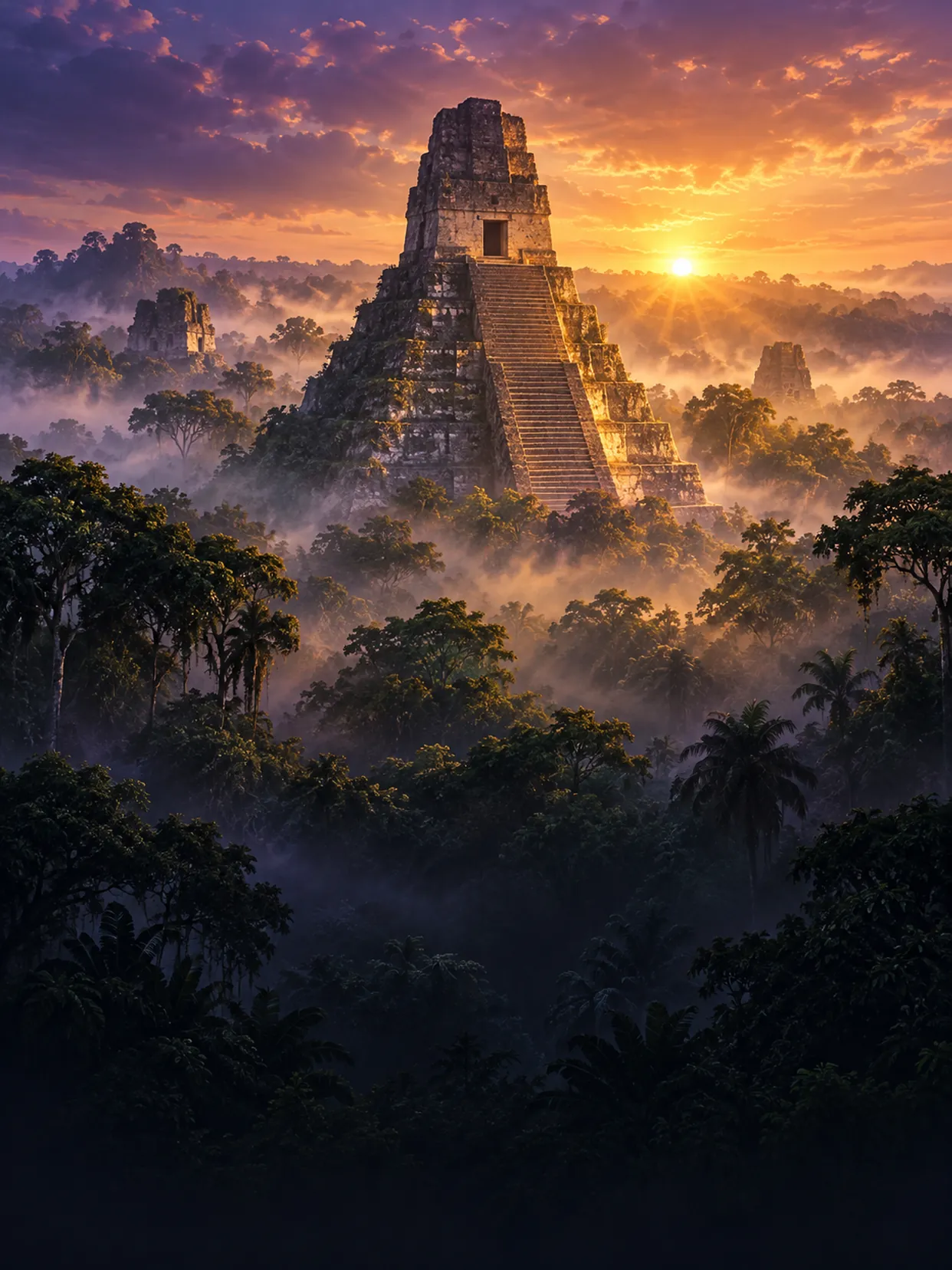
Maya religion is the body of belief and practice of the Maya peoples of southern Mexico, Guatemala, Belize and Honduras, continuous from at least 1500 BCE to today. Its Classic-period form (c. 250–900 CE) centred on divine kingship: rulers mediated between their people and a pantheon of nature gods through bloodletting and sacrifice, while priests tracked an elaborate system of interlocking calendars. Great temple-cities such as Tikal, Palenque and Copán were abandoned after about 900, and the Spanish conquest and Diego de Landa's 1562 burning of Maya books destroyed most of what had been written down. Yet more than five million people still speak Mayan languages, and in the Guatemalan highlands day-keepers still use the ancient 260-day calendar, usually alongside Catholic or Evangelical worship.[1–4, 7–11]
History

Origins and early ceremonial centres c. 1500 BCE–250 CE
Maya farming villages, growing corn, beans and squash, appear in the archaeological record from about 1500 BCE, influenced by the earlier Olmec civilization. By 200 CE these villages had grown into cities with temples, pyramids, palaces, ballcourts and plazas, laying the groundwork for the religious and political life of the Classic period.[12]
Classic-period kingship and ritual c. 250–900 CE
At its height Classic Maya civilization comprised more than 40 cities, among them Tikal, Copán and Palenque, each ruled by a king who claimed to act as intermediary with the gods. Decipherment of the hieroglyphic script has shown that rulers underwent ritual bloodletting and that warfare between rival cities supplied captives for sacrifice, overturning an earlier scholarly image of the Classic Maya as a basically peaceful, priest-led people. After about 900, the great lowland cities were abandoned, for reasons still debated among scholars, including warfare, drought and the breakdown of trade.[10–11, 13]
Survival in the Yucatán and conquest 900–1562
After the lowland collapse, cities in the Yucatán Peninsula such as Chichén Itzá and Mayapán flourished for centuries more, blending Maya tradition with newly arrived Toltec influence, until the Spanish conquered the region in the 16th century. In July 1562 the Franciscan friar Diego de Landa, suspecting the Maya of Maní of idolatry and human sacrifice, held an inquisition there and ordered many Maya books burned; only four pre-conquest codices are known to survive today.[6, 8, 14]
Continuity under colonial rule and today 16th century–present
Even as missionaries suppressed open worship, K'iche' Maya writers in highland Guatemala set down the Popol Vuh in the 1550s, preserving the creation story and royal genealogies in the Latin alphabet. Most Maya today are nominally Roman Catholic or Evangelical Protestant, but this Christianity is generally layered over native cosmology, and in the Guatemalan highlands day-keepers still perform ceremonies by the 260-day sacred calendar.[7, 9, 15]
Key moments
- c. 250 CEClassic Maya temple-cities · Tikal, Palenque, Copán
- 1562 CELanda burns the Maya books · Maní, Yucatán, Mexico
Beliefs
k'uh
godliness, sacred power
Maya religion centred on a pantheon of nature gods, including deities of the sun, moon, rain and corn, while ritual specialists, often called day-keepers, ran the rites and calendar that connected these forces to daily and agricultural life.[3]
cardinal directions
Maya cosmology, like that of other Mesoamerican peoples, organized the universe around a centre and four cardinal directions, each carrying its own colour (red east, white north, black west, yellow south), a pattern that also shaped the ritual calendar.[16]
bloodletting
Kings and queens were believed to appease the gods and conjure ancestral spirits through their own blood; Classic-period art shows a queen pulling an obsidian-studded rope through her tongue, and captives taken in war were sacrificed for the same end, helping maintain the cosmic order.[10, 17]
Practice

Bloodletting and sacrifice
Rulers practised ritual bloodletting as a religious obligation, and war captives, including rival cities' nobles, were sacrificed to the gods. At Chichén Itzá, children were sacrificed and buried near the city's Sacred Cenote; a 2024 genetic study of one such burial found the children were all boys, mostly aged three to six, with an unusually high number of close relatives among them, including two pairs of identical twins, suggesting they were chosen in part for their kinship.[17–18]
The calendar round
Priests tracked a 260-day sacred Tzolk'in alongside a 365-day solar Haab', the two running together in a 52-year cycle, and recorded longer spans on the Long Count, fixed to a mythical starting point around 3113 BCE.[4]
Day-keeping today
In the Guatemalan highlands, trained day-keepers called ajq'ij still use the 260-day Cholq'ij calendar to guide ceremonies, divination and healing; every 260 days a new-year rite, Wajxaqib' B'atz', initiates new day-keepers, and the printed Cholq'ij calendar is in everyday use in many highland communities.[7, 19]
Holy days
Wajxaqib' B'atz'
every 260 days, in the Guatemalan highlands
The new-year rite of the 260-day Cholq'ij calendar, at which highland day-keepers are initiated and communities mark the calendar's completion and renewal; it is among the clearest living continuations of pre-conquest Maya religious practice.[7, 19]
People
Chaac · Chaahk
deity
The rain and storm god, venerated throughout the Maya region; because water was scarce in the lowlands, acts of appeasement to him mattered for the well-being of whole communities.[3]
Lady K'ab'al Xook
ruler · 8th century CE
A prominent wife of Shield Jaguar II, ruler of the Classic city of Yaxchilán, shown on a carved limestone lintel, now in the British Museum, performing bloodletting by pulling a rope through her tongue while her husband holds a flaming torch above her.[10]
Diego de Landa
other · 1524–1579
A Spanish Franciscan friar and later bishop of Yucatán who both destroyed Maya religious books in a 1562 burning at Maní and wrote a long colonial account of Maya culture and writing, a deeply mixed legacy for later scholarship.[8]
Scripture
Popol Vuh · Popol Wuj
written c. 1554–1558
A K'iche' Maya account of creation, the exploits of the Hero Twins Hunahpu and Xbalanque, and the genealogy of K'iche' kings to 1550, written in the Latin alphabet; the original manuscript is lost, but a copy and Spanish translation made by the friar Francisco Ximénez around 1701–1715 survives in Chicago's Newberry Library. Stucco panels found at El Mirador, Guatemala, dated to about 300 BCE, show the Hero Twins centuries before the manuscript was written, confirming the antiquity of its story.[5, 20]
Dresden Codex
pre-conquest
One of only four Maya painted books known to survive the Spanish book-burnings, containing eclipse-prediction tables and calculations of the synodic period of Venus of exceptional accuracy, now held in Dresden's Saxon State Library.[6, 21]
Places

Tikal
GTM · UNESCO World Heritage, 1979
A Classic Maya city in the Guatemalan lowlands whose Great Plaza, lined with carved stelae, and North Acropolis formed its ritual core from the start of the first millennium CE; its authority, like that of other lowland cities, collapsed around the start of the tenth century.[11, 13]
Chichén Itzá
MEX · UNESCO World Heritage, 1988
A Yucatán city built beside sacred cenotes, which gave it its name; it flourished after Toltec warriors associated with the figure Kukulkan took it over in the 10th century, blending Maya and Toltec religious architecture before declining after about 1440.[14, 22]
Palenque
MEX · UNESCO World Heritage, 1987
A Classic-period Maya city in Chiapas, one of more than 40 cities at the height of Maya civilization, abandoned along with the other great lowland cities after about 900 CE.[11, 13]
Art & objects
Public-domain objects from museum collections. Select one to see it at the museum.
 Eccentric FlintMexico, c. 200 CE
 Vessel Depicting K'awiil (God K) and Itzamna Exchanging GiftsGuatemala, 700–800 CE
 PectoralMexico, 200–800 CE
 Hieroglyphic PanelGuatemala, 650–800
 Hieroglyphic AltarBonampak, 650–700
 StelaCampeche state, c. 702
 Crown Ornament (Hu’unal)Mexico or Central America, Maya, 250–900 CE
 Chahk (rain god)Maya, 800–1000 CE
 Censer SupportMaya, mid-7th–9th century
 Whistle with the Maize God emerging from a flowerMaya, 600–900 CE
 Mirror-bearerMaya, 410–650 CE
 Deity figureMaya, 200–600 CE
 Head of a solar deityMaya, 600–900 CE
How we know
Surviving books and colonial bias
Nearly all pre-conquest Maya painted books were destroyed in Spanish book-burnings, most infamously Diego de Landa's 1562 auto-da-fé at Maní, leaving only four known codices. Much of what is otherwise known comes from Spanish colonial writers, including Landa himself, whose long account of Maya culture also served to justify his actions, so scholars read their accounts critically against archaeology and the surviving hieroglyphic inscriptions.[6, 8]
Decipherment and a changed picture
Early and mid-20th-century scholars, working from only a partly understood script, pictured the Classic Maya as a basically peaceful, priest-led society. The decipherment of Maya hieroglyphic writing, which advanced greatly from the 1960s onward, instead revealed dynastic warfare, captive-taking and sacrifice as central to Maya kingship and religion, a major correction built on inscriptions rather than colonial-era texts alone.[10–11]
Common misconceptions
Myth The ancient Maya were a uniquely peaceful, priest-led people with no interest in war.
Fact Decipherment of Maya hieroglyphs shows that rival cities fought frequently, that captured nobles were sacrificed, and that warfare was tied to kings' duty to maintain the cosmic order and honour their patron gods; the earlier peaceful image came from scholars working before the script was read.[10–11]
Myth The Maya disappeared after the Classic-period collapse.
Fact More than five million people still speak Mayan languages across Mexico, Guatemala, Belize and Honduras, and highland Guatemalan day-keepers still use the 260-day sacred calendar; what ended around 900 CE was the lowland cities' political system, not the people or all of their religion.[7, 9]
Myth Chichén Itzá's Sacred Cenote mainly received sacrificed young women chosen for their beauty.
Fact DNA from one mass child burial next to the Sacred Cenote, analysed in 2024, showed every one of the 64 sacrificed children was a boy, mostly aged three to six, and that an unusually large share were close relatives, including two sets of identical twins; the long-told image of sacrificed maidens is not what this evidence shows.[18]
Glossary
- Tzolk'in · Cholq'ij
- The 260-day sacred calendar, combining 20 named days with the numbers 1 to 13, used for ritual and divination and still kept by highland day-keepers.[4]
- Haab'
- The 365-day solar calendar of eighteen 20-day months plus five unlucky days, run alongside the Tzolk'in.[4]
- Long Count
- A continuous count of days from a mythical starting point in 3113 BCE, used to fix events over long spans of Maya history.[4]
- ajq'ij
- A trained highland Maya calendar-keeper who performs ceremonies and divination by the 260-day Cholq'ij calendar.[7, 19]
- stela
- A freestanding carved stone slab, often paired with a low altar, recording a Maya ruler's deeds and dates; Tikal's Great Plaza held about seventy.[13]
- K'iche'
- A Mayan people and language of the Guatemalan highlands, whose 1550s writers set down the Popol Vuh.[5]
Sources
Each statement above was checked against published sources; the verdict says whether it stood as written, was corrected or was hedged.
- VerifiedBritannica, Maya; Smithsonian NMAI, The Maya Calendar System.
- VerifiedBritannica, Maya; Met, Tikal.
- VerifiedBritannica, Maya; Metropolitan Museum of Art, Lives of the Gods: Divinity in Maya Art; Encyclopedia.com, Maya Religion; EBSCO, Chaac (supporting).
- VerifiedBritannica, Maya; Smithsonian NMAI, The Maya Calendar System.
- CorrectedBritannica, Popol Vuh; Encyclopedia.com, Popol Vuh.
- VerifiedEncyclopedia.com, Codices; Metropolitan Museum of Art, Lives of the Gods: Divinity in Maya Art; University of North Carolina at Chapel Hill Library, Maya Codices; Britannica, Mayan religion; EBSCO, Maya books (supporting).
- VerifiedSmithsonian NMAI, The Maya Calendar System; Britannica, Maya.
- VerifiedBritannica, Diego de Landa; Penn Museum, Jones, Maya Hieroglyphs: A History of the Decipherment, Expedition 27(3), 1985; University of North Carolina at Chapel Hill Library, Relation des choses de Yucatan; Encyclopedia.com, Landa, Diego De; EBSCO, Maya books (supporting).
- VerifiedBritannica, Maya; Smithsonian NMAI, The Maya Calendar System.
- VerifiedBritannica, Maya; Cambridge University Press, Aoyama, Classic Maya Warfare and Weapons: Spear, dart, and arrow points of Aguateca and Copan, Ancient Mesoameri; Cambridge University Press, Hernandez and Bracken, Unleashing Maya Warfare: Inquiry into the Practical Aspects of War-Making, Ancient Mesoam; Metropolitan Museum of Art, Lives of the Gods: Divinity in Maya Art; British Museum, Yaxchilan Lintel 24; Encyclopedia.com, Maya Religion; EBSCO, Ancient Maya (supporting).
- VerifiedBritannica, Maya; Met, Tikal.
- VerifiedBritannica, Maya; Met, Tikal.
- VerifiedBritannica, Maya; Met, Tikal.
- VerifiedBritannica, Maya; UNESCO, Pre-Hispanic City of Chichen-Itza.
- VerifiedBritannica, Popol Vuh; Encyclopedia.com, Popol Vuh.
- VerifiedBritannica, Mayan religion; Encyclopedia.com, Calendars: Mesoamerican Calendars.
- VerifiedBritannica, Maya; Encyclopedia.com, Maya Religion; Metropolitan Museum of Art, Lives of the Gods: Divinity in Maya Art; Art Institute of Chicago, Vessel Depicting a Sacrificial Ceremony for a Royal Accession; Hudson Museum, University of Maine, Maya: Warfare; Cambridge University Press, Hernandez and Bracken, Unleashing Maya Warfare: Inquiry into the Practical Aspects of War-Making, Ancient Mesoam; EBSCO, Ancient Maya (supporting).
- Correctedpmc.ncbi.nlm.nih.gov; Max Planck Institute for Evolutionary Anthropology, Ritual sacrifice at Chichén Itzá.
- VerifiedSmithsonian NMAI, The Maya Calendar System; Britannica, Maya.
- VerifiedBritannica, Popol Vuh; Encyclopedia.com, Popol Vuh.
- CorrectedBritannica, Dresden Codex; SLUB Dresden, The Maya Codex in the SLUB Dresden.
- VerifiedUNESCO, Pre-Hispanic City of Chichen-Itza; Britannica, Maya.
Last fact-checked 4 October 2026.