
Overview
Mandaeism is a Gnostic baptismal religion, one of the few communities to carry a pre-Islamic Gnostic tradition into the present. Its name comes from manda, "knowledge," and its neighbors have long called its members Sabians, or Subbi, "baptizers." Mandaeans trace their roots to Mesopotamia in the first centuries CE, though scholars debate the religion's exact origin. They revere John the Baptist as their greatest prophet and teacher, while rejecting Jesus as a false messiah. Salvation lies in gnosis, knowledge of the soul's divine origin, won partly through repeated baptism in flowing river water. A hereditary priesthood guards the faith's Aramaic scriptures and rites. Mandaeism's historic home is southern Iraq and Iran's Khuzestan province, but war and persecution have scattered most of the community into a worldwide diaspora since 2003.[1–4, 8–10]
History

Uncertain origins 1st–3rd centuries CE
Most scholars place the religion's beginnings somewhere in the first three centuries CE, but its origin is highly conjectural: some locate it in southwestern Mesopotamia, others argue for roots in the Jordan Valley and an early migration eastward. Mandaeans came to revere John the Baptist as their greatest prophet, crediting him with reforming and revitalizing an older faith rather than founding a new one, while viewing Jesus as a false messiah.[2–3]
Life along the rivers antiquity–20th century
For most of their history Mandaeans have lived along the waterways of southern Iraq and Khuzestan in southwestern Iran, a riverine world suited to their central rite of baptism in flowing water. A hereditary priesthood of ganzibra and tarmida preserved the community's Aramaic scriptures and rituals, though the office of rishama, the supreme religious head, has stood vacant since the mid-19th century; an 1831 cholera epidemic killed much of the priestly class outright.[6, 10–11]
War and diaspora 2003–present
Iraq's Mandaean community collapsed under the sectarian violence that followed the 2003 war. By the early 2020s the United States government estimated that only around 10,000 to 15,000 remained in the country, mainly in the south. Most of the worldwide community of roughly 60,000 to 100,000 Mandaeans now live scattered abroad, with sizeable settlements in Sweden and smaller ones elsewhere in Europe, the Americas and Australia, while several thousand Mandaeans remain in Iran's Khuzestan province, a second historic homeland also diminished by emigration.[8]
Beliefs
Gnosis · manda
knowledge
Salvation comes through esoteric knowledge of the soul's divine origin, not through faith or works alone. As in other Gnostic systems, the soul's ascent back through the heavens after death is held to be obstructed by evil archons, rulers of the lower world who must be overcome before the soul can return to its true home of light.[9]
Maṣbuta
baptism
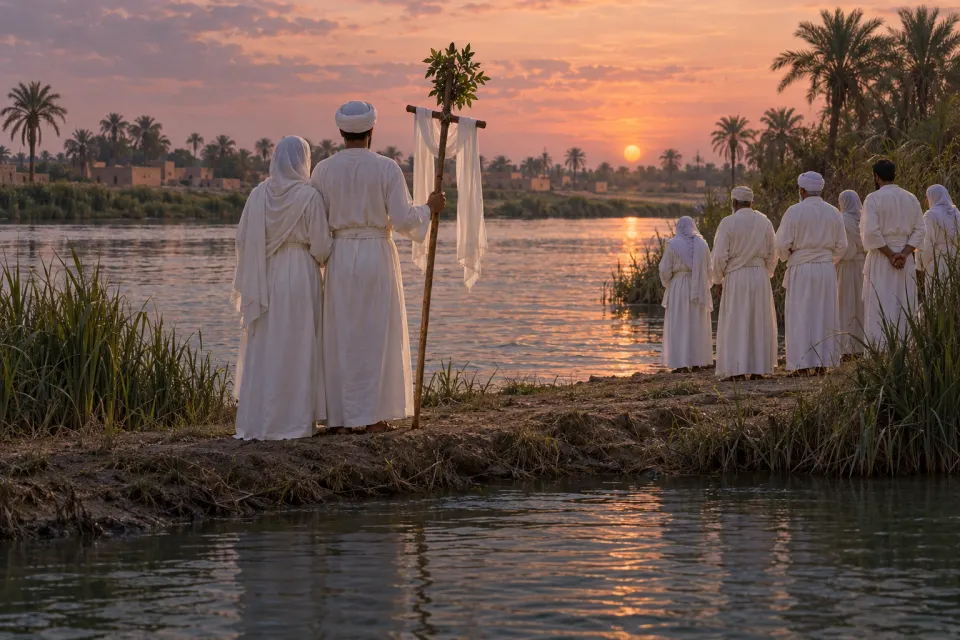
Baptism in flowing water is Mandaeism's defining and most elaborate ritual, understood to grant purification, physical health and a measure of immortality; it is performed repeatedly through life rather than once, and the community's main rites fall on Sunday rather than the Sabbath.[4]
John the Baptist
Mandaeans honor John the Baptist as the greatest of their prophets and credit him with healing through baptism, though they do not regard him as the faith's founder; they reject Jesus, viewing him instead as a false messiah.[3]
Practice
Marriage and purity
Mandaeism places strong value on marriage and forbids sexual license, while also prohibiting circumcision, a practice that sets it apart from the Judaism and Islam of its neighbors.[12]
The priesthood
Religious authority rests with a small hereditary priesthood. The tarmida officiates at most rites; the ganzibra, a senior priest, ranks above him; the supreme office of rishama has had no occupant since the mid-19th century, leaving the two lower ranks to lead the community.[6, 11]
People
John the Baptist
prophet
Revered by Mandaeans as their greatest prophet and teacher, credited with reforming and revitalizing their faith through baptism, though not regarded as its founder.[3]
Hibil Ziwa
other
A heavenly figure of light regarded as the Mandaeans' savior; a dedicated scripture, the Baptism of Hibil Ziwa, recounts his own ritual purification and is one of the faith's four most important texts.[5]
Scripture
Ginza Rba · ginza rba
Mandaeism's principal scripture, a cosmological treatise sometimes called the Book of Adam; it is the central text of the faith's Aramaic scriptural corpus.[5]
Book of John · drasha d-yahya
A scripture describing the activities of John the Baptist, alongside the Ginza Rba one of the community's most important surviving writings.[5]
Book of the Zodiac
A collection of astrological and magical texts ranked among the four most important Mandaean writings, used alongside the Ginza Rba and the Book of John.[5]
Places
Basra
IRQ
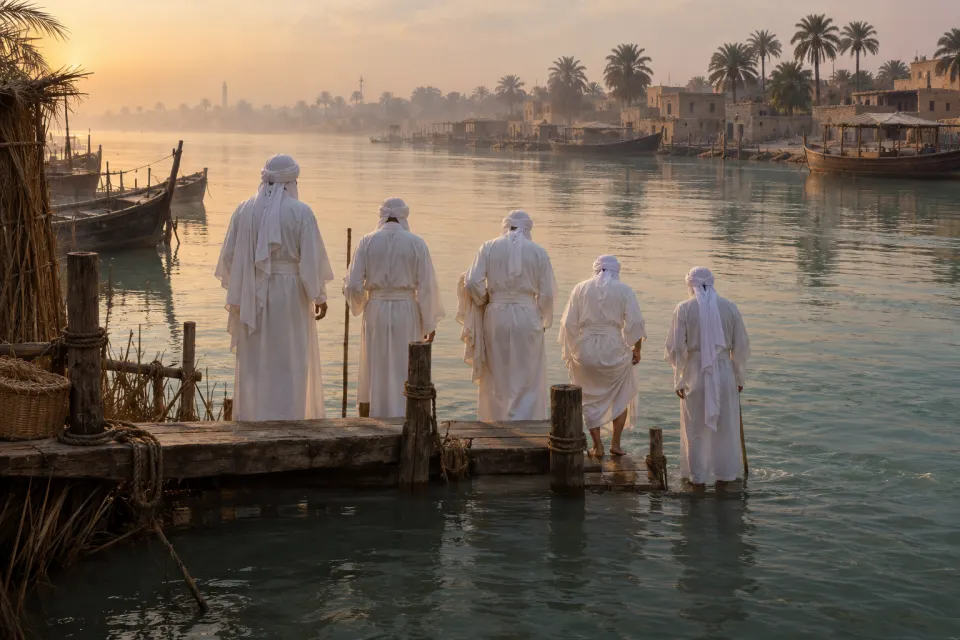
A city on the Tigris-Euphrates waterways in southern Iraq, historically one of the centers of Mandaean population and a site for the community's baptismal rites in flowing water.[10]
Ahvaz
IRN
The main city of Iran's Khuzestan province, the other historic heartland of Mandaean settlement and, until the 20th century, home to communities still speaking Neo-Mandaic.[7, 10]
Art & objects
Public-domain objects from museum collections. Select one to see it at the museum.

Numbers
- Followers
- c. 60,000–100,000 worldwide (2020s)[8]
University of Exeter/Leiden research project estimate; Iraq's pre-2003 community of 60,000-70,000 has mostly scattered abroad since.
National censuses
| Country | Year | Count | Share |
|---|---|---|---|
| Australia Mandaean | 2021 | 9,178 | 0.0% |
Source: Australian Bureau of Statistics, Census of Population and Housing 2021, 'Religious affiliation in Australia' (Table 4), CC BY 4.0.
Common misconceptions
Myth Mandaeans are a Christian sect because they revere John the Baptist and practice baptism.
Fact Mandaeism is an independent Gnostic religion with its own scriptures, priesthood and cosmology, not a form of Christianity. Mandaeans view Jesus as a false messiah, treat John the Baptist as a reformer of an older faith rather than a founder, and practice baptism repeatedly throughout life rather than once, for reasons rooted in their own doctrine of gnosis.[3–4, 9]
Myth Mandaeism is a small but stable community that has always lived mainly in Iraq.
Fact The 2003 Iraq War and the sectarian violence that followed nearly destroyed the Iraqi Mandaean community, which by the early 2020s had fallen to an estimated 10,000-15,000 people remaining in the country; most Mandaeans alive today, out of a worldwide total of roughly 60,000-100,000, live in diaspora communities outside the Middle East, with the largest single settlement in Sweden.[8]
Glossary
- Manda
- "Knowledge": the root of the name Mandaeism, reflecting the faith's Gnostic emphasis on saving knowledge.[1]
- Maṣbuta
- Baptism in flowing water, Mandaeism's central and repeated ritual, believed to purify and heal.[4]
- Ginza Rba
- "Great Treasure": the principal Mandaean scripture, a cosmological text also called the Book of Adam.[5]
- Ganzibra
- A senior Mandaean priest, ranking above the tarmida; the term means "treasurer."[6]
- Tarmida
- An ordinary Mandaean priest, from a word related to "disciple"; officiates at most rites.[6]
- Rishama
- "Head of the people": the supreme Mandaean religious office, vacant since the mid-19th century.[11]
- Mandaic
- The East Aramaic language of Mandaean scripture and ritual, still spoken in a dwindling Neo-Mandaic form in Iran's Khuzestan province.[7]
- Sabian · Subbi
- A name neighboring communities have long used for Mandaeans, meaning "baptizers," after their central rite of repeated immersion in flowing water.[1]
- Hibil Ziwa
- A heavenly being of light regarded as the Mandaeans' savior, whose own purification is the subject of a dedicated Mandaean scripture.[5]
Sources
Each statement above was checked against published sources; the verdict says whether it stood as written, was corrected or was hedged.
- VerifiedBritannica, Mandaeanism; Encyclopedia.com, Mandaean Religion.
- VerifiedBritannica, Mandaeanism; Encyclopedia.com, Mandaean Religion.
- VerifiedBritannica, Mandaeanism; Encyclopedia.com, Mandaean Religion.
- VerifiedBritannica, Mandaeanism; Encyclopedia.com, Mandaean Religion.
- VerifiedBritannica, Mandaeanism; Encyclopedia.com, Mandaean Religion.
- VerifiedEncyclopedia.com, Mandaean Religion; Encyclopaedia Iranica, MANDAEANS iv. Community in Iran.
- VerifiedEncyclopedia.com, Mandaean Religion; Encyclopaedia Iranica, MANDAEANS vi. Neo-Mandaic Language.
- CorrectedUniversity of Exeter/Leiden, The Worlds of Mandaean Priests; US Department of State, 2022 Report on International Religious Freedom: Iraq.
- VerifiedBritannica, Mandaeanism; Encyclopedia.com, Mandaean Religion.
- VerifiedBritannica, Mandaeanism; Encyclopaedia Iranica, MANDAEANS iv. Community in Iran.
- VerifiedEncyclopedia.com, Mandaean Religion; Encyclopaedia Iranica, MANDAEANS iv. Community in Iran.
- VerifiedBritannica, Mandaeanism; Encyclopedia.com, Mandaean Religion.
Last fact-checked 3 October 2026.