Overview
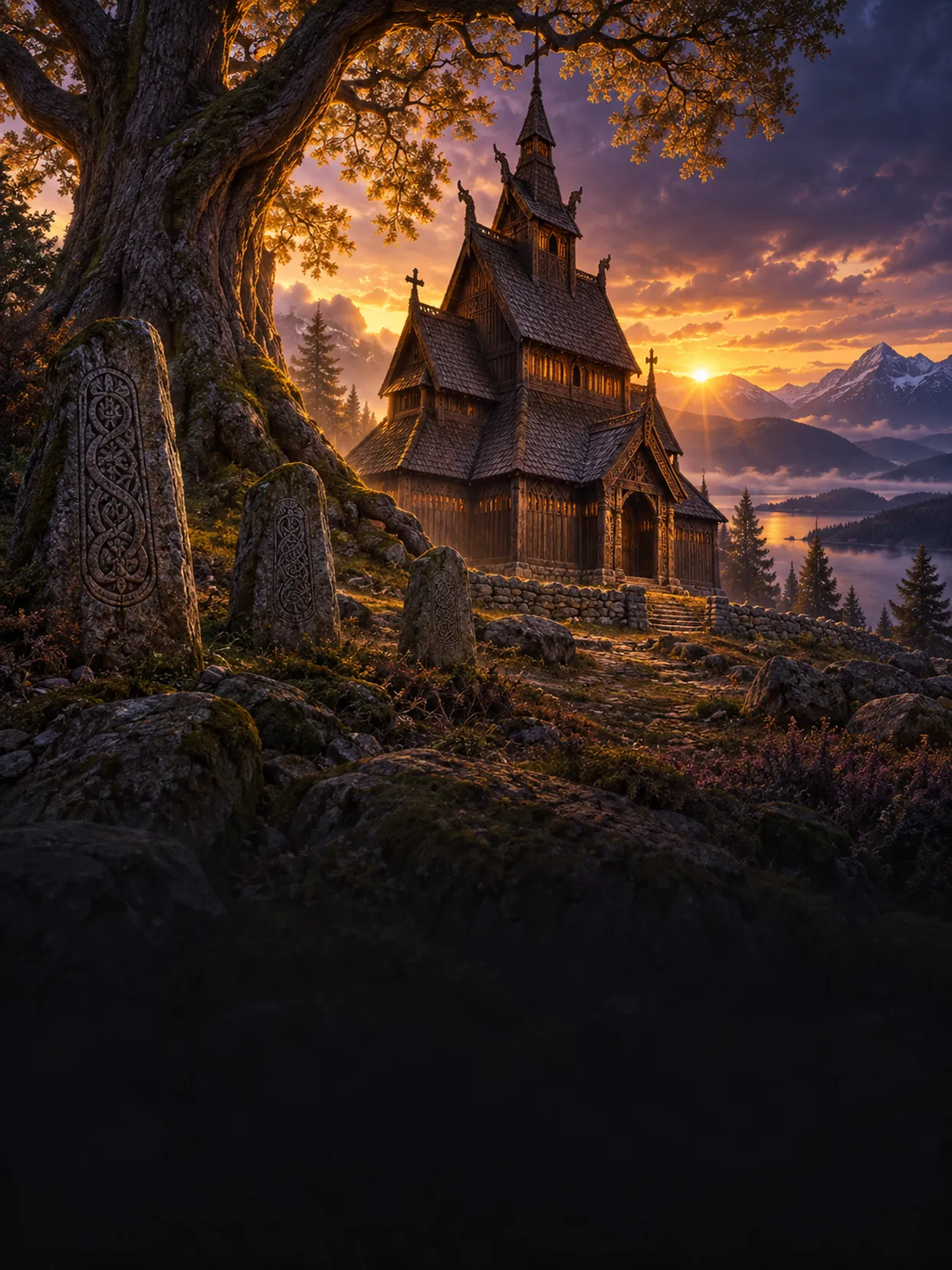
Germanic religion is the name scholars give to the gods, myths and rituals of the Germanic-speaking peoples of northern Europe before they became Christian. Its best-known form is the Norse religion of Viking-Age Scandinavia, the world of Odin, Thor, Freyja and the world tree Yggdrasil. It had no founder and no scripture. People gave offerings to gods, spirits and the dead in groves, lakes and bogs, and at feasts in chieftains' halls. The peoples converted at different times, from many Goths in the 4th century to the Swedes around 1100 or later. Almost everything written about the old gods comes from outsiders or from Christians, so scholars weigh the texts against archaeology, runes and place-names.[3, 10–14]
History

Offerings in the bogs c. 500 BCE – 400 CE
Long before anything was written down, people in southern Scandinavia sank offerings into lakes and bogs. Around 350 BCE the defenders of the Danish island of Als beat off a seaborne war band and gave its weapons and one of its boats to the bog at Hjortspring, apparently as thanks for victory. Around 205 CE, at Illerup Ådal in Jutland, the deliberately wrecked gear of a defeated army went into a lake. The Roman historian Tacitus, writing about 98 CE and probably without visiting, described sacred groves rather than temples and human sacrifice to a god he called Mercury, whom scholars identify with Wodan, the later Odin.[15–18]
Goths, Anglo-Saxons and Saxons c. 300 – 800 CE
Two gold horns from Gallehus in Jutland, made around 400 CE and melted down by a thief in 1802, bore images that probably had religious meaning. Germanic peoples who moved into the Roman world turned Christian early: many Goths in the 4th century, when Bishop Wulfila gave them an alphabet and a Bible. Anglo-Saxon settlers brought Woden, Thunor, Tiw and Frige to Britain, where four weekdays still bear their names. A mission from Pope Gregory reached Kent in 597, yet in the early 7th century an East Anglian ruler was given a 27-metre ship grave at Sutton Hoo. Charlemagne burned the Saxons' sacred pillar, the Irminsul, in 772, and a law of the 780s made refusing baptism a capital crime.[19–24]
The Viking Age c. 750 – 1050
In Scandinavia the old religion lasted longest. Place-names and many small hammer amulets suggest that Thor was the most widely worshipped god, while Odin belonged above all to kings, poets and warriors. Chieftains hosted seasonal sacrificial feasts in great halls, like the one excavated at Tissø on Zealand. The powerful were buried with ships, animals and rich goods: two women at Oseberg in Norway in the 9th century, a man at Gokstad around 900. In 922 the Arab envoy Ibn Fadlan watched Rus traders on the Volga burn their dead chief in his ship, with an enslaved woman killed to join him.[25–28]
conversion of the North c. 960 – 1100s
Around 965 the Danish king Harald Bluetooth raised a runestone at Jelling claiming that he had made the Danes Christian. In Norway Olaf Tryggvason pressed the faith on his subjects by force in the late 990s, and Olaf Haraldsson made it the only lawful religion in 1024; killed at Stiklestad in 1030, he was soon venerated as a saint. Iceland's assembly agreed in 999 or 1000 that everyone should be baptised, tolerating private sacrifice for a few years. Sweden changed slowly: Adam of Bremen, writing about 1075, reported public sacrifice still held at Uppsala, and the country was hardly Christian before about 1100.[29–32]
Memory, revival and misuse 1100s – today
christian Icelanders preserved the old poetry. Ari the Learned wrote the first history of the Icelanders in 1122–33, Snorri Sturluson retold the myths for young poets in the 1220s, and the Eddic poems were copied into the Codex Regius around 1270. In the early 20th century small völkisch groups in Germany and Austria claimed to revive the religion of a Nordic race, and racist readings of the gods and symbols persist on the far right. Modern Heathenry, which grew from the 1970s, is a separate tradition; by 2015 most Heathens surveyed rejected racial interpretations, and Iceland's Ásatrú association has denounced neo-Nazism.[33–35]
Beliefs
Æsir and Vanir · Æsir, Vanir
the two families of gods
Norse sources divide the gods into two families. The Æsir, among them Odin, Thor, Tyr and Frigg, rule and fight; the Vanir, the sea god Njörd and his children Freyr and Freyja, bring wealth and fertility. Myth tells of a war between them that ended in a truce and an exchange of hostages, which brought the Vanir to live among the Æsir.[36]
Yggdrasil · Yggdrasill
the world tree
At the centre of the cosmos stands a vast evergreen ash whose roots reach the realms of the dead, the frost giants and humans; the poems and Snorri count nine worlds around it. In the poem Hávamál Odin hangs on the tree for nine nights, wounded by a spear, to win the secret of the runes.[37–38]
Gods and giants · jǫtnar
giants
The gods' great opponents are the giants, who live at the edges of the world and threaten gods and humans alike. Thor, armed with his hammer, is the gods' champion against them in story after story. The line between the two races is not sharp, though: Loki, counted among the gods, is the son of a giant.[39]
Death and the afterlife · Valhǫll, Hel
There was no single teaching about death. Poems say that Odin took half of those slain in battle to Valhalla, the hall of the fallen, to train for the last battle, and Freyja took the other half. Other sources send the dead to Hel, a gloomy underworld, or picture them living on in the grave, where a restless corpse might trouble the living.[40–42]
Ragnarök · Ragnarǫk
fate of the gods
The poem Völuspá and Snorri foretell the end of the gods' world. Loki and the wolf Fenrir break free, giants attack, Odin dies in the wolf's jaws, and Thor and the World Serpent kill each other. The earth then sinks into the sea and rises again green and renewed. Scholars see Christian colouring in Völuspá, probably composed in Iceland around 1000.[43–44]
Practice

Blót: sacrifice and feast · blót
The central rite was the blót, an offering made so that the gods would give something back: good seasons, fertility or victory. Animals, especially horses and cattle, were slaughtered, their blood sprinkled on altars and people, and the meat eaten at a feast with toasts to the gods. Roman writers and Adam of Bremen also report human sacrifice.[45]
Holy places · hǫrgr, vé, hof
Much worship took place in the open: in groves, by waterfalls and lakes, and at the hörgr, a stone cairn used as an altar. Consecrated sites, vé, survive in place-names such as Odense, Odin's shrine. Whether there were true temples is debated: sagas describe them, but archaeologists have found only a few small cult houses, and many rites probably took place in chieftains' halls.[46–47]
Seeresses and seiðr · vǫlva, seiðr
Seeresses, völur, were respected specialists called in to foresee the future when a household or district was in trouble. A saga describes one seated on a high seat with a staff while singers helped her into a trance. Myth links this trance magic, seiðr, with Freyja and the Vanir, and says Freyja taught it to Odin.[48–49]
Burial
The dead were cremated or buried, often with weapons, tools, food, animals and sometimes servants. The greatest were laid in ships under mounds, as at Oseberg, Gokstad and Sutton Hoo. Ship graves may express a journey to the otherworld, but scholars also read them as statements of rank and power made by the mourners.[50–51]
Runes · rúnar
Germanic peoples wrote in runes from the early centuries CE, cutting them into weapons, jewellery and stone. Myth says Odin won them by sacrifice, and ancient and later writers credited them with magical power, but historians increasingly see this as later elaboration, since most surviving inscriptions are practical messages or memorials. Viking-Age runestones mostly honoured the dead, and some, like Harald's at Jelling, proclaimed the new faith.[38, 52–53]
Holy days
Winter Nights · vetrnætr
Start of winter in the Norse year (autumn)
Sagas describe a sacrifice at the start of winter for a good season, and private household offerings around this time to the dísir, female guardian spirits, and to the elves.[54]
Yule · jól
Midwinter (December–January)
A midwinter feast of ale and sacrifice that, by Snorri's account, once lasted three days. Snorri's saga credits the Christian king Haakon the Good with moving it to coincide with Christmas by law; Yule became a name for Christmas itself.[55]
Uppsala festival
Every nine years (season uncertain)
Adam of Bremen describes a festival for all Swedes every ninth year, at which male animals and humans were hanged in a grove beside the temple. Scholars debate how much is eyewitness report and how much Christian stereotype.[56]
People
Odin · Óðinn; Old English Wōden
deity
The foremost god of the Norse poems: ruler, poet, magician and god of war and the dead, who gave an eye at Mímir's well for wisdom and gathers fallen heroes in Valhalla. Place-names suggest he was chiefly a god of kings and warriors. Romans equated him with Mercury, hence Wednesday.[57]
Thor · Þórr; Old English Þunor
deity
The thunder god, immensely strong, who rides a goat-drawn chariot and fights giants with his hammer Mjöllnir. Protector of farmers and ordinary people, he was apparently the most widely worshipped god in late pagan Scandinavia. Romans matched him with Jupiter, hence Thursday.[58]
Freyr · Freyr
deity
A god of the Vanir, his name meaning Lord, who ruled peace, fertility, rain and sunshine; the boar was sacred to him. He was worshipped above all in Sweden, and Adam of Bremen's Fricco, honoured at Uppsala for weddings, is usually taken to be Freyr.[59]
Freyja · Freyja
deity
Freyr's sister, her name meaning Lady: goddess of love and fertility but also of battle and death, who chooses half the slain. She owns the necklace Brísingamen, travels in a chariot drawn by cats, and is said to have taught seiðr magic to the gods.[60]
Tyr · Týr; Old English Tīw
deity
One of the oldest Germanic gods, probably once a sky god, later linked to war, law and oaths. Myth says he lost a hand to the wolf Fenrir, having put it in the wolf's mouth as a pledge. Romans matched him with Mars, hence Tuesday; Danish place-names such as Tissø, Tyr's lake, recall his cult.[61]
Frigg · Frigg; Old English Frīg
deity
Odin's wife, already paired with Wodan as Frea or Friia in early Lombard and German sources. In Snorri she is the grieving mother of Balder, who tries to make all things swear not to harm him. Her name survives in Friday, which translated the Roman day of Venus.[62]
Loki · Loki
deity
A shape-shifting trickster, son of a giant yet counted among the gods, who helps them with clever schemes but brings about Balder's death and is bound until Ragnarök. He is a figure of story: no trace of a cult of Loki, or of places named after him, has been found.[63]
Scripture
Germania
c. 98 CE
A short Latin study of the Germanic tribes by the Roman historian Tacitus, and the earliest substantial account of their religion: sacred groves, sacrifices to gods given Roman names, and the procession of the earth goddess Nerthus. He drew on reports and older books.[64]
Poetic Edda · Eddukvæði
manuscript c. 1270
Mythological and heroic poems preserved mainly in the Codex Regius, an Icelandic manuscript of about 1270. The anonymous poems are older, though how much older is disputed. They include Völuspá, from creation to Ragnarök, and Hávamál, wisdom ascribed to Odin.[65]
Prose Edda · Snorra Edda
c. 1220s
Snorri Sturluson's handbook for poets, written in Iceland in the 1220s. Its first part retells the myths from creation to Ragnarök, the fullest account of Norse myth, but its Christian author frames the gods with a prologue drawn from church learning.[66]
Deeds of the Bishops of Hamburg · Gesta Hammaburgensis ecclesiae pontificum
c. 1075
Adam of Bremen's church history. Its fourth book, on the northern lands, gives the only detailed description of the temple and nine-yearly sacrifices at Uppsala, written while many Swedes still kept the old religion. Adam relied on informants.[67]
Places

Gamla Uppsala
SWE
Political and religious centre of the early Svear kingdom, with great mounds of the 6th and 7th centuries. Adam of Bremen placed his golden temple here; excavations have not confirmed it, though finds of Thor's-hammer amulets show the old religion was practised.[68]
Jelling
DNK · UNESCO World Heritage, 1994
Royal seat of Gorm and his son Harald Bluetooth, now a World Heritage site. Two great mounds, Gorm's runestone for Queen Thyra, Harald's stone of about 965 with Scandinavia's oldest image of Christ, and the church mark the passage from paganism to Christianity.[69]
Sutton Hoo
GBR
Anglo-Saxon burial ground in Suffolk where, in 1939, excavators found the imprint of a 27-metre ship holding the richest early medieval grave in Europe, probably a king's of the early 7th century; Raedwald of East Anglia is the favoured candidate.[70]
Þingvellir
ISL · UNESCO World Heritage, 2004
Open-air meeting place of Iceland's assembly, the Althing, from about 930. Here in 999 or 1000, by Ari's account, the still-pagan lawspeaker Thorgeir ruled that all Icelanders should share one law and be baptised.[71]
Where it spread
| Region | From | How |
|---|---|---|
| Germany | 500 BCE – 800 CE | North German plain; the Saxons were forcibly converted under Charlemagne, 772–804 |
| Denmark | 500 BCE – 965 CE | Iron Age Jutland; Harald Bluetooth's Jelling stone marks the official conversion |
| Norway | 500 BCE – 1030 CE | Converted under Olaf Tryggvason and Olaf Haraldsson |
| Sweden | 500 BCE – 1100 CE | Uppsala was the last major cult center; conversion completed around 1100 |
| Romania | 270 CE – 376 CE | Tervingi Goths north of the Danube, some already Christian |
| Netherlands | 400 CE – 790 CE | Frisians; Boniface was killed at Dokkum in 754 |
| Belgium | 450 CE – 510 CE | DEU. Salian Franks around Tournai; Clovis was baptized about 500 |
| United Kingdom | 450 CE – 690 CE | DEU. Anglo-Saxon England; conversion from 597, the Isle of Wight last |
| Iceland | 870 CE – 1000 CE | NOR. Norse settlers; the Althing adopted Christianity in 999 or 1000 |
| Greenland | 985 CE – 1000 CE | ISL. Erik the Red's settlement; Christian by about 1000 |
How we know
Written down by Christians
The richest sources, the Eddas and sagas, survive in Icelandic manuscripts of the 12th to 14th centuries, written about two centuries after the conversion by people who could not have held the myths sacred. Snorri set the gods within a Christian prologue, and Völuspá shows Christian influence. Sagas mix history with fiction and must be judged one by one, so scholars treat detailed myths as late literary versions.[72]
Outsiders' reports
Earlier texts come from outside. Tacitus gave Germanic gods Roman names. Adam of Bremen never went to Sweden, and his account of Uppsala is hotly debated: some scholars trust his eyewitness informant, others see Christian stereotypes of paganism, perhaps even an echo of the biblical temple of Solomon. Ibn Fadlan saw a single Rus funeral on the Volga, far from Scandinavia.[28, 73–74]
Archaeology, runes and names
Finds escape the filter of later writers but are hard to read: a ship grave may express belief in a journey or simply rank. Place-names show which gods were honoured where, though names travelled with settlers and do not prove a cult on the spot. The great temples the texts lead us to expect have mostly not appeared, which keeps the debate about cult buildings open.[47, 51, 75]
Common misconceptions
Myth Vikings wore horned helmets.
Fact Viking warriors wore plain iron helmets; the horned image comes from 19th-century opera costume. The famous horned helmets from Viksø in Denmark date to around 900 BCE, nearly two thousand years before the Vikings, and were probably ceremonial objects later given to a bog as offerings.[76]
Myth Every Norse warrior hoped for Valhalla, the one heaven of the old religion.
Fact Valhalla belongs mainly to poetry about Odin, the god of kings and warriors, and scholars doubt the belief was widespread. Sources also send half the slain to Freyja and other dead to Hel or the grave mound, and some people seem to have expected no afterlife at all.[77]
Glossary
- Blót · blót
- Sacrifice: an offering of animals, food or drink to gods or spirits, usually followed by a shared feast.[78]
- Hörgr · hǫrgr
- A cairn or heap of stones used as an altar, often on open ground; the word was sometimes used for a roofed shrine.[79]
- Hof · hof
- The saga word for a temple or cult building; it seems to belong to the later pagan period, and what such buildings looked like is debated.[80]
- Vé · vé
- A consecrated place or shrine, found in place-names such as Odense, Odin's shrine.[81]
- Völva · vǫlva
- A seeress who foretold the future in a trance, often holding a staff; a respected figure consulted in times of trouble.[82]
- Seiðr · seiðr
- Trance magic used for prophecy and influence, linked in myth with Freyja and the Vanir and regarded as disreputable, even unmanly, for men.[83]
- Rune · rún
- A letter of the alphabet used by Germanic peoples from the early centuries CE for inscriptions on objects and stones.[84]
- Interpretatio Romana
- The Roman habit of calling foreign gods by Roman names, as when Tacitus called the Germanic Wodan Mercury.[85]
Sources
Each statement above was checked against published sources; the verdict says whether it stood as written, was corrected or was hedged.
- VerifiedBrit GRM; Encyclopedia.com, Germanic religion overview; NatMus, Weapon sacrifices in the Iron Age.
- VerifiedBrit GRM; Encyclopedia.com, Germanic religion overview.
- VerifiedBrit GRM; EoR Eddas; NatMus, The old religion.
- VerifiedBrit GRM; Encyclopedia.com, Germanic religion overview; English Heritage, Early medieval religion (supporting).
- VerifiedBrit GRM; Britannica, Edda; EoR Eddas; NatMus, The old religion.
- VerifiedBrit GRM; Hultgård 2022; NatMus, Vikingernes blót.
- VerifiedNatMus, Vikingernes blót; NatMus, Viking seeresses; Encyclopedia.com, Germanic religion overview.
- VerifiedBrit GRM; Hultgård 2022; NatMus, The old religion.
- VerifiedBritannica, Heathenry; World Religions and Spirituality Project.
- VerifiedBrit GRM; Encyclopedia.com, Germanic religion overview.
- VerifiedBrit GRM; Encyclopedia.com, Germanic religion overview; NatMus, The old religion.
- VerifiedBrit GRM; Encyclopedia.com, Germanic religion overview; NatMus, Vikingernes blót.
- HedgedBrit GRM; Encyclopedia.com, Germanic religion overview.
- VerifiedBrit GRM; Encyclopedia.com, Germanic religion overview.
- VerifiedNatMus, Weapon sacrifices in the Iron Age; Aarhus University, danmarkshistorien.dk, J. Varberg, Våbenofringen i Illerup Ådal ca. år 205 e.v.t.; Encyclopedia.com, Germanic religion overview.
- VerifiedNatMus, The army from Hjortspring Bog; Fauvelle et al., PLOS One 2025.
- VerifiedAarhus University, danmarkshistorien.dk; NatMus, Weapon sacrifices in the Iron Age.
- VerifiedBrit GRM; Encyclopedia.com, Germanic religion overview; Tacitus, Germania 9, tr. Church and Brodribb.
- HedgedNatMus, The Golden Horns; Britannica, Gallehus Horns.
- VerifiedBrit GRM; Britannica, Ulfilas; New Catholic Encyclopedia / Encyclopedia of World Biography / Oxford Dictionary of Phrase and Fable, Ulfilas.
- VerifiedEnglish Heritage (supporting); EoR, Paganism, Anglo-Saxon; NatMus, The old religion.
- CorrectedBritannica, St. Augustine of Canterbury; EoR, Paganism, Anglo-Saxon; English Heritage (supporting).
- VerifiedBritish Museum, The Anglo-Saxon ship burial at Sutton Hoo; Britannica, Sutton Hoo.
- CorrectedEncyclopedia.com, Germanic religion overview; Britannica, Germany: Charlemagne.
- VerifiedBrit GRM; Britannica, Thor; NatMus, The Viking gods; Encyclopedia.com, Germanic religion overview.
- VerifiedNatMus, Vikingernes blót; Hultgård 2022; Brit GRM.
- VerifiedBritannica, Oseberg ship; Britannica, Sandefjord; Museum of the Viking Age; Museum of the Viking Age, Gokstad.
- VerifiedNYU Press, Mission to the Volga, tr. J.E. Montgomery; University of Utah, Ethics of Suicide Digital Archive, Ibn Fadlan (supporting); Encyclopedia.com, Germanic religion overview.
- VerifiedNatMus, The Jelling Stone; UNESCO, Jelling Mounds, Runic Stones and Church, read via web.archive.org.
- VerifiedBritannica, Olaf I Tryggvason; Store norske leksikon, Olav den hellige (supporting); Brit GRM; Encyclopedia.com, Germanic religion overview.
- VerifiedBrit GRM; Ari, Íslendingabók ch. 7, tr. S. Grønlie; Encyclopedia.com, Germanic religion overview.
- VerifiedBrit GRM; Hultgård 2022; Encyclopedia.com, Germanic religion overview.
- VerifiedViking Society for Northern Research, Íslendingabók and Kristni saga; Britannica, Edda; Britannica, Codex Regius; EoR Eddas.
- VerifiedBritannica, Heathenry; wrldrels.org, Asatru iceland.
- VerifiedBritannica, Heathenry; WRSP, Ásatrú.
- VerifiedBrit GRM; Encyclopedia.com, Germanic religion overview; Britannica, Freyr.
- VerifiedBrit GRM; Britannica, Yggdrasill; Encyclopedia.com, Germanic religion overview.
- VerifiedBritannica, Hávamál; Brit GRM; EoR Eddas.
- VerifiedBrit GRM; Britannica, Loki; Encyclopedia.com, Germanic religion overview; NatMus, The old religion.
- VerifiedBrit GRM; Encyclopedia.com, Germanic religion overview.
- VerifiedBritannica, Freyja; Britannica, Valhalla; Encyclopedia.com, Germanic religion overview.
- VerifiedBrit GRM; Encyclopedia.com, Germanic religion overview.
- VerifiedBrit GRM; Britannica, Ragnarök; Encyclopedia.com, Germanic religion overview.
- HedgedBrit GRM; Britannica, Völuspá; EoR Eddas.
- VerifiedNatMus, Vikingernes blót; Brit GRM; Encyclopedia.com, Germanic religion overview.
- VerifiedBrit GRM; University of Copenhagen, Names in Denmark: Odense; NatMus, Vikingernes blót.
- VerifiedBrit GRM; Hultgård 2022; NatMus, Vikingernes blót.
- VerifiedNatMus, Viking seeresses; Encyclopedia.com, Germanic religion overview.
- VerifiedBrit GRM; Britannica, Freyja; Encyclopedia.com, Germanic religion overview; NatMus, Viking seeresses.
- VerifiedBrit GRM; British Museum, Sutton Hoo; Museum of the Viking Age, Oseberg; University of Utah, Ibn Fadlan (supporting).
- VerifiedBrit GRM; British Museum, Sutton Hoo.
- HedgedBritannica, Runic alphabet; Brit GRM; NatMus, Runic magic.
- VerifiedNatMus, Rune stones; Britannica, Runic alphabet; UNESCO, Jelling.
- VerifiedBrit GRM; Snorri, Heimskringla, tr. S. Laing; NatMus, Vikingernes blót.
- CorrectedBritannica, Yule; University of Oslo, Norgeshistorie, Håkon den godes saga – om kristningen; Snorri, Heimskringla.
- VerifiedHultgård 2022; Brit GRM.
- VerifiedBrit GRM; Britannica, Odin; NatMus, The Viking gods; Encyclopedia.com, Germanic religion overview.
- VerifiedBritannica, Thor; Brit GRM; NatMus, The Viking gods; Encyclopedia.com, Germanic religion overview.
- VerifiedBritannica, Freyr; Brit GRM; Hultgård 2022; NatMus, The Viking gods.
- VerifiedBritannica, Freyja; Encyclopedia.com, Germanic religion overview; NatMus, The Viking gods.
- VerifiedBritannica, Tyr; Brit GRM; Encyclopedia.com, Germanic religion overview; NatMus, Vikingernes blót; English Heritage (supporting).
- VerifiedBrit GRM; Encyclopedia.com, Germanic religion overview; English Heritage (supporting).
- VerifiedBritannica, Loki; Encyclopedia.com, Germanic religion overview; NatMus, The Viking gods.
- VerifiedBrit GRM; Britannica, Nerthus; Encyclopedia.com, Germanic religion overview; Tacitus, Germania 9.
- VerifiedBritannica, Codex Regius; Brit GRM; EoR Eddas.
- VerifiedBritannica, Edda; Britannica, Snorri Sturluson; EoR Eddas.
- VerifiedBritannica, Adam of Bremen; Hultgård 2022.
- VerifiedBritannica, Uppsala; Hultgård 2022.
- VerifiedUNESCO, Jelling, read via web.archive.org; NatMus, The Jelling Stone.
- VerifiedBritish Museum, Sutton Hoo; Britannica, Sutton Hoo.
- VerifiedUNESCO, Þingvellir National Park, read via web.archive.org; Britannica, Thingvellir; Ari, Íslendingabók ch. 7, tr. Grønlie; Encyclopedia.com, Germanic religion overview.
- VerifiedEoR Eddas; Brit GRM; NatMus, The old religion.
- VerifiedBrit GRM; Encyclopedia.com, Germanic religion overview.
- VerifiedHultgård 2022; Brit GRM.
- VerifiedBrit GRM; Encyclopedia.com, Germanic religion overview; University of Copenhagen, Odense.
- VerifiedBritannica, Viking; NatMus, The Viksø helmets; Aarhus University, New study about the Viksø helmets.
- VerifiedBrit GRM; Encyclopedia.com, Germanic religion overview; Britannica, Freyja.
- VerifiedNatMus, Vikingernes blót; Brit GRM.
- VerifiedBrit GRM; NatMus, Vikingernes blót.
- VerifiedBrit GRM; Hultgård 2022.
- VerifiedBrit GRM; University of Copenhagen, Odense.
- VerifiedNatMus, Viking seeresses; Encyclopedia.com, Germanic religion overview.
- VerifiedNatMus, Viking seeresses; Brit GRM; Encyclopedia.com, Germanic religion overview.
- VerifiedBritannica, Runic alphabet; NatMus, The Golden Horns.
- VerifiedEncyclopedia.com, Germanic religion overview; Brit GRM.
Last fact-checked 3 October 2026.