
Overview
The Bahá'í Faith is a monotheistic religion that grew out of the Bábí movement in mid-19th-century Iran. Its founder, Bahá'u'lláh, proclaimed in 1863 that the Báb had foretold his coming. Bahá'ís believe that one God, whose essence cannot be known, has sent a series of messengers, among them Abraham, Moses, Zoroaster, the Buddha, Jesus and Muhammad, and that Bahá'u'lláh is the most recent. Its teachings are often summed up as the oneness of God, of religion and of humanity, with stress on ending prejudice, the equality of women and men, universal education and world peace. There is no clergy: elected councils run the community, headed since 1963 by the Universal House of Justice in Haifa, Israel. Bahá'ís live in almost every country, while in Iran, the faith's birthplace, they have been persecuted, most severely since 1979.[5, 10–15]
History
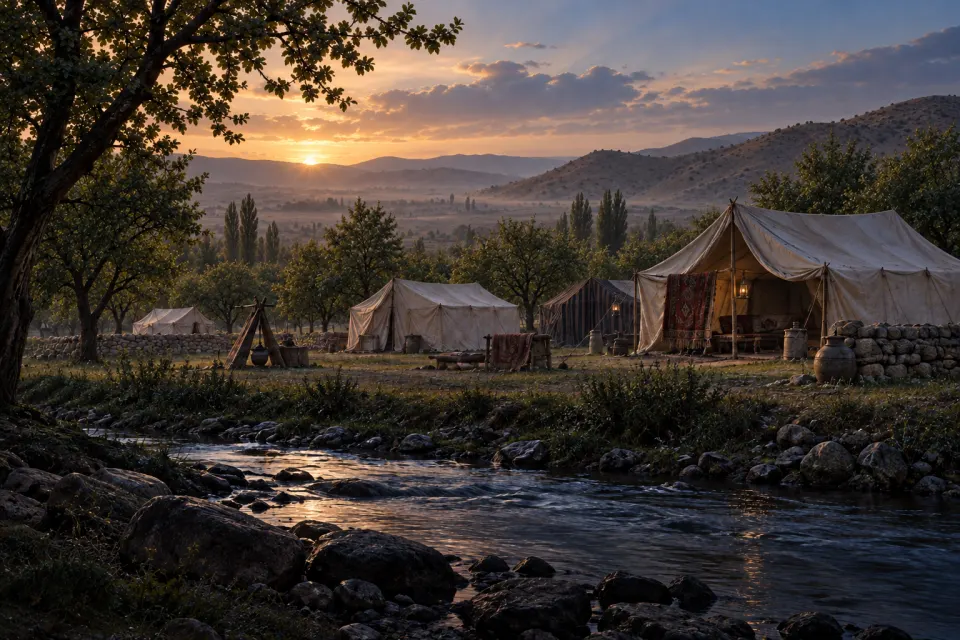
The Báb and the Bábí upheaval 1844–1850
Many Shiʿi Muslims in Iran expected the hidden Twelfth Imam to return around 1844. On the evening of 22 May that year in Shiraz, a young merchant, Sayyid ʿAlí-Muḥammad, told a visiting scholar that he was the Báb, the "gate" to the Imam; he later claimed to be the Mahdi himself, bringing a new religious law. His movement spread fast and met fierce opposition from clergy and state. At Badasht in 1848 his followers proclaimed a break with Islamic law. Government troops crushed the Bábís, killing most of their leaders, and the Báb was shot by a firing squad in Tabriz in July 1850.[16–19]
Bahá'u'lláh in exile 1852–1892
After Bábís tried to kill the shah in 1852, a wave of executions followed. Among those jailed was Mírzá Ḥusayn-ʿAlí Núrí, a Bábí noble known as Bahá'u'lláh, who by his own account first sensed a divine mission in a Tehran dungeon. Exiled to Ottoman Baghdad in 1853, he revived the Bábí community. In April 1863, before being sent on to Constantinople, he told companions in a Baghdad garden that he was the one the Báb had promised. From Edirne he wrote to rulers proclaiming his claim and broke with his half-brother Ṣubḥ-i Azal; most Bábís followed Bahá'u'lláh. Sent in 1868 to the prison city of Acre, he died at nearby Bahjí in 1892.[20–23]
ʿAbdu'l-Bahá and the move West 1892–1921
Bahá'u'lláh's will named his eldest son, ʿAbdu'l-Bahá, head of the faith and interpreter of his writings. The religion now reached the West: the first American converts joined in Chicago in 1894. In 1909 ʿAbdu'l-Bahá laid the Báb's remains, smuggled out of Iran years before, in a shrine on Mount Carmel. Freed after the Young Turk revolution of 1908, he visited Egypt and Europe and in 1912 spent eight months in North America, laying the cornerstone of a temple near Chicago. He died in Haifa in 1921.[24–26]
Shoghi Effendi and the administrative order 1921–1963
ʿAbdu'l-Bahá's will made his grandson Shoghi Effendi, then an Oxford student, Guardian and interpreter of the faith. Shoghi Effendi built up elected local and national assemblies and ran planned campaigns through them, sending settlers through Latin America from 1937 and worldwide in a Ten Year Crusade from 1953. He also translated Bahá'u'lláh's main works into English. He died in 1957 with no successor; the Hands of the Cause he had appointed led until April 1963, when the national assemblies elected the first Universal House of Justice. Only a few hundred Bahá'ís followed Mason Remey's rival claim to the Guardianship.[27–29]
Persecution in Iran 1979–present
Bahá'ís in Iran faced recurrent violence from the 19th century on, but after the 1979 revolution persecution became state policy. In the Islamic Republic's first years some 200 Bahá'ís, many of them community leaders, were executed. Bahá'í assemblies were dissolved, property and holy places seized and the house of the Báb in Shiraz demolished. Bahá'ís have been dismissed from public jobs and barred from universities, and seven members of an informal leadership group were jailed in 2008. In 2024 and 2026 UN human-rights experts reported a rise in arrests, with allegations of torture and enforced disappearance.[30–32]
A worldwide community 1963–present
Since 1963 the Universal House of Justice, elected every five years, has guided the faith through multi-year plans. From the 1960s many joined in rural India, Africa, Latin America and the Pacific, and most Bahá'ís now live in the developing world. The community reports more than 5 million members and 188 national councils. Houses of worship stand on every inhabited continent, among them Wilmette (1953), New Delhi's Lotus Temple (1986) and Santiago, Chile. In 2008 UNESCO inscribed the Haifa and Western Galilee holy places as a World Heritage site.[33–36]
Key moments
- 1863 CEThe Bahá'í Faith begins · Garden of Riḍván, Baghdad
Beliefs
The unknowable God
Bahá'ís believe in one Creator whose essence is beyond human understanding and who is known through the attributes shown in creation and, above all, in the messengers God sends. They hold that the soul is immortal and continues to progress after death, and they read heaven and hell as symbols of nearness to God or distance from God.[37]
Manifestations of God · Maẓhar-i-Iláhí
a messenger who perfectly reflects God's attributes
God, in Bahá'í teaching, educates humanity through a line of messengers, each bringing teachings fitted to his age. Bahá'u'lláh named Abraham, Moses, Zoroaster, Jesus, Muhammad and the Báb, and his successors added the Buddha and Krishna. Bahá'ís call this progressive revelation. Bahá'u'lláh is the latest messenger but not the last: another is expected after at least a thousand years.[11, 38]
The oneness of humanity
Bahá'u'lláh taught that humankind is one family whose unity is the great task of this age. Bahá'ís work to abolish prejudice of race, class, nation and religion as a spiritual duty. In his Western talks ʿAbdu'l-Bahá called such prejudice destructive of society and pressed American Bahá'ís to overcome the racial divide.[39]
Equality of women and men
Bahá'í writings treat the equality of women and men as part of that oneness. Parents must educate daughters as well as sons. Women serve on local and national assemblies, though the Universal House of Justice is limited to men.[40–41]
Reason, science and education
Among the principles ʿAbdu'l-Bahá taught in the West, Bahá'ís stress that each person should investigate truth independently, that true religion and science agree, and that religion causing conflict is worse than none. The writings also call for universal education, so that all can read scripture without intermediaries.[42]
World peace and consultation
Bahá'u'lláh urged rulers to cut armaments, act together against aggression and adopt an auxiliary world language. Bahá'ís pursue this vision of world peace without partisanship and may not join political parties. Their own decisions are made by consultation, a frank group discussion that seeks the truth together.[43]
Practice
Daily obligatory prayer
Each Bahá'í says one of three obligatory prayers daily: a short one between noon and sunset, a medium one three times a day, or a long one once in 24 hours. It is said privately, after ablutions, facing the shrine of Bahá'u'lláh. Bahá'ís also repeat Alláh-u-Abhá, "God is most glorious", 95 times a day.[44]
The Nineteen-Day Feast
At the start of each Bahá'í month the local community meets for the Feast, which joins devotional readings by lay members, consultation on community business and shared food. As it is partly a business meeting, it is for enrolled Bahá'ís; most other Bahá'í gatherings are open to all.[45]
The Fast
In the last month of the year, the nineteen days before the March new year, Bahá'ís aged 15 to 70 go without food and drink from sunrise to sunset unless ill, travelling or otherwise unable. The Fast is a time of prayer and detachment and ends at Naw-Rúz.[46]
Elections without candidates
Each year at Riḍván, adult Bahá'ís in a locality elect a nine-member Local Spiritual Assembly by secret ballot, with no nominations, candidates or campaigning. Delegates elect each National Spiritual Assembly, and every five years the members of all national assemblies elect the Universal House of Justice.[47]
Laws of daily life
Bahá'í law forbids alcohol and non-medical mind-altering drugs, gambling and backbiting. Marriage is monogamous and requires the consent of the couple and of all living parents. Believers pay Ḥuqúqu'lláh, 19 percent on wealth beyond their needs, and only Bahá'ís may give to Bahá'í funds.[48]
Pilgrimage and houses of worship
Bahá'ís who can are encouraged to make a nine-day pilgrimage to the holy places in Haifa and Acre. Their houses of worship are nine-sided and open to all; services consist of readings and unaccompanied singing of scripture, with no sermons or rituals. Most local worship happens in homes and community centres.[49]
Holy days
The year ahead
| Date | Holy day | Reckoned |
|---|---|---|
| 10 November 2026 – 11 November 2026 Begins the evening before | Twin Holy Birthdays | the first and second day after the eighth new moon following Naw-Rúz |
| 26 February 2027 – 1 March 2027 Begins the evening before | Ayyám-i-Há | Ayyám-i-Há, day 1 |
| 2 March 2027 – 20 March 2027 Begins the evening before | The Nineteen-Day Fast | 1 ʿAláʾ, Badíʿ calendar |
| 21 March 2027 Begins the evening before | Naw-Rúz نوروز | 1 Bahá, Badíʿ calendar |
| 21 April 2027 – 2 May 2027 Begins the evening before | Festival of Riḍván رضوان | 13 Jalál, Badíʿ calendar |
| 24 May 2027 Begins the evening before | Declaration of the Báb | 8 ʿAẓamat, Badíʿ calendar |
| 29 May 2027 Begins the evening before | Ascension of Bahá'u'lláh | 13 ʿAẓamat, Badíʿ calendar |
| 10 July 2027 Begins the evening before | Martyrdom of the Báb | 17 Raḥmat, Badíʿ calendar |
Naw-Rúz
1 Bahá; the March equinox (20 or 21 March)
The new year falls at the spring equinox, reckoned since 2015 by its timing in Tehran, and ends the Fast. It is one of nine holy days on which Bahá'ís suspend work.[50]
Festival of Riḍván · رضوان
13 Jalál – 5 Jamál (21 April – 2 May)
Twelve days marking Bahá'u'lláh's declaration in a Baghdad garden in 1863, the most important event in the Bahá'í year. The first, ninth and twelfth days are holy days, and local and national assemblies are elected during the festival.[47, 51]
Declaration of the Báb
8 ʿAẓamat (23 or 24 May, from the previous sunset)
Marks the evening of 22 May 1844 when the Báb declared his mission in Shiraz; as Bahá'í days begin at sunset, it is kept from the evening before. By Bahá'í tradition ʿAbdu'l-Bahá was born that night.[52]
Twin Holy Birthdays
Moves; mid-October to mid-November
The births of the Báb and Bahá'u'lláh were long celebrated in the West on 20 October and 12 November, and in the Middle East on 1 and 2 Muḥarram. Since 2015, by decision of the Universal House of Justice, they fall on the two days after the eighth new moon following Naw-Rúz.[53]
People


Bahá'u'lláh · بهاءالله
founder · 1817–1892
Mírzá Ḥusayn-ʿAlí Núrí, born in Tehran to a family serving the Qajar court, took the title Bahá'u'lláh, the Glory of God, around 1848. Bahá'ís regard him as the Manifestation of God for this age. He spent four decades in exile and prison and left a vast body of writings in Arabic and Persian.[55–56]

ʿAbdu'l-Bahá · عبدالبهاء
teacher · 1844–1921
ʿAbbás Effendi, Bahá'u'lláh's eldest son, took a name meaning servant of Bahá and shared his father's exiles from childhood. Bahá'ís see him as the perfect exemplar and authorised interpreter of the teachings, not as a prophet. Britain knighted him in 1920 for his humanitarian work.[57–58]

Shoghi Effendi · شوقی افندی
other · 1897–1957
ʿAbdu'l-Bahá's eldest grandson led the faith as Guardian from 1921 until his death. Educated in Beirut and at Balliol College, Oxford, he wrote thousands of letters and a history of the faith's first century, God Passes By (1944). He shunned personal prominence, meeting Bahá'ís mostly in small groups of pilgrims.[59–60]
Ṭáhirih · طاهره
other · c. 1814/1818–1852
A poet and theologian from a Qazvin clerical family, also called Qurratu'l-ʿAyn, she was one of the Báb's first disciples. Her unveiling at Badasht in 1848 signalled the break with Islamic law. Executed in Tehran in 1852, she is often called the first Iranian woman to speak out for the equality of the sexes.[61–62]
Scripture
Kitáb-i-Aqdas (The Most Holy Book) · کتاب اقدس
1873
Bahá'u'lláh's book of laws, written in Arabic in Acre. It sets out prayer, fasting, marriage and other laws, provides for houses of justice to run the community, and replaces the laws of the Báb's Bayán.[63]
Kitáb-i-Íqán (The Book of Certitude) · کتاب ایقان
1862
Bahá'u'lláh's main theological work, written in Baghdad. It reads images such as the Day of Resurrection as symbols of a new messenger's coming, grounding the idea of progressive revelation.[64]
The Bayán · بیان
late 1840s
The Báb's chief work, in Persian and Arabic versions, written in prison. It laid out a new religious law and promised “he whom God shall make manifest”, a figure Bahá'ís identify with Bahá'u'lláh.[65]
Places
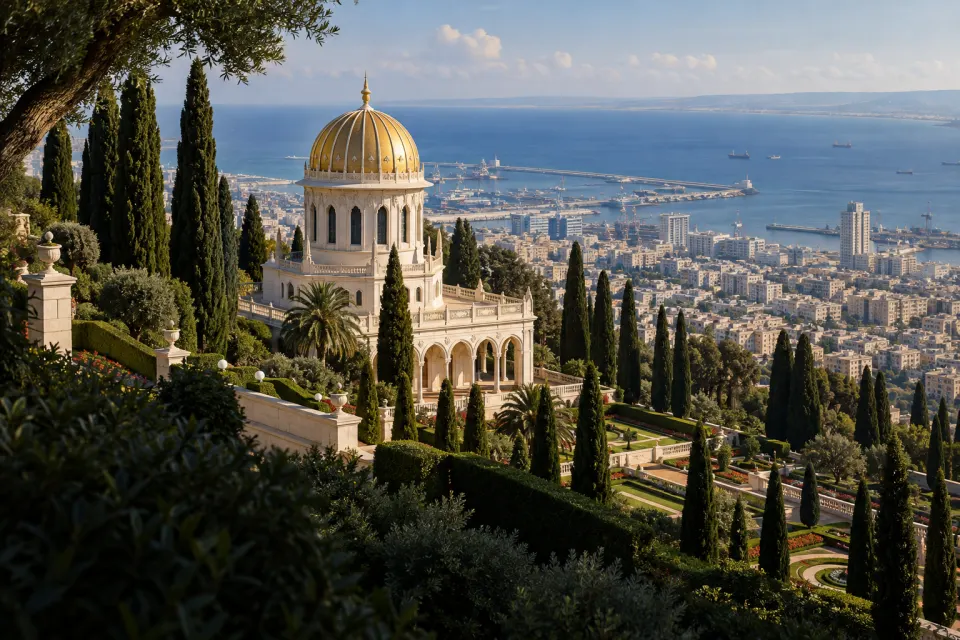
Shrine of the Báb, Haifa
ISR · UNESCO World Heritage, 2008
Halfway up Mount Carmel, this gold-domed shrine holds the remains of the Báb, interred in 1909, and of ʿAbdu'l-Bahá. Shoghi Effendi added its marble arcade and dome in 1948–53.[66–67]
Shrine of Bahá'u'lláh, Bahjí
ISR · UNESCO World Heritage, 2008
Beside the mansion of Bahjí near Acre, where Bahá'u'lláh spent his last years. It is the Qiblih Bahá'ís face in obligatory prayer and, with the Shrine of the Báb, one of the faith's two holiest places.[67–68]
Lotus Temple, New Delhi
IND
India's Bahá'í house of worship, dedicated in December 1986 and designed by Fariborz Sahba. Its 27 white marble petals, clustered in threes, form nine sides around a hall open to all.[69]
House of Worship, Wilmette
USA
North America's Bahá'í house of worship, near Chicago. ʿAbdu'l-Bahá laid its cornerstone on 1 May 1912, and it was dedicated in 1953 after four decades of building.[70]
Where it spread
| Region | From | How |
|---|---|---|
| Iran | 1844 CE | The Báb declared his mission in Shiraz in 1844; Bahá'í institutions have been banned since 1983 |
| Iraq | 1853 CE | IRN. Bahá'u'lláh lived in exile in Baghdad, 1853–63 |
| Israel | 1868 CE | Acre and Haifa, the faith's holy places and world center |
| Turkmenistan | 1884 CE – 1938 CE | IRN. Ashgabat, where the first Bahá'í house of worship was built; suppressed under Soviet rule |
| United States | 1894 CE | First believers in Chicago; the Wilmette house of worship was dedicated in 1953 |
| United Kingdom | 1898 CE | First believers in London |
| Australia | 1920 CE | Sydney; its house of worship was dedicated in 1961 |
| Chile | 1943 CE | Santiago's house of worship, the first in South America, opened in 2016 |
| DR Congo | 1953 CE | A national house of worship opened in Kinshasa in 2023 |
Numbers
- Bahá'ís worldwide
- c. 5–7.3 million (community figure; WRD, 2010)[8]
Community figure: more than 5 million (BWNS, self-reported). World Religion Database: 7.3 million for 2010 (Johnson and Grim).
- Bahá'ís in Iran
- c. 300,000 (estimate)[71]
Britannica and the Bahá'í community give 300,000; the World Religion Database gave 251,000 for 2010 (Johnson and Grim).
- Bahá'ís in India's 2011 census
- 4,572[72]
National censuses
| Country | Year | Count | Share |
|---|---|---|---|
| Canada Baha'i | 2021 | 18,975 | 0.1% |
| Australia Baha'i | 2021 | 14,937 | 0.1% |
| United Kingdom (England and Wales) Other religion: Baha'i | 2021 | 4,716 | 0.0% |
| India Bahai / Bahais | 2011 | 4,572 | 0.0% |
| New Zealand Baha'i | 2018 | 2,925 | 0.1% |
Source: Australian Bureau of Statistics, Census of Population and Housing 2021, 'Religious affiliation in Australia' (Table 4), CC BY 4.0. Source: Office of the Registrar General & Census Commissioner, India, Census of India 2011, Table C-01 Population by religious community and its appendix, under the Government Open Data License – India. Source: Office for National Statistics licensed under the Open Government Licence v.3.0 Adapted from Statistics Canada, Table 98-10-0342-01 Religion by visible minority and generation status: Canada, provinces and territories, census metropolitan areas and census agglomerations with parts, released 2022-10-26. This does not constitute an endorsement by Statistics Canada of this product. Source: Stats NZ, 2018 Census, licensed by Stats NZ for re-use under the Creative Commons Attribution 4.0 International licence.
How we know
How many Bahá'ís are there?
Counts differ widely. The Bahá'í community, which keeps membership rolls, reports more than 5 million members. The World Religion Database estimated 7.3 million for 2010, with India the largest community. Censuses, which record self-description, find far fewer: India's 2011 census counted 4,572 Bahá'ís. Much of the gap lies in areas of mass enrolment since the 1960s, so every figure here is an estimate.[8, 33, 72–73]
Common misconceptions
Myth The Bahá'í Faith is a sect of Islam.
Fact It began among Shiʿi Muslims in Iran, amid hopes for a returning Imam, but Bahá'ís regard it as an independent religion with its own scripture, law, calendar and institutions; Bahá'u'lláh's book of laws was meant to supersede the Qur'an's. Many Muslim scholars treat belief in a prophet after Muhammad as apostasy.[74]
Myth Bahá'ís think all religions are the same, or blend them into a mix.
Fact Bahá'ís hold that the great religions come from one God and share a spiritual core, but also that each revelation was shaped for its time, that human interpretation added errors, and that Bahá'u'lláh's revelation supersedes earlier religious law. It presents itself as a distinct religion, not a blend.[75]
Myth The Bahá'í headquarters is in Israel because of ties to the Israeli state.
Fact The world centre is in Haifa and Acre because the Ottoman Empire exiled Bahá'u'lláh to Acre in 1868, eighty years before Israel was founded. Iranian authorities have used the link to accuse Bahá'ís of spying for Zionism; Bahá'í rules bar members from partisan politics.[76]
Glossary
- Manifestation of God · Maẓhar-i-Iláhí
- A messenger, such as Moses, Jesus, Muhammad, the Báb or Bahá'u'lláh, who in Bahá'í belief reveals God's will and founds a religion.[77]
- Local Spiritual Assembly
- The nine-member council elected each year by the adult Bahá'ís of a town or district to run local community affairs; a National Spiritual Assembly does the same for a country.[78]
- Universal House of Justice
- The faith's nine-member supreme governing body, first elected in 1963 and seated in Haifa. It legislates on matters the scriptures leave open but does not interpret scripture.[79]
- Guardian · Valíy-i-Amru'lláh
- The office of head and interpreter of the faith that ʿAbdu'l-Bahá created for Shoghi Effendi. It lapsed at his death in 1957, as he left no eligible successor.[80]
- Covenant · ʿAhd
- The line of authority Bahá'u'lláh set out in his will, passing to ʿAbdu'l-Bahá as Centre of the Covenant, and on to Shoghi Effendi and the Universal House of Justice.[81]
- Mashriqu'l-Adhkár
- Literally, the dawning place of God's remembrance: a Bahá'í house of worship, nine-sided and open to all, meant to be the centre of schools, hospitals and other services.[82]
- Ḥuqúqu'lláh
- Literally, the right of God: a payment of 19 percent on wealth beyond a believer's necessary expenses, paid to the Bahá'í Faith.[83]
Sources
Each statement above was checked against published sources; the verdict says whether it stood as written, was corrected or was hedged.
- VerifiedEncyclopaedia Iranica, Bahaism i. The Faith; Britannica, Bahāʾī Faith; Encyclopedia of Islam and the Muslim World.
- VerifiedBritannica, Bahāʾī Faith; Encyclopaedia Iranica, Bahāʾ-Allāh; Encyclopaedia Iranica, Bāb, ʿAli Moḥammad Širāzi.
- VerifiedBritannica, Bahāʾī Faith; Worldmark Encyclopedia of Religious Practices; Encyclopaedia Iranica, Bahaism i. The Faith.
- VerifiedBritannica, Bahāʾī Faith; Worldmark Encyclopedia of Religious Practices; Encyclopedia of Religion, 2nd ed..
- VerifiedBritannica, Bahāʾī Faith; Encyclopaedia Iranica, Bahaism i. The Faith; Worldmark Encyclopedia of Religious Practices.
- VerifiedBritannica, Bahāʾī Faith; Encyclopaedia Iranica, Bahaism viii. Bahai Shrines; UNESCO World Heritage Centre, Bahá'i Holy Places in Haifa and the Western Galilee.
- VerifiedBritannica, Bahāʾī Faith; Encyclopaedia Iranica, Bahaism i. The Faith; Worldmark Encyclopedia of Religious Practices; bahai.org, The Bahá'í Calendar (supporting).
- CorrectedBahá'í World News Service, Statistics (supporting); Melton's Encyclopedia of American Religions; Johnson and Grim, The World's Religions in Figures; Encyclopedia of Religion, 2nd ed..
- CorrectedWorldmark Encyclopedia of Religious Practices; Encyclopaedia Iranica, Bahaism ix. Bahai Temples; Universal House of Justice and Shoghi Effendi statements, as compiled in The Nine-Pointed Star: History and Symbolism (supporting).
- VerifiedBritannica, Bahāʾī Faith; Encyclopaedia Iranica, Bahaism i. The Faith; Encyclopedia of Islam and the Muslim World; Encyclopedia of Religion, 2nd ed..
- VerifiedEncyclopaedia Iranica, Bahaism i. The Faith; Worldmark Encyclopedia of Religious Practices.
- VerifiedWorldmark Encyclopedia of Religious Practices; Britannica, Bahāʾī Faith; Encyclopaedia Iranica, Bahaism i. The Faith.
- VerifiedBritannica, Shoghi Effendi Rabbānī; Britannica, Bahāʾī Faith; Encyclopaedia Iranica, Bahaism i. The Faith.
- VerifiedWorldmark Encyclopedia of Religious Practices; Britannica, Bahāʾī Faith; Bahá'í World News Service, Statistics (supporting).
- VerifiedBritannica, Bahāʾī Faith; Encyclopaedia Iranica, Bahaism vii. Bahai Persecutions; Worldmark Encyclopedia of Religious Practices.
- VerifiedEncyclopaedia Iranica, Bahaism i. The Faith; Britannica, Bahāʾī Faith; World Religions Reference Library; Encyclopaedia Iranica, Bāb, ʿAli Moḥammad Širāzi; Worldmark Encyclopedia of Religious Practices.
- VerifiedEncyclopaedia Iranica, Bāb, ʿAli Moḥammad Širāzi; Worldmark Encyclopedia of Religious Practices; Britannica, Bahāʾī Faith; Melton's Encyclopedia of American Religions.
- VerifiedEncyclopaedia Iranica, Bāb, ʿAli Moḥammad Širāzi; Encyclopedia of Religion, 2nd ed.; World Religions Reference Library.
- VerifiedEncyclopaedia Iranica, Bahaism i. The Faith; Worldmark Encyclopedia of Religious Practices; Encyclopaedia Iranica, Bāb, ʿAli Moḥammad Širāzi; Britannica, Bahāʾī Faith.
- VerifiedEncyclopaedia Iranica, Bahaism i. The Faith; Encyclopedia of Religion, 2nd ed.; Encyclopaedia Iranica, Bahāʾ-Allāh; Britannica, Bahāʾī Faith.
- VerifiedBritannica, Bahāʾī Faith; Encyclopaedia Iranica, Bahāʾ-Allāh; Worldmark Encyclopedia of Religious Practices; Encyclopaedia Iranica, Bahaism i. The Faith; Encyclopedia of Islam and the Muslim World.
- VerifiedEncyclopaedia Iranica, Bahaism i. The Faith; Worldmark Encyclopedia of Religious Practices; Encyclopedia of Islam and the Muslim World; Britannica, Bahāʾī Faith.
- VerifiedEncyclopaedia Iranica, Bahāʾ-Allāh; Worldmark Encyclopedia of Religious Practices; Britannica, Bahāʾī Faith.
- VerifiedBritannica, Bahāʾī Faith; Encyclopaedia Iranica, ʿAbd-al-Bahāʾ; Worldmark Encyclopedia of Religious Practices; Encyclopedia of Religion, 2nd ed.; Encyclopaedia Iranica, Bahaism i. The Faith.
- VerifiedEncyclopaedia Iranica, Bahaism viii. Bahai Shrines; Encyclopedia of Religion, 2nd ed..
- VerifiedEncyclopaedia Iranica, ʿAbd-al-Bahāʾ; Worldmark Encyclopedia of Religious Practices; Encyclopaedia Iranica, Bahaism ix. Bahai Temples; Encyclopedia of Religion, 2nd ed..
- VerifiedEncyclopaedia Iranica, Shoghi Effendi; Britannica, Shoghi Effendi Rabbānī; Worldmark Encyclopedia of Religious Practices; Encyclopaedia Iranica, Bahaism i. The Faith.
- VerifiedWorldmark Encyclopedia of Religious Practices; Encyclopaedia Iranica, Shoghi Effendi; Encyclopaedia Iranica, Bahaism i. The Faith; Britannica, Shoghi Effendi Rabbānī.
- VerifiedWorldmark Encyclopedia of Religious Practices; Encyclopaedia Iranica, Bahaism i. The Faith; Britannica, Shoghi Effendi Rabbānī; Melton's Encyclopedia of American Religions.
- VerifiedEncyclopaedia Iranica, Bahaism i. The Faith; Encyclopaedia Iranica, Bahaism vii. Bahai Persecutions; Worldmark Encyclopedia of Religious Practices; VOA/AFP, Executed Women Haunt, Inspire Iranian Baha'is 40 Years Later (supporting).
- VerifiedEncyclopaedia Iranica, Bahaism i. The Faith; Encyclopaedia Iranica, Bahaism viii. Bahai Shrines; Worldmark Encyclopedia of Religious Practices; OHCHR press release, Iran: Experts alarmed at systematic targeting of Baha'i women; USCIRF, Iran: USCIRF Condemns Religious Freedom Violations against Baha'is.
- VerifiedUSCIRF, Iran: USCIRF Condemns Religious Freedom Violations against Baha'is; VOA/AFP, Executed Women Haunt, Inspire Iranian Baha'is 40 Years Later; OHCHR press release, Iran: Experts alarmed at systematic targeting of Baha'i women; OHCHR press release, Iran: UN experts alarmed by alleged torture, enforced disappearances and persecution of Bahá'í minority; JURIST, UN experts raise concern over Iran's intensified persecution of Bahá'ís….
- VerifiedEncyclopaedia Iranica, Bahaism i. The Faith; Worldmark Encyclopedia of Religious Practices; Encyclopedia of Islam and the Muslim World; Johnson and Grim, The World's Religions in Figures; Encyclopedia of Religion, 2nd ed..
- HedgedBahá'í World News Service, Statistics (supporting); Melton's Encyclopedia of American Religions; Britannica, Bahāʾī Faith.
- VerifiedBritannica, Bahāʾī Faith; Encyclopaedia Iranica, Bahaism ix. Bahai Temples; Britannica, Lotus Temple.
- VerifiedUNESCO World Heritage Centre, Bahá'i Holy Places in Haifa and the Western Galilee; Britannica, Haifa.
- VerifiedBritannica, Bahāʾī Faith; Worldmark Encyclopedia of Religious Practices; Encyclopaedia Iranica, Eschatology iv. In Babism and Bahaism; Encyclopedia of Religion, 2nd ed.; Melton's Encyclopedia of American Religions.
- VerifiedEncyclopaedia Iranica, Bahaism i. The Faith; Worldmark Encyclopedia of Religious Practices; Britannica, Bahāʾī Faith; Encyclopedia of Religion, 2nd ed..
- VerifiedBritannica, Bahāʾī Faith; Worldmark Encyclopedia of Religious Practices; Encyclopaedia Iranica, Bahaism i. The Faith; Encyclopedia of Religion, 2nd ed..
- CorrectedWorldmark Encyclopedia of Religious Practices; Encyclopaedia Iranica, Bahaism i. The Faith; Encyclopedia of Religion, 2nd ed..
- VerifiedEncyclopaedia Iranica, Bahaism i. The Faith; Encyclopaedia Iranica, Bayt-al-ʿAdl; Worldmark Encyclopedia of Religious Practices; Encyclopedia of Religion, 2nd ed..
- VerifiedEncyclopaedia Iranica, Bahaism i. The Faith; Melton's Encyclopedia of American Religions; World Religions Reference Library; Worldmark Encyclopedia of Religious Practices.
- VerifiedEncyclopaedia Iranica, Bahaism i. The Faith; Worldmark Encyclopedia of Religious Practices.
- VerifiedEncyclopaedia Iranica, Bahaism i. The Faith; Worldmark Encyclopedia of Religious Practices.
- VerifiedEncyclopaedia Iranica, Bahaism i. The Faith; Britannica, Bahāʾī Faith; Worldmark Encyclopedia of Religious Practices.
- VerifiedBritannica, Bahāʾī Faith; Encyclopaedia Iranica, Bahaism i. The Faith; Worldmark Encyclopedia of Religious Practices.
- VerifiedEncyclopaedia Iranica, Bahaism i. The Faith; Britannica, Bahāʾī Faith; Worldmark Encyclopedia of Religious Practices.
- VerifiedBritannica, Bahāʾī Faith; Encyclopaedia Iranica, Bahaism i. The Faith; Worldmark Encyclopedia of Religious Practices.
- VerifiedWorldmark Encyclopedia of Religious Practices; Encyclopaedia Iranica, Bahaism i. The Faith; Encyclopaedia Iranica, Bahaism ix. Bahai Temples; Britannica, Bahāʾī Faith.
- VerifiedBritannica, Bahāʾī Faith; Encyclopaedia Iranica, Bahaism i. The Faith; Universal House of Justice, message of 10 July 2014 (supporting); Moojan Momen, The Badíʿ Calendar: An Introduction (supporting); Worldmark Encyclopedia of Religious Practices.
- VerifiedEncyclopaedia Iranica, Bahaism i. The Faith; Worldmark Encyclopedia of Religious Practices; Universal House of Justice, message of 10 July 2014 (supporting).
- VerifiedEncyclopaedia Iranica, Bāb, ʿAli Moḥammad Širāzi; Worldmark Encyclopedia of Religious Practices; bahai.org, The Bahá'í Calendar (supporting); Universal House of Justice, message of 10 July 2014 (supporting); Encyclopedia of Religion, 2nd ed.; Encyclopaedia Iranica, ʿAbd-al-Bahāʾ.
- VerifiedEncyclopaedia Iranica, Bahaism i. The Faith; Worldmark Encyclopedia of Religious Practices; Encyclopedia of Religion, 2nd ed.; Universal House of Justice, message of 10 July 2014 (supporting); Moojan Momen, The Badíʿ Calendar: An Introduction (supporting).
- VerifiedEncyclopaedia Iranica, Bāb, ʿAli Moḥammad Širāzi; Worldmark Encyclopedia of Religious Practices; Britannica, Bahāʾī Faith.
- VerifiedEncyclopaedia Iranica, Bahāʾ-Allāh; World Religions Reference Library; Britannica, Bahāʾ Allāh.
- VerifiedEncyclopaedia Iranica, Bahaism i. The Faith; Britannica, Bahāʾī Faith; Worldmark Encyclopedia of Religious Practices; Encyclopaedia Iranica, Bahāʾ-Allāh.
- VerifiedEncyclopaedia Iranica, ʿAbd-al-Bahāʾ; Melton's Encyclopedia of American Religions; Worldmark Encyclopedia of Religious Practices.
- VerifiedEncyclopedia of Religion, 2nd ed.; Encyclopaedia Iranica, ʿAbd-al-Bahāʾ.
- VerifiedEncyclopaedia Iranica, Shoghi Effendi; Britannica, Shoghi Effendi Rabbānī.
- VerifiedEncyclopaedia Iranica, Shoghi Effendi; Britannica, Shoghi Effendi Rabbānī; Worldmark Encyclopedia of Religious Practices; Encyclopedia of Islam and the Muslim World.
- VerifiedEncyclopedia of Religion, Qurrat al-ʿAyn Ṭāhirah; Women Poets Iranica, Tāhirah Qurrat al-ʿAyn; Encyclopaedia Iranica, Bāb, ʿAli Moḥammad Širāzi.
- VerifiedEncyclopedia of Religion, Qurrat al-ʿAyn Ṭāhirah; Oxford Reference, Qurrat al-ʿAyn, in The Oxford Encyclopedia of Women in World History; Women Poets Iranica, Tāhirah Qurrat al-ʿAyn.
- VerifiedEncyclopaedia Iranica, Bahaism i. The Faith; Encyclopedia of Religion, 2nd ed.; Worldmark Encyclopedia of Religious Practices.
- VerifiedEncyclopaedia Iranica, Bahaism i. The Faith; Worldmark Encyclopedia of Religious Practices; Encyclopedia of Religion, 2nd ed..
- VerifiedEncyclopaedia Iranica, Bāb, ʿAli Moḥammad Širāzi; Encyclopedia of Religion, 2nd ed.; Encyclopaedia Iranica, Bahaism i. The Faith; Encyclopedia of Islam and the Muslim World.
- VerifiedEncyclopaedia Iranica, Bahaism viii. Bahai Shrines; Encyclopedia of Religion, 2nd ed.; UNESCO World Heritage Centre, Bahá'i Holy Places in Haifa and the Western Galilee.
- VerifiedUNESCO World Heritage Centre, Bahá'i Holy Places in Haifa and the Western Galilee; Britannica, Haifa; Encyclopaedia Iranica, Bahaism viii. Bahai Shrines.
- VerifiedEncyclopaedia Iranica, Bahaism viii. Bahai Shrines; Worldmark Encyclopedia of Religious Practices; UNESCO World Heritage Centre, Bahá'i Holy Places in Haifa and the Western Galilee.
- VerifiedBritannica, Lotus Temple; Encyclopaedia Iranica, Bahaism ix. Bahai Temples.
- VerifiedEncyclopaedia Iranica, Bahaism ix. Bahai Temples; Melton's Encyclopedia of American Religions.
- HedgedBritannica, Bahāʾī Faith; Worldmark Encyclopedia of Religious Practices; Johnson and Grim, The World's Religions in Figures; Bahá'í World News Service, Statistics (supporting).
- VerifiedCensus of India 2011, Table C-01 Appendix; Pew Research Center, Population growth and religious composition.
- CorrectedJohnson and Grim, The World's Religions in Figures; Encyclopedia of Religion, 2nd ed..
- VerifiedBritannica, Bahāʾī Faith; Encyclopaedia Iranica, Bahaism i. The Faith; Encyclopedia of Religion, 2nd ed.; Encyclopedia of Islam and the Muslim World.
- VerifiedEncyclopaedia Iranica, Bahaism i. The Faith; Worldmark Encyclopedia of Religious Practices; Encyclopedia of Islam and the Muslim World.
- VerifiedEncyclopaedia Iranica, Bahaism i. The Faith; Encyclopaedia Iranica, Bahāʾ-Allāh; Worldmark Encyclopedia of Religious Practices.
- VerifiedWorldmark Encyclopedia of Religious Practices; Encyclopaedia Iranica, Bahaism i. The Faith.
- VerifiedEncyclopaedia Iranica, Bahaism i. The Faith; Britannica, Bahāʾī Faith; Worldmark Encyclopedia of Religious Practices.
- VerifiedBritannica, Bahāʾī Faith; Encyclopaedia Iranica, Bayt-al-ʿAdl; Melton's Encyclopedia of American Religions; Encyclopedia of Religion, 2nd ed..
- VerifiedEncyclopaedia Iranica, Shoghi Effendi; Encyclopaedia Iranica, Bahaism i. The Faith; Britannica, Shoghi Effendi Rabbānī.
- VerifiedEncyclopaedia Iranica, ʿAbd-al-Bahāʾ; Encyclopedia of Religion, 2nd ed..
- VerifiedEncyclopaedia Iranica, Bahaism ix. Bahai Temples; Britannica, Lotus Temple.
- VerifiedEncyclopaedia Iranica, Bahaism i. The Faith; Worldmark Encyclopedia of Religious Practices.
Last fact-checked 3 October 2026.