
The story behind the day
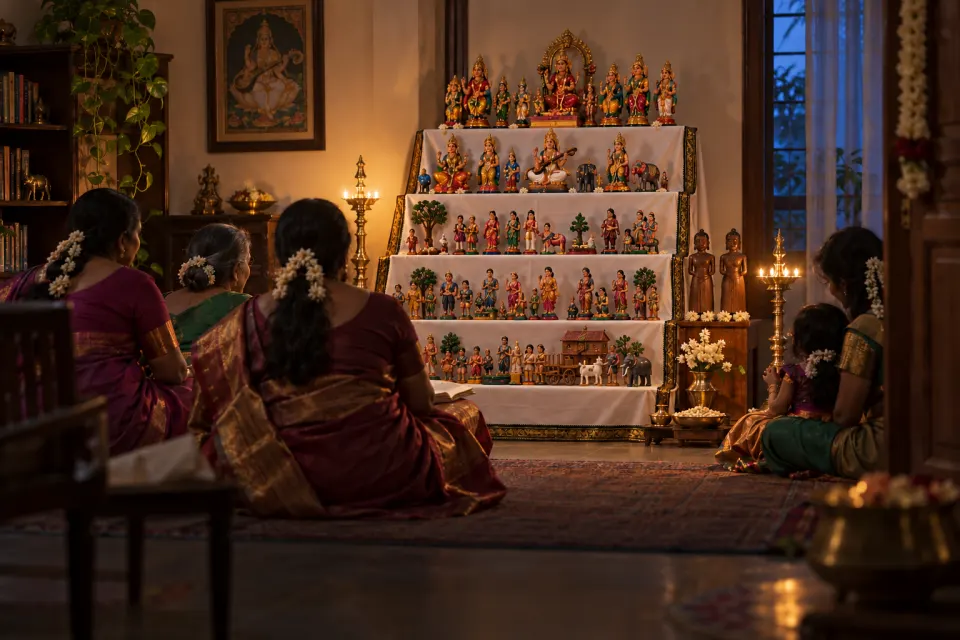
Navarātri, "nine nights," is the festival of the Goddess, kept in spring and, far more grandly, in autumn on the first nine nights of the bright fortnight of Āśvina, in September or October. The nine nights lead to the tenth day, Vijayadaśamī, also called Dussehra. In the tradition of the Devīmāhātmya the goddess Durgā kills the buffalo demon Mahiṣāsura, and across much of India the tenth day also recalls Rāma's victory over Rāvaṇa. The festival is kept in different ways: Durgā Pūjā in Bengal, garba in Gujarat and Rāmlīlā in the north.[1–6]
Origins

The Devīmāhātmya, a section of the Mārkaṇḍeya Purāṇa, is the earliest major text on the Goddess as supreme power. In it the goddess is born to destroy the buffalo demon Mahiṣāsura when the gods cannot; she takes shape from the radiance of the gods, receives a weapon from each, rides a lion, and kills him. Her victory is one of two stories attached to the tenth day. The other is the epic story of Rāma's victory over the demon king Rāvaṇa, which is recalled at Dussehra when large figures of Rāvaṇa, with his son and brother, go up in flames after dark.[2–3, 7–8]
What it marks
The name means nine nights, and the festival is dedicated to the Goddess in her many forms. Its tenth day is Vijayadaśamī, the "victory tenth," a celebration of good over evil. Popular tradition holds it so auspicious that anything begun on it will succeed, so children are started on the alphabet and new undertakings are begun. The medieval digests prescribe worship of Aparājitā and of the śamī tree and the crossing of the village boundary.[1, 3, 9]
How it came to be
The tenth day grew into a royal and martial festival. Soldiers worshipped their weapons, kings sent out armies, and the digests describe a lustration of horses, elephants and soldiers. Durbars and processions were held at Baroda and Mysore, and in Mysore the former ruler still presides in his ritual role. The festival is also kept in spring: the spring Navarātri ends with Rāma Navamī, while the autumn one ends with Dussehra.[1, 10]
How it is kept

In Bengal Durgā Pūjā is a ten-day worship. Artisans sculpt images of the goddess and her family from unfired clay taken from the Gaṅgā, with Lakṣmī and Gaṇeśa on one side and Sarasvatī and Kārttikeya on the other, and on the tenth day they are given back to the river that supplied the clay. The worship has always had a public, social side, open to people of every group, and in Bengal children get a school holiday and state workers paid leave. In Gujarat the nine nights are marked by garba, a circle dance around a lamp-lit earthen pot or an image of the mother goddess.[5–6, 11–12]
Across regions
In northern India the festival ends with Dussehra, and Rāmlīlā performances bring the Rāmāyaṇa to life over ten or twelve days, or in Benares over a month. UNESCO lists Durgā Pūjā in Kolkata (2021), Rāmlīlā (2008) and the garba of Gujarat (2023) among the world's intangible cultural heritage.[4–6]
Sources
Each statement above was checked against published sources; the verdict says whether it stood as written, was corrected or was hedged.
- VerifiedJ. G. Lochtefeld, The Illustrated Encyclopedia of Hinduism; P. V. Kane, History of Dharmaśāstra, vol. V part 1; Encyclopedia.com.
- VerifiedEncyclopedia.com; J. G. Lochtefeld, The Illustrated Encyclopedia of Hinduism; P. V. Kane, History of Dharmaśāstra, vol. V part 1.
- VerifiedJ. G. Lochtefeld, The Illustrated Encyclopedia of Hinduism; P. V. Kane, History of Dharmaśāstra, vol. V part 1; Encyclopedia.com.
- VerifiedUNESCO Intangible Cultural Heritage, Ramlila, the traditional performance of the Ramayana; J. G. Lochtefeld, The Illustrated Encyclopedia of Hinduism.
- VerifiedUNESCO Intangible Cultural Heritage, Durga Puja in Kolkata; J. G. Lochtefeld, The Illustrated Encyclopedia of Hinduism; P. V. Kane, History of Dharmaśāstra, vol. V part 1.
- VerifiedUNESCO Intangible Cultural Heritage, Garba of Gujarat; Encyclopedia.com.
- VerifiedJ. G. Lochtefeld, The Illustrated Encyclopedia of Hinduism; P. V. Kane, History of Dharmaśāstra, vol. V part 1; Encyclopedia.com.
- VerifiedJ. G. Lochtefeld, The Illustrated Encyclopedia of Hinduism; Encyclopedia.com.
- VerifiedP. V. Kane, History of Dharmaśāstra, vol. V part 1; J. G. Lochtefeld, The Illustrated Encyclopedia of Hinduism.
- VerifiedJ. G. Lochtefeld, The Illustrated Encyclopedia of Hinduism; P. V. Kane, History of Dharmaśāstra, vol. V part 1.
- VerifiedUNESCO Intangible Cultural Heritage, Durga Puja in Kolkata; P. V. Kane, History of Dharmaśāstra, vol. V part 1.
- VerifiedP. V. Kane, History of Dharmaśāstra, vol. V part 1; J. G. Lochtefeld, The Illustrated Encyclopedia of Hinduism.