The story behind the day
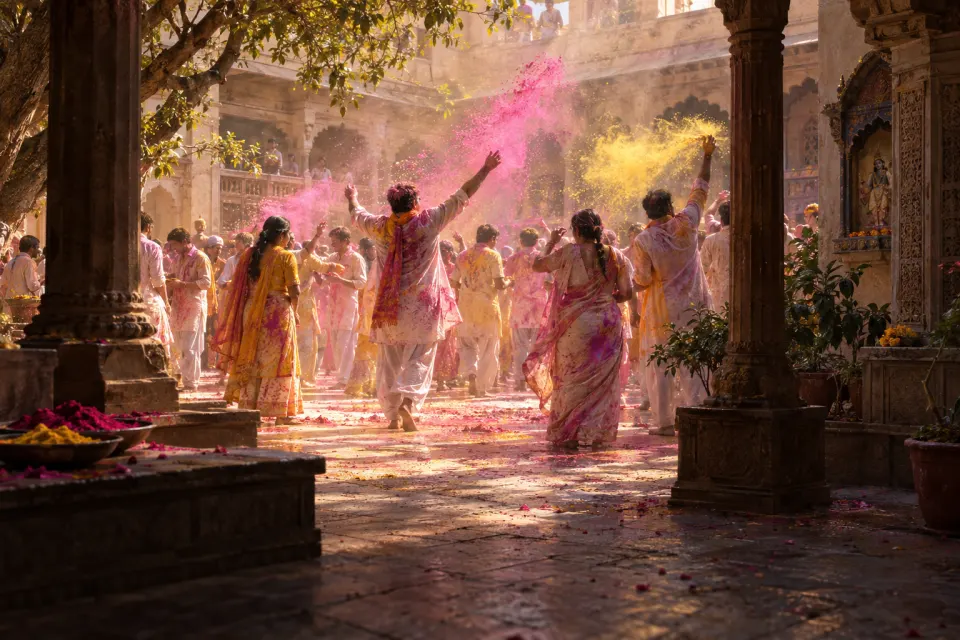
Holi is the Hindu spring festival of colours. It falls on the full moon of the lunar month Phālguna, in late February or March, when a bonfire is lit and people douse one another with coloured powder and water. Tradition tells of the demoness Holikā burned in the fire meant for the boy Prahlāda, and many keep the festival as a celebration of good over evil. It is also linked with the playful love of Kṛṣṇa and the cowherd girls, and scholars see in it an old festival of the coming of spring.[1–7]
Origins

The best-known legend is that of Prahlāda. The demon king Hiraṇyakaśipu tried to kill his devout son by making him sit on a burning pile in the lap of his sister Holikā. She was said to have a boon against dying by fire, yet it was she who perished while the boy came through unharmed. Scholars, though, read the festival as older than the tale: it began as a celebration of spring, and the bonfire stands for the end of winter's cold.[3, 6]
What it marks
For many Hindus Holi is the victory of good over evil, and the bonfire is read as a fire that burns up the world's evil. It is also bound up with Kṛṣṇa. Holi is described as a feast of love that re-enacts his play with the cowherd boys and girls, and paintings from the Pahari courts of northern India show him and Rādhā in the revels. Another thread is Kāma, the god of love: the Bhaviṣyottara Purāṇa has Kāma worshipped on the day after the fire, and in the south he is burned in effigy in memory of Śiva reducing him to ashes.[4–5, 9]
How it is kept

On the night of the full moon a bonfire is lit; the things piled on it are meant to be old and worn out, so that burning them clears away the previous year. Worshippers circle the fire, throw in coconuts and grain, and in some places a priest conducts the rite. In much of the north the play of colour comes the next morning, with people dousing one another in coloured water and powder, squirted from syringes of bamboo or metal. Holi is a festival of reversal, and for a day ordinary restraint is relaxed. The festival has been called that of the śūdra, and reference works note that even people of rank take part in the sprinkling.[2, 7, 10]
Regions and abroad
Holi does not take one form everywhere. In Bengal the fire is replaced by the Dolayātrā, in which an image of Kṛṣṇa is set on a swing, and the day is tied to the worship of Kṛṣṇa. In South India, according to the Encyclopedia of Religion, Holi is not known as such, and a Kāma festival is kept in its season; a Kannada dictionary describes the Kāmadahana as a symbolic burning of Kāma. Among the descendants of Indian indentured labourers in Trinidad, the festival is also called Phagwa.[8, 11–12]
Sources
Each statement above was checked against published sources; the verdict says whether it stood as written, was corrected or was hedged.
- VerifiedJ. G. Lochtefeld, The Illustrated Encyclopedia of Hinduism; link.springer.com; P. V. Kane, History of Dharmaśāstra, vol. V part 1; Encyclopedia.com.
- VerifiedJ. G. Lochtefeld, The Illustrated Encyclopedia of Hinduism; P. V. Kane, History of Dharmaśāstra, vol. V part 1; Encyclopedia.com.
- VerifiedJ. G. Lochtefeld, The Illustrated Encyclopedia of Hinduism; link.springer.com; Encyclopedia.com.
- VerifiedJ. G. Lochtefeld, The Illustrated Encyclopedia of Hinduism; link.springer.com; Encyclopedia.com.
- VerifiedEncyclopedia.com; Cleveland Museum of Art, Krishna being dressed in women's clothes for the spring festival Holi; Cleveland Museum of Art, Radha and Hindu God Krishna celebrating the festival Holi.
- Verifiedlink.springer.com; P. V. Kane, History of Dharmaśāstra, vol. V part 1; Cleveland Museum of Art, Krishna celebrates Holi.
- VerifiedJ. G. Lochtefeld, The Illustrated Encyclopedia of Hinduism; P. V. Kane, History of Dharmaśāstra, vol. V part 1; Cleveland Museum of Art, Krishna celebrates Holi; Encyclopedia.com.
- VerifiedEncyclopedia.com; National Trust of Trinidad and Tobago.
- VerifiedEncyclopedia.com; P. V. Kane, History of Dharmaśāstra, vol. V part 1; Wisdom Library, Kamadahana.
- VerifiedJ. G. Lochtefeld, The Illustrated Encyclopedia of Hinduism; Encyclopedia.com; Encyclopedia.com; P. V. Kane, History of Dharmaśāstra, vol. V part 1.
- VerifiedP. V. Kane, History of Dharmaśāstra, vol. V part 1; Encyclopedia.com.
- VerifiedEncyclopedia.com; Encyclopedia.com; Wisdom Library, Kamadahana.