The story behind the day
Ugādi and Guḍī Pāḍvā mark the Hindu lunar new year, kept on the first day of the bright fortnight of Caitra, in March or April. Ugādi is the new year of Telugu and Kannada speakers, and Guḍī Pāḍvā the festival of Maharashtra. Many Hindus hold that Brahmā began creation on this day. Other regions begin the year elsewhere in the calendar: in mid-April, when the Sun enters Aries, or, in some calendars, just after Dīvālī in the month of Kārttika.[1–6]
Origins
The name Ugādi, also spelled Yugādi, comes from yuga, an age, and ādi, a beginning, so that it means the start of a new age. Hindu tradition ties the day to creation. The Brahma Purāṇa, as the medieval digests quote it, says Brahmā made the world at sunrise on the opening day of Caitra's waxing fortnight and set the count of time going, and the digests tell the faithful to begin the year by worshipping him.[2, 7]
What it marks
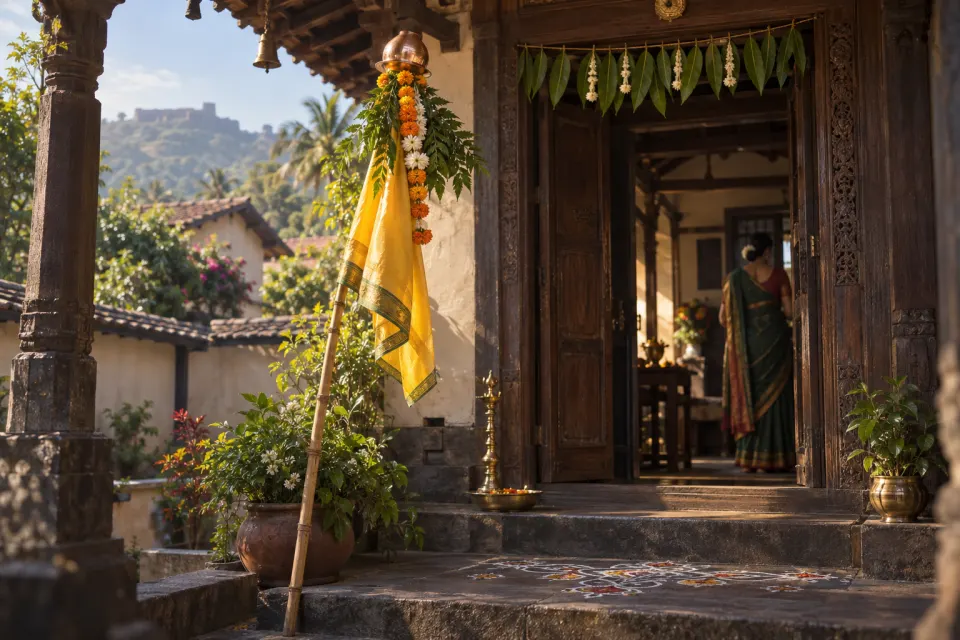
Where the year opens with Caitra, as in the Deccan, the first tithi of the bright fortnight begins it, and Andhra uses the name Yugādi, glossed as the start of a cosmic cycle, for the spring equinox, a time often held to be when Brahmā begins creation. Ugādi is the Telugu New Year's Day and the festival of the lunar year's first day in Karnataka and Andhra Pradesh. In Maharashtra the day is Guḍī Pāḍvā, named for the pole raised in front of the house. In North India the religious year begins in Caitra with the spring Navarātri, the nine nights of the Goddess.[1–4, 8]
How it is kept

In Maharashtra a pole wrapped in cloth, with a pot set over the top, is raised before the door on the first day of the year and worshipped. The custom is also found in Saurāṣṭra.[9]
Across regions
Not every community begins the year in Caitra. Across much of the country the new year falls in mid-April, at the vernal equinox, when the Sun enters Meṣa (Aries); where months are counted by the Sun, the first day of the solar year is the first day of that month. Reference works add that Dīvālī itself, which follows the autumn equinox, is also felt as a beginning, and some calendars open the year on the day after it. The lunar year itself is counted two ways: North India ends its months at the full moon and Maharashtra, Bengal and the south at the new moon, so in the north the waning fortnight of Caitra falls at the end of the old year. Where the Sun governs the count, the year opens with Meṣa; the Tamil year, for instance, begins with Chittirai. Years are numbered in the Vikrama era in the north and Gujarat and in the Śaka era in the Deccan and south.[5–6, 10–12]
Sources
Each statement above was checked against published sources; the verdict says whether it stood as written, was corrected or was hedged.
- VerifiedJ. G. Lochtefeld, The Illustrated Encyclopedia of Hinduism; P. V. Kane, History of Dharmaśāstra, vol. V part 1; Encyclopedia.com.
- VerifiedP. V. Kane, History of Dharmaśāstra, vol. V part 1; Encyclopedia.com; Wisdom Library, Yugadi.
- VerifiedEncyclopedia.com; Wisdom Library, Ugadi.
- VerifiedWisdom Library, Gudhipadava; Wisdom Library, Gudhi; P. V. Kane, History of Dharmaśāstra, vol. V part 1.
- VerifiedEncyclopedia.com; P. V. Kane, History of Dharmaśāstra, vol. V part 1.
- VerifiedEncyclopedia.com; J. G. Lochtefeld, The Illustrated Encyclopedia of Hinduism; P. V. Kane, History of Dharmaśāstra, vol. V part 1.
- VerifiedWisdom Library, Yugadi; Encyclopedia.com.
- VerifiedEncyclopedia.com; J. G. Lochtefeld, The Illustrated Encyclopedia of Hinduism; P. V. Kane, History of Dharmaśāstra, vol. V part 1.
- VerifiedP. V. Kane, History of Dharmaśāstra, vol. V part 1; Wisdom Library, Gudhi.
- VerifiedJ. G. Lochtefeld, The Illustrated Encyclopedia of Hinduism; P. V. Kane, History of Dharmaśāstra, vol. V part 1.
- VerifiedJ. G. Lochtefeld, The Illustrated Encyclopedia of Hinduism; P. V. Kane, History of Dharmaśāstra, vol. V part 1; Encyclopedia.com.
- VerifiedJ. G. Lochtefeld, The Illustrated Encyclopedia of Hinduism; P. V. Kane, History of Dharmaśāstra, vol. V part 1.