
The story behind the day
Gaṇeśa Caturthī is the birthday of Gaṇeśa, the elephant-headed son of Śiva and Pārvatī, worshipped as the Lord of Obstacles and invoked first at the start of any undertaking. It comes on the fourth tithi of Bhādrapada's bright fortnight, in August or September. Households and neighbourhoods install clay images of the god, worship them for a day and a half or for as long as ten days, and then carry them in procession to water for immersion. Maharashtra is its heartland.[1–5]
Origins
The Śiva Purāṇa tells how Pārvatī made a boy from the dirt of her body and set him, armed with a staff, at her door as gatekeeper. When Śiva came, the boy barred his way and beat him with the staff, and in the fight his head was cut off. It was replaced with an elephant's head, and Śiva made him leader of his host and decreed that he be honoured before any other god. The Purāṇas disagree on the details. Another Śiva Purāṇa passage has Śani's glance destroy the child's head; in the Skanda Purāṇa Pārvatī forms only a torso and her son Skanda adds the head; and in the Varāha Purāṇa Śiva himself gives it. The broken tusk has several explanations too. Older texts know the Vināyakas as mischievous beings who cause obstacles, and a later Purāṇa says Gaṇeśa himself hinders those who forget to worship him first.[6–8]
What it marks
The day celebrates the birth of Gaṇeśa. Hindus consider him the Lord of Obstacles, with power both to remove difficulties and to place them, and so they invoke him at the start of a ritual, a business, a marriage, a new home or an examination. He is portrayed with an elephant's head, a bowl of sweets and a rat close by; medieval sculptures show him with a broken tusk and a sweet he lifts with his trunk, as in a twelfth-century figure from Tamil Nadu now in Los Angeles. By tradition he broke off the tusk to write down the Mahābhārata as Vyāsa dictated it.[2, 9–11]
How it came to be
Gaṇeśa is a relatively minor deity in the pantheon but a major one in everyday life, and the large public festival is more recent. In the 1890s the Maharashtrian leader Bal Gaṅgādhar Tilak promoted Gaṇeśa Caturthī as a visible public occasion in the time of British rule, when the government avoided interfering with religious observance. Reference works note a renewed interest in the festival in Maharashtra from 1893.[12]
How it is kept

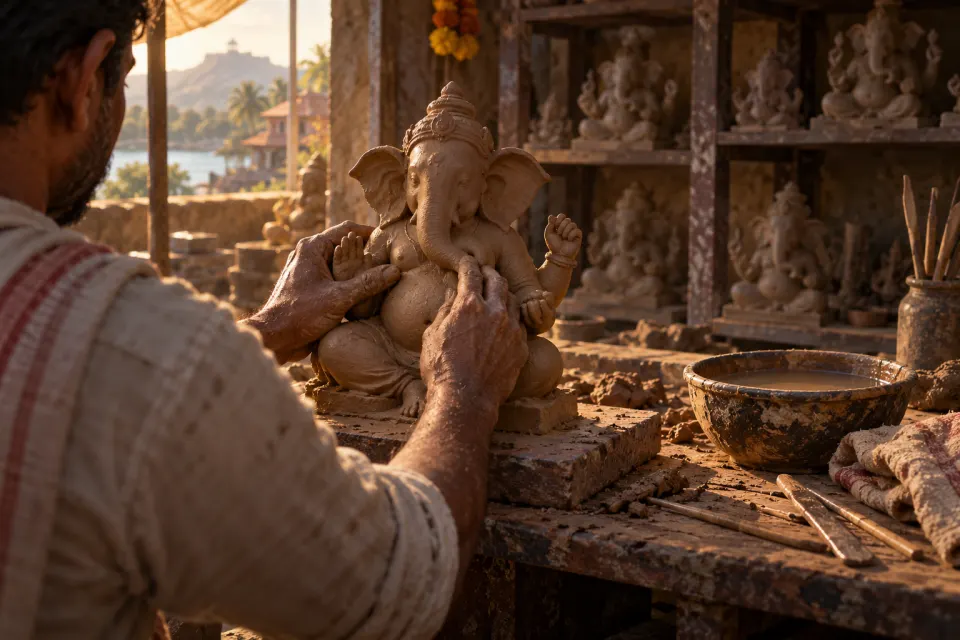
Images of Gaṇeśa, in clay, are consecrated and worshipped in homes and public places. How long they stay depends on the household: a day and a half, two, five or seven days, or ten days, ending on Ananta Caturdaśī. At the end the images are carried in procession to the sea, a river, a tank or a village pond and immersed. The festival is observed throughout India and is particularly celebrated in Maharashtra, where it is also called Vināyaka Caturthī.[3–5]
Sources
Each statement above was checked against published sources; the verdict says whether it stood as written, was corrected or was hedged.
- VerifiedJ. G. Lochtefeld, The Illustrated Encyclopedia of Hinduism; P. V. Kane, History of Dharmaśāstra, vol. V part 1; Encyclopedia.com; link.springer.com.
- VerifiedJ. G. Lochtefeld, The Illustrated Encyclopedia of Hinduism; P. V. Kane, History of Dharmaśāstra, vol. V part 1; Encyclopedia.com.
- VerifiedP. V. Kane, History of Dharmaśāstra, vol. V part 1; link.springer.com.
- VerifiedJ. G. Lochtefeld, The Illustrated Encyclopedia of Hinduism; P. V. Kane, History of Dharmaśāstra, vol. V part 1.
- VerifiedJ. G. Lochtefeld, The Illustrated Encyclopedia of Hinduism; link.springer.com.
- VerifiedWisdom Library; J. G. Lochtefeld, The Illustrated Encyclopedia of Hinduism; Encyclopedia.com.
- VerifiedWisdom Library; Encyclopedia.com; P. V. Kane, History of Dharmaśāstra, vol. V part 1; J. G. Lochtefeld, The Illustrated Encyclopedia of Hinduism.
- VerifiedEncyclopedia.com; P. V. Kane, History of Dharmaśāstra, vol. V part 1; J. G. Lochtefeld, The Illustrated Encyclopedia of Hinduism.
- VerifiedJ. G. Lochtefeld, The Illustrated Encyclopedia of Hinduism; Encyclopedia.com.
- VerifiedJ. G. Lochtefeld, The Illustrated Encyclopedia of Hinduism; Encyclopedia.com.
- VerifiedLos Angeles County Museum of Art, Ganesha, Lord of Obstacles; Cleveland Museum of Art, Ganesha.
- VerifiedJ. G. Lochtefeld, The Illustrated Encyclopedia of Hinduism; Encyclopedia.com.